Recollections
by
Robert
Darlaston



In
Three Parts:
Memories
of Childhood in Birmingham in the 1940s and early 1950s
Life
at King Edward’s School, Birmingham, 1951-59, and
Anecdotes
from Barclays Bank Trust Company Limited 1959-97
Illustrated
with family photographs throughout
Part One:

Harebells on the Common
A Birmingham
Childhood Remembered
1943 – 1951
First
edition, February 2006
Second
edition, October 2023
Cover
illustrations show the crests of:
The
City of Birmingham (where I lived and worked from 1940 to 1972),
King Edward’s School, Birmingham (attended
1951-59)
Barclays Bank (my employer from 1959 to 1997 -
and who still pay my pension!).
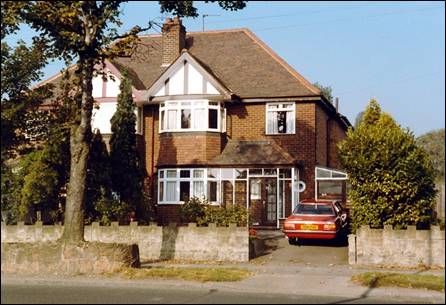
My
childhood home: 165 Stechford Road, Hodgehill, Birmingham
Childhood is measured out
by sounds and smells
And sights, before the dark of reason grows
John
Betjeman
Summoned by Bells
That is the land of lost
content,
I see it shining plain,
The happy highways where I went
And cannot come again.
A.E. Housman
A Shropshire Lad; XL
Contents of Part One
Early Years My first hazy
memories – 1943
Wartime Birmingham Air
raids; trams
and buttered toast; shopping and the
cinema
South Wales Holidays Farms, seaside and “The Resurrection”
Domestic Life in the 1940s Clothes, wash day,
Christmas and starting School
Worries about Health Tonsils and small boy stuff. Discovery of a chick
A Hard
Winter Snow and fog, 1940s
style
School Days Amberley Prep School;
first glimpse of stocking tops
Children’s Hour Wireless, and Ladies to
tea: I meet the constabulary
A Balanced Diet Meals,
rationing and days out
The King Passes by Glimpses
of the King and of Russian leaders
Changing Times Impressed
by the news and also by Silvana Mangano
A New School Moving to King Edward’s,
The End of
an Era A Festival, a Funeral and a
Coronation
These
pages include some memories of my childhood, dug out of the deepest recesses of
my mind, concentrating where possible on episodes which illustrate how life in
the 1940s differed from that we know today.
I have tried to choose incidents which might amuse, but including topics
both serious and saucy: all part of the
process of growing up in the post-war era!
I hope this account entertains others and ring bells in their own
memories. The 1940s were a grey world
of coal smoke and gas-lit streets, of Winston Churchill and Clement Attlee, Spam*
and steam trains, mangles and woolly vests. There were no mobile phones or DVDs, no
televisions or refrigerators, no foreign holidays or central heating, no computers
and very few motor cars. But it was the only world I knew as a child and I was
well content with it.
(* Spam
was tinned meat and had nothing to do with computers!!)
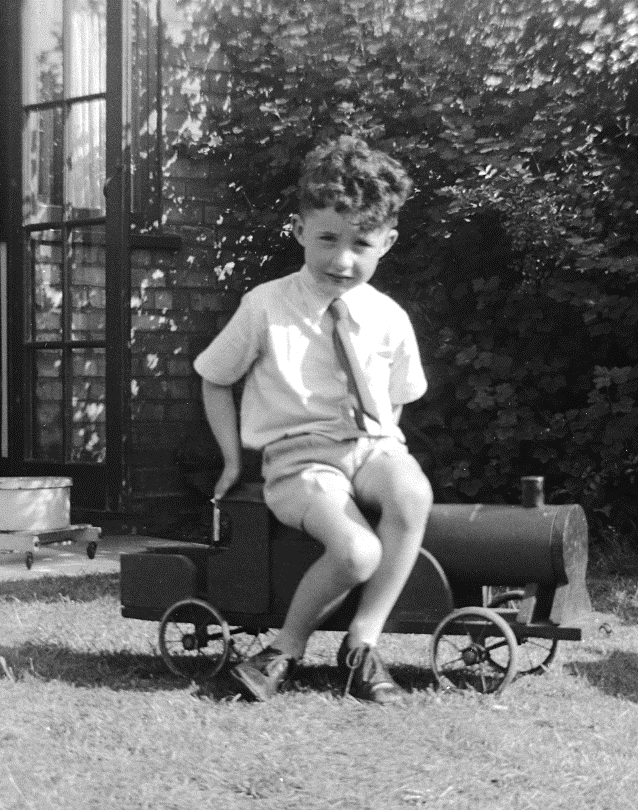
Fifth
birthday, 23rd June 1945.
The
war in Europe is now over and I am sitting on the big red engine made by my
father.
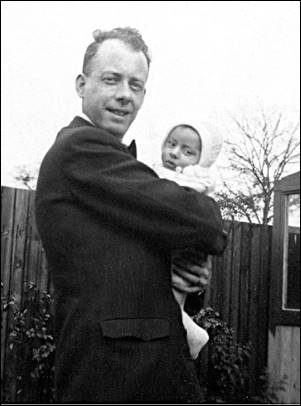
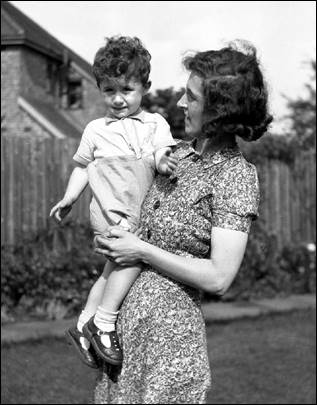
With my parents in the
back garden in 1940 and 1942
|
A |
PRETTY
BLUE LIGHT was flickering, just within reach and looking so attractive, so
tempting. I reached my fingers up to
touch – and: O-U-C-H, “Mumm–e-e-e-e!” The light was the flame of a burner on the
gas cooker which had attracted my innocent curiosity. I would have been only two years of age, but
luckily the impact was fleeting and no lasting damage was done. But the incident remains in my memory as
possibly my earliest recollection. It
was probably early in 1943, a time when others across the world were
experiencing far greater suffering than my rather trivial burn.
Then there was the occasion which stayed in memory as being the first
time I ever saw my mother wearing trousers.
It was the cold night of 23rd April 1943. I was not yet three years of age. The air-raid siren had just gone and my
parents and I were in the dining room, the windows securely covered by the
thick blackout curtains made by my mother, who, in an effort to relieve wartime
austerity, had trimmed the hems with decorative tapes of green and gold. For no particular reason, I was sitting on
the cross-bar beneath the dining table.
We were about to go into the cold night to settle down once again in the
air raid shelter. It is a memory
inextricably tied up with the below-ground smell of damp earth and of the
methylated spirit lamp that illuminated our tiny shelter, built into the garden
rockery. The event can be dated
accurately, because it was the first air raid for several months and thereafter
raids ceased in the Midlands. There are
other associated memories: waiting
before an air raid, the tension tangible in the anxious atmosphere: being told not to suck my thumb after playing
on the floor “because of the danger of picking up germs” – or was it Germans? The words were puzzlingly similar to a
two-year-old.
We cling to our early memories as the starting point of our
life’s journey. The underlying theme
from those days was war: war against a
society so evil it is now hard to realise that it existed in Europe within my
own lifetime. But my parents protected
me securely from that unseen horror, providing an environment of security and
stability. Thus, even though I grew up in
a world of bombs and death, I can look back with nostalgia to a happy childhood. With the exception of my loyal but silent
companion Edward Bear, almost everyone and everything I knew and cherished in
those earliest years has been swept away by the passage of time. But they remain alive in memory, vivid if
intangible, enabling me to make a return journey to my past. There I can once more relive those infant
events and encounters, recreating for a moment the images of childhood.
I was an only child, born on 23rd June 1940 at 1.35
p.m. at
My mother had been born in 1904 and came from Welsh farming
stock, but her mother had died in childbirth.
Consequently, for several years as a baby and toddler she had been
passed around an array of aunts, until, eventually, her father remarried. It must have been an unsettling childhood
for her. She left home at eighteen
years of age and had taken up nursing, first at Newport in South Wales and,
from 1929, in Birmingham. There she met
my father who had been born and bred in the city, although prior to the 1790s
his family’s roots lay in the village of Harlaston,
near Lichfield (hence the family name, originally De Harlaston). My father was born in 1906 and had lost both
parents while still a child, his mother dying in 1915 and his father in 1919. A maiden aunt became responsible for his
upbringing and he was sent to boarding school at Hanley Castle in
Worcestershire, so his childhood too was far from secure and settled.
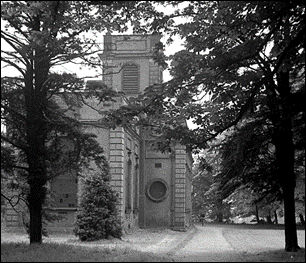
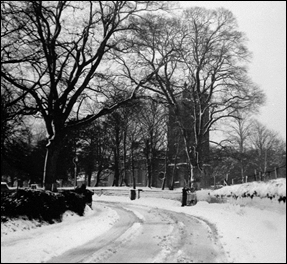
Castle
Bromwich Church, where I was Baptised.
The Church in snow, January 1963
The
Church is an attractive neo-Classical building dating from 1726-31 and is Grade
I listed.
Like most children, I have many random early
memories: a ride in the pram, a harsh
word here, a tumble there; of the fun
when my father surprised me by hiding in the pantry, and of the panic when I
wandered off to explore alone while my mother’s attention was distracted in the
local butcher’s shop. But unlike the
air raid memories, those cannot be dated.
Then there are those wonderful impressions left in the childhood mind by
patterns; shadows on a carpet; enchanting floral designs on curtains or wallpaper. Wallpaper played a significant
part in my life at an early age. After
lunch each day I was put in my cot for a sleep, but there was a time when sleep
would not come. I lay awake and was
bored. Through the bars of my cot I
could see a small irregularity in the wallpaper. I recall teasing at it with my
fingernail. Oh joy! I could peel a little bit off. A bit more effort and off came another
inch. This was the most satisfying
thing I had ever done. I set to work
with gusto and can still remember the sensuous pleasure of peeling off strips
of paper. Eventually, my mother arrived
to check on her sleeping infant, only to find a joyous child surrounded by
shreds of paper. Suffice it to say that
I was never put down for another afternoon nap.
Paper of a different sort provided further entertainment when my
mother, unable in wartime to obtain the usual brand of toilet roll, bought
instead a box of interleaved lavatory paper (always hard and shiny in those
days). I was fascinated by the
apparently endless supply – pull out a sheet, and, hey presto! – there was
another. Anxious to get to the bottom
of this (sorry!), I kept on pulling sheets until the lavatory floor was
invisible beneath paper and the box was empty.
Once more, I was surprised to find that my mother did not share my
interest in research into paper production.
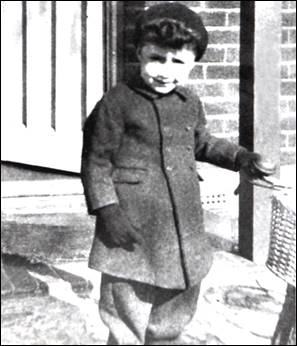
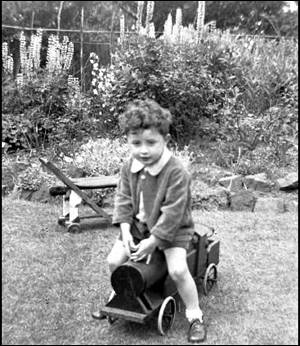
1943:
Ready to go shopping:
my 3rd birthday: on the big red engine
There
were always Lupins in the garden on my birthday
It is to
my parents’ credit that the nocturnal trips to the air raid shelter caused me
no major worries, other than frustration at my father’s refusal to let me have
a battery in my torch. I suppose he had
an understandable reluctance to let me wave it in cheery greeting to the
Luftwaffe flying overhead. The war was,
despite my own lack of concern, the inevitable background to life and everyone
told me how everything would be “different when the war ended.” News was so dominated by the war that I
believed that when peace came “news” would cease. I now look back, amazed at my good fortune
in being so well insulated from the horrors of those years. My only memories of the end of the war are
of a street party close by and of an unpleasantly hard toffee apple on VE night
at a small funfair erected for the occasion on nearby Hodgehill
Common. Toys were largely unobtainable
until a few years after the end of the war, and magazines would often carry
advertisements for items such as electric train sets, so desirable to a small
boy, but they were marked “For Export Only”.
Consequently, most of my toys were made by my father, including a
handsome wooden train and a soldiers’ fort.
I was lucky that because my father’s work was connected with aeroplane
production he was not liable for military service. He did, however, have to work six (and often
seven) days each week during the war, plus nights spent fire watching. Consequently, he was something of a rare
figure in my early years. Another
result of the war was the occasional visit from a Polish airman, befriended by
my parents and some of their friends. I
was puzzled by an adult whose knowledge of the English language was smaller
than my own.
Some manifestations of war
did cause me alarm. There were sinister
gaps in nearby rows of houses where willow herb grew among the rubble left by
bombing raids. Sometimes an interior
wall was left standing, exposed to the elements, leaving the last residents’
taste in wallpaper for all to see.
There was also the vast ruin of the sauce factory to be seen from the
tram going into Birmingham. One bomb
landed less than 100 yards from home, sucking open the French windows: I was too young to recall the incident, but
the damage to the window frames remained evident until they were replaced
twenty years later. There were baleful
barrage balloons moored nearby on Hodgehill Common
and, from time to time throughout the war, convoys of tanks would pass our
house, driven under their own power, the steel tracks making a deafening racket
on the road surface and sending me scuttling indoors in search of quiet. Worst of all were low flying aircraft, which
terrified me by day and haunted my dreams at night. In 1940, while only a few months old, I had
been in my pram in the garden when a plane came over, flying very low. My mother rushed outside and looked up in
time to see a plane with the German cross and (she said) a Nazi pilot peering
through the cockpit window. She grabbed
me in terror and fled to hide beneath the stairs. (The pilot, probably equally terrified, was
apparently soon brought down some miles away).
Of course I can have no recollection of that incident, but did my
mother’s terror somehow impress itself into my slowly developing mind? Even today, the sound of a jumbo jet
climbing overhead can provoke an involuntary and momentary shiver.
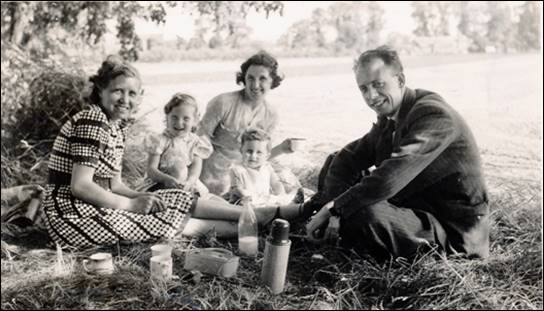
Wartime Picnic with the Godsall family (left) – location unknown, alas
This photo is proof that there
were happy, light-hearted moments during the war.
But suits were still de rigeur, even on picnics!
Jill, sitting between her mother and mine, later became a professional
pianist and remains a friend in the 21st century.
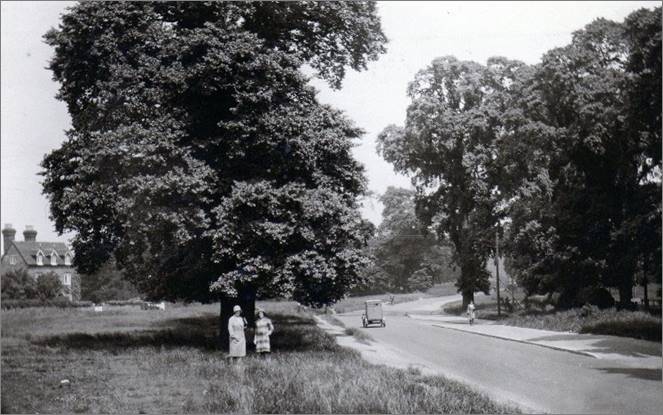
A 1930s postcard showing
Coleshill Road crossing Hodgehill Common.
Less than a decade later, I would
be here picking Harebells for my mother.
But there are
pleasant memories too; of lazy summer
afternoons when I picked Harebells for my mother on the nearby grassy common,
and of shopping trips to town. In “Summoned by Bells” John Betjeman
recalled his childhood as “safe in a world of trains and buttered toast”: in my world trams and buttered toast were the features which linger in the
memory. We went shopping by tram and my
mother always concluded the afternoon with a call at “Pets’ Corner” in Lewis’s
department store, to see the monkeys and parrots, followed by coffee and hot
buttered toast at the Kardomah café. After I started school the trams in their
attractive dark blue and primrose colours became a vital part of my daily
life.
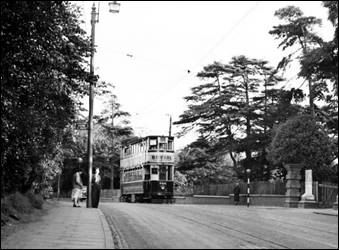
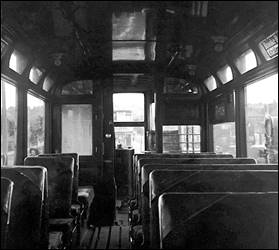
Left: The tram stop where I waited for the tram
home every afternoon after school, (which was behind the hedge at the
left). (photograph by Ray
Wilson)
Right: the lower deck of a tram,
showing reversible seats.
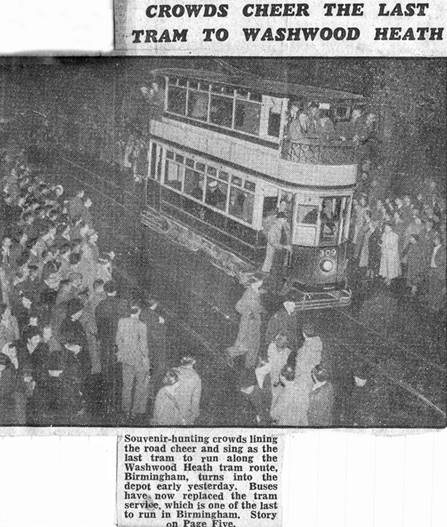
October
1950: The last tram on the No. 10 route,
as seen by the long-defunct Birmingham Gazette.
I had
travelled this route daily on my way to and from school and sorely missed the
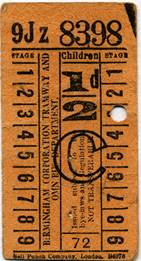
trams with their fascinating character:
a souvenir ticket (“Ha’penny child’s”) reminds
one how inexpensive tram travel was in the 1940s.
A special treat in the
summer holidays would be the tram ride to the Lickey
Hills on the Worcestershire border: a
twelve-mile journey across the city, taking over an hour. Tram seats had reversible backs so that one
normally sat facing the direction of travel, but one could leave a seat unreversed
enabling a party of four to face one another as a group, just as on a
train. At the city centre terminus
passengers left the tram at the front while new passengers boarded at the rear. This gave small boys the irresistible
temptation of treading on the driver’s pedal which mechanically sounded the
gong – the tram’s warning equivalent of a motor horn. For the latter part of the journey from the
city to the Lickey Hills the trams forsook the
streets for their own reservation, bowling merrily along through the sunlit
trees at speeds approaching 40 m.p.h.
We would lean happily out of the window, taking care to retreat as other
trams passed close by in the opposite direction. Once at the Lickey
terminus everyone would want to rush off to the hills, but I would try to
linger and watch the conductor placing the trolley pole on the overhead wire
for the return journey; no easy task if
the sun was in his eyes.
Shopping trips
to the centre of
Holidays in South Wales
Wartime holidays
had been confined to annual trips to my grandparents who farmed in
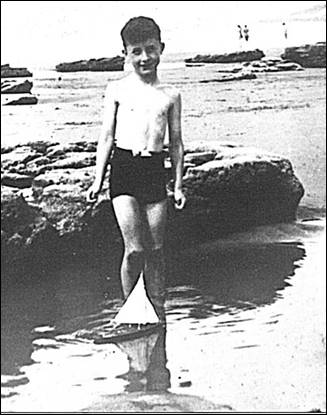
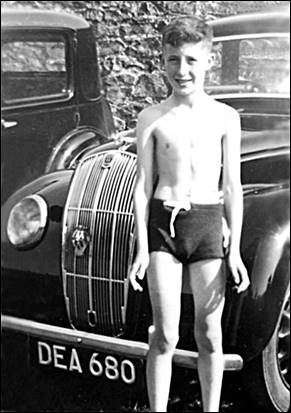
Paddling in a rock pool at Southerndown, 1949;
and by the Morris 8 motor car after changing for the beach in 1950 (note
the old AA badge on the car’s radiator grill).
As a small
child I was bored by the journey to
The wild and dramatic
scenery of the Beacons was, for me, the high spot of the journey as it
signalled our entry into South Wales.
For several miles the road lies above the 1000’ foot contour and at
Easter 1947, after the severe winter snowfalls, only a single passage had been
cut through drifts which towered above our car. On two occasions our journeys were impeded
by serious flooding. By contrast, one
hot day of summer in the early 1950s, we memorably detoured through the Forest
of Dean, passing the historic Speech House, to emerge deep in the wooded Wye
Valley near the imposing ruins of Tintern Abbey. The idyllic situation must have inspired the
Cistercian monks who worshipped there so long ago, just as it inspired
Wordsworth who, after visiting Tintern, wrote of “
the still, sad music of humanity”.
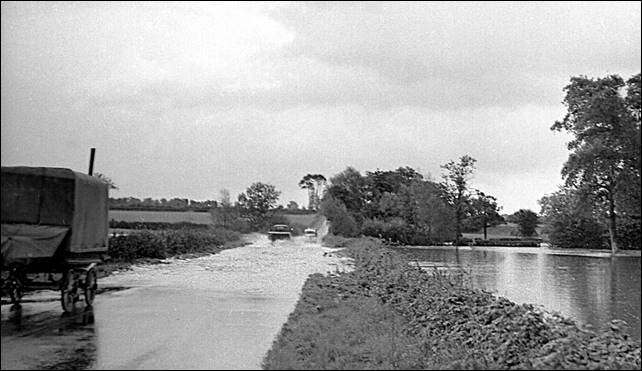
On the way to South Wales: floods near
the progress of a gypsies’ vardo
on 3rd October 1958
At Gilfach
my grandparents did not occupy the traditional farm house, which was deemed too
primitive, but lived in a double fronted Victorian villa (“Oak Cottage”) 200
yards away. This was scarcely any more
luxurious. Electricity was confined to
the downstairs rooms, so I went up to bed by candlelight (logic decreed that as
one only slept upstairs, there was clearly no need for electric lights there!),
and I settled down to sleep with an embroidered text above my bed saying
“Simply to Thy Cross I cling”. There
was no hot water and no cooker: my
grandmother, a tiny, Chapel-going lady, had to rely on the coal fire with a
traditional oven alongside, producing wonderful meals. In the bedrooms there were chamber pots
beneath the beds, and marble washstands with china jugs and basins which would
now be collectors’ pieces. Of the
primitive outside lavatory arrangements at Oak Cottage, the less said the
better. But some farmhouse facilities
were far more exotic, with a long walk to the privy in the orchard where one
might find a commodious building offering accommodation for two patrons seated
on a timber bench side-by-side, and (in one memorable location) even a
three-seater for that special social occasion!
Staying at Gilfach introduced me to farming routines almost unchanged over
the centuries. I would accompany my
grandmother to collect eggs warm from the chickens who roamed free on the
bracken-covered hillside. I would watch
my grandfather with other local farmers as they dipped or marked the
sheep. I would play with his sheepdogs,
who, when they thought duty called, would abandon me and rush off to attend to
the sheep which they found more absorbing than a small boy. On a fine summer’s evening Grandad would put
me on Ginger, his old mountain pony, for a ride up to the paddock: I felt like a maharajah. Grandad was a kind and thoughtful man and
his sheep were almost as dearly loved as his family. In a decade of wars and atomic bomb
development I remember overhearing him say to a farming friend: “I worry about the future for these boys”
(i.e., my cousin and me). How amazed he
would have been at the comfortable and fortunate lives we have led, when
compared with the struggles his generation experienced.
But one Welsh journey in
1945 was alarming. We set off to a remote
Welsh valley to find the farm which was to be the home of Auntie Maud and Uncle
Len, then newly-married. Signposts were
still almost non-existent following the war.
Cloud and fog clung to the mountainside and the drenching rain drifted
across in soaking sheets. As the
Morris climbed slowly into the all-engulfing mist, with a sheer drop of 200
feet at the side of the road, we passed whitewashed signs on the bare rock
face: “Prepare to meet thy God”. Was this to be our final journey? But when we reached Gelli
Farm I found a place which was to me, as a city child, close to heaven in more
childlike ways: 3000 acres of
freedom.
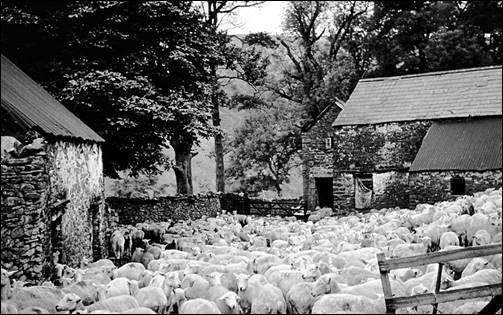
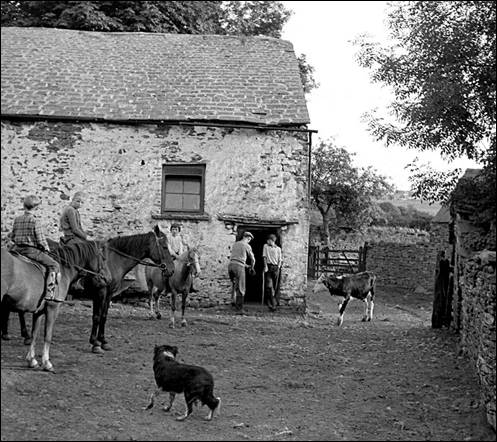
Gelli farm in
the 1950s: A cow approaches, ready for
milking as young riders look on.
In wet weather such farmyards
would be a sea of mud and wellington boots the only possible footwear.
At Gelli
I could escape into a carefree world of the imagination with mountains to climb
and streams to dam – Everest and the Nile lay before me: who cared if my shoes and socks were soaked
through, or if the forgotten chicken’s egg, placed carefully in my trouser
pocket, smashed when I went sprawling in the tussocky
grass? But in those drab, chill
post-war years, the unimaginative adults were more concerned about the lack of
electricity, the enormous fireplace with its chimney open to the sky, and with
the ivy growing indoors on the damp, peeling, farmhouse walls.
Initially Gelli farm lacked any modern mechanical aids and Uncle Len
relied on horses, not just to ride when gathering sheep, but also as everyday
local transport. Once, about 1947, when
we were staying there, he received a message (by runner? – there was no
telephone then) to say there was a dead sheep by the roadside in Abergwynfi. So a
horse (Leicester by name, a rather spiteful animal) and cart were prepared and
I set off with my uncle to retrieve the dead sheep, the only extended
horse-powered working journey of my life!
I was so impressed by the experience I later wrote it up in a school
essay, much to the chagrin of my mother who seemed to feel it reflected badly
on the family!
Throughout
the later 1940s and all through the 1950s my grandfather would stay at Gelli for a few days from time to time to help out at
shearing or other busy times. Horse and
dogs would be essential once he arrived there and began helping with gathering
the sheep. His generation never took to
motor transport, so when it was time to start he would mount Ginger, call his
dogs and they would all set off from Gilfach across
the bleak mountain tops for the twelve mile journey, following the old drovers’
tracks which had been the traditional routes for farmers for many
centuries. To my grandfather this was
more natural than following the motor road round the valleys which was half as
long again and, even then, busy with motor traffic. But farming methods were soon to change,
even in the Welsh mountains, so Grandad was perhaps the last man regularly to
use the old drovers’ roads of South Wales.
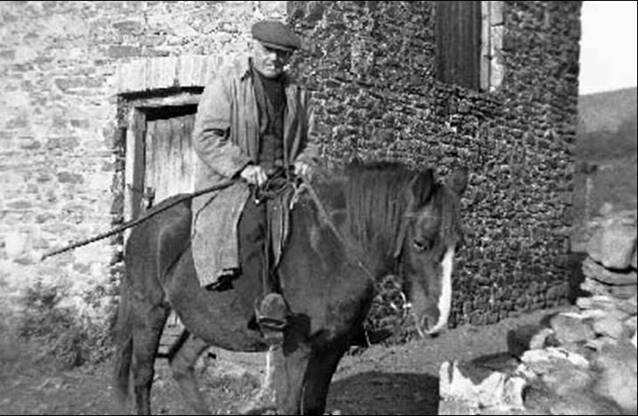
Grandad about to set off from Gilfach
on Ginger
Other favoured
destinations when we stayed in South Wales included Barry with its wonderfully
tawdry funfair and its miles of docks, then alive with shipping, and Mumbles
with its electric railway around the bay from Swansea. Nor must one forget those day-long steamer
trips when the Glen Usk,
the Britannia, and the splendid
new Cardiff Queen would take us to
Somerset or Devon, landing us at far away Lynmouth or
Ilfracombe, and once continuing on into the stomach-churning Atlantic swell to
land at Lundy Island.
Visits to
In those childhood days
central heating was almost unknown and only one room in a house would normally be
heated, by a coal fire, although the kitchen might also be warm from
cooking. Thus, for much of the year one
expected to be cold as soon as one moved away from the fire and going to bed on
a winter’s night was an especial ordeal.
So instead of wandering about the house (as is now customary) in
shirtsleeves, I would as a child wear thick woollen underclothes (knitted by my
mother – how did I tolerate wool next to the skin?), a grey shirt of a
substantial Viyella-type material, a long-sleeved
woollen pull-over (also knitted by my mother) and a heavy school blazer. I quickly learned the knack of taking off
pull-over, shirt and vest in one go, ready to be put on in similar manner next
morning, saving time and exposure of one’s skin to the bracing winter morning
air when intricate ice patterns decorated the inside of the bedroom windows.
There were usually two blazers on call:
one was new and too large and was worn to school, the other was old and
too small and was worn about the house and for play. School caps, scarves and gabardine raincoats
were added for out-door excursions in all but the warmest weather (and
sometimes even to the beach if there was a chill wind). By contrast, short trousers were de rigeur up
to 13 years of age. In consequence,
knees, habitually exposed to the elements and to frequent close encounters with
the ground, were frequently chapped and scarred. Older men would hardly ever be seen in
shorts unless on a camping holiday when their appearance suggested they might
be home on leave from the East African Rifles.
With a fire in
only one room, winter Mondays were especially miserable to a child, because
Monday was washday and if the weather was wet the washing would be hung to dry
on a clothes-horse in front of the fire.
I recall Monday, 23rd December 1946 as the longest and
dreariest day of my life. Outside it
was cold and damp. There was steaming
washing arrayed in front of the fire, the windows were running with
condensation and my mother was busy, pre-occupied with ironing and mince-pie
manufacture. The rest of the house was
chilly and unwelcoming. I was bored and
bad-tempered. I wanted Christmas to
come quickly, but time seemed to be at a standstill. Eventually, after what seemed more like two
weeks than two days, Christmas arrived and brought a rarity: a red clockwork
engine, number 6161: no rails, for the
war was but recently over and toy production was limited. Soon after breakfast tragedy struck, for the
engine, on a fully wound spring, shot across the floor like the proverbial bat
from Hades, and wedged itself underneath the sofa, crushing its tinplate cab in
the process. There were tears, but my
father was on hand to administer repairs, and the engine returned to service in
fair, if not pristine, condition.
Presents at
Christmas arrived mysteriously, during the night, in a pillow case at the foot
of my bed until I was thirteen years of age, by which time the identity of
Father Christmas had long since been established. One wartime Christmas, my main present had
been a Golliwog, carefully made by my dear mother, arranged with his head
peeping out of the pillowcase. No
political correctness in the 1940s!
Notwithstanding the war and its associated militaristic attitudes, I was
never allowed a toy gun and once when someone gave me a water pistol, it
disappeared very rapidly. Violence and
aggression were not to be part of my upbringing.
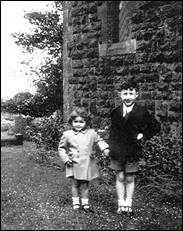
With Jackie: holding hands in 1948!
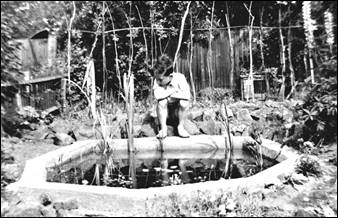
165
Stechford Road: the new pond in 1949
I had started school in May
1945, shortly before my fifth birthday.
My parents chose to send me to Amberley Preparatory School, a small
private school on Coleshill Road about a quarter of a mile from home, although
it was later to move a mile further away to Ward End. I seemed to get on well, but after a few
months had some sort of minor breakdown (which I do not remember, and which was
never discussed, although I do recall hearing myself described as
“highly-strung”!) Thus, for a couple of
terms I only went to school in the mornings.
I had been attending school for scarcely a year when I was required to
take part in an event which would not have been out of place in a novel by
Dickens. The school was a small affair
in a Victorian house, run by two unmarried ladies, Miss Major and Miss
Ainsworth. Sadly, quite soon after my
arrival, Miss Major was diagnosed as suffering from a terminal illness. At her request, as a farewell gesture, the
entire school (about fifty children) had to process slowly through her bedroom
on the top floor. As children we
accepted this strange ritual as just another everyday event, but my mind now
gives it the quality of an event in a Dickens novel or, maybe, a sentimental
Victorian oil painting, vast and dark:
“Miss Major’s farewell to her young pupils.”
A curious quirk of my early childhood was that for several years
most of my playmates were girls: there
simply weren’t any boys of my age living locally – had something been put in
the water? Names of girls living within
a few hundred yards that still spring to mind include Jill, J’Ann,
Judith, Juliet, Jackie, (all those Js!), Norma,
Wendy, Iola, Lynne, Hazel and Beryl.
Oh, there was one boy, Timothy, but somehow we never hit it off.
Many random memories were
acquired over those early childhood years, often involving smells: lilac blossom and wellington boots, privet
hedges and coke boilers. But when I
was five I experienced a recurrent bad throat with associated nasal
problems. So, in accordance with the
contemporary medical practice of removing all such evidently unnecessary items
of anatomy, I went into the Birmingham Ear, Nose and Throat Hospital to have my
tonsils and adenoids taken out. This
was a major upheaval for one who had so far led a very sheltered
existence. It thus became the first
event in my life to imprint itself on my mind complete in almost every minor
detail, from beginning to end.
For a start, it was unprecedented in those days of petrol
rationing to go into the centre of
But I soon had my
revenge. For the first (and, I believe,
only) time in my life, I got a girl into trouble. On emerging from the anaesthetic I had a
raging sore throat. I uttered those
famous childhood words: “I want a drink
of water.” The ward was under the
control of a Sister who appeared to be related to Wagner’s Valkyries. She told me firmly that I could not have a
drink. A few minutes later a pretty
young nurse passed by. (Even at five
years of age, I could appreciate a pretty girl). I repeated my request and she kindly
produced a drink. Ten minutes later the
Valkyrie flew past and noticed the empty cup (of a celluloid-type material –
ugh!). “WHO gave you that drink?”
she demanded. I remember my reply. Precisely.
Word by incriminating word: “the NICE
nurse gave it to me.” The sharp intake
of breath seemed in danger of making the walls implode. The Valkyrie mounted her invisible steed and
stormed off on a punishment mission.
For the first, but not the last time in my life, I knew I had said the
wrong thing.
In the years following the hospital visit, health matters gave me
several worried moments. I suffered the
usual childhood ailments in turn – Whooping Cough and Chicken Pox one year,
Measles and Mumps the next. But my most
serious health problem in childhood occurred at about seven years of age, when
I was diagnosed with Ulcerative Colitis, which was dubiously blamed on the
bland wartime diet in my earlier years.
It meant that for several years I was not allowed to eat any fruit
unless all the skin and pips had been removed.
A far more serious worry in the 1940s was tuberculosis, then widespread
and often fatal. Our neighbour’s
daughter and the brother of a school friend had both contracted the disease in
their late teens and had been in sanatoriums for many months. Happily, they both recovered, but the fear of
being carted away from my home in such circumstances did not bear thinking
about.
Then there was an absurd worry, typical of the fears teasing a
small boy’s mind in a sheltered and solitary childhood. This began when I noticed a rather personal
difference between me and the other boys who knelt to contribute to the
hospital’s communal chamber pot.
Similarly, I noticed that I differed from my cousin with whom I shared
an occasional bath when he came to stay.
Despite being a subject of immense fascination to growing lads, it was
not the kind of thing discussed in the best circles in the 1940s. But I had overheard talk of children born
with deformities and thus, for several years, I worried anxiously about my
apparent abnormality and whether it had potential for future problems. Eventually, communal school showers revealed
that the difference schoolboys knew as “Cavaliers and Roundheads” was, after
all, not uncommon. It was to be over
fifty years before I learned that in those pre-N.H.S. days the required surgery
had been performed not in hospital, but one afternoon on our kitchen table by
Dr Lillie. There was no anaesthetic for
the infant patient, but the genial Scots doctor had (as my mother tartly observed)
first fortified himself with rather more whisky than seemed advisable for one
about to wield a surgical knife. Such
operations were then encouraged for claimed hygienic reasons and were doubtless
a welcome supplementary source of income for a G.P. I might add here that in accordance with
the prim standards of modesty of the day, I was even longer to remain ignorant
of the far more interesting structural differences between males and
females. My parents had a small female
nude statue on the mantelpiece, but I attributed its lack of masculinity to
natural reticence and decency on the part of the manufacturer. Once, when I was about nine, a girl who was
a playmate persuaded me to strip off for her edification, but, alas, despite
her promises, reciprocal facilities proved not to be on offer, so in an era
when nudity was never seen in public my innocence was long to remain intact!
But in 1946 there was another event of much
greater amusement to a five-year-old than health or bodily matters. The week before I went into the Ear, Nose and
Throat Hospital my mother and I had found a day old chick. It was squatting, fluffed up against the
cold March wind, on the pavement of an otherwise deserted suburban
A Hard Winter
No
recollection of the 1940s is complete without mention of the heavy snowfalls of
1947, arguably the hardest winter of the twentieth century. Even in suburban
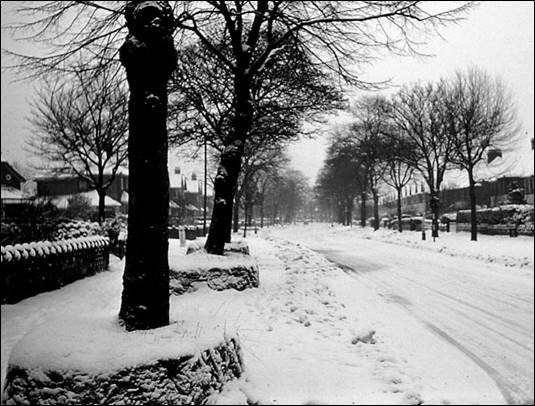
An
old-fashioned winter: Stechford Road,
seen from our front drive entrance
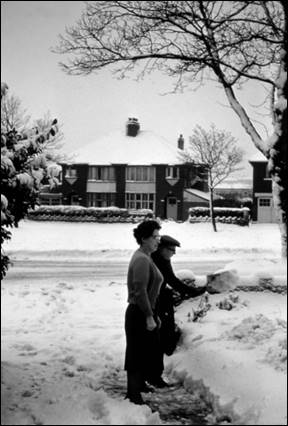
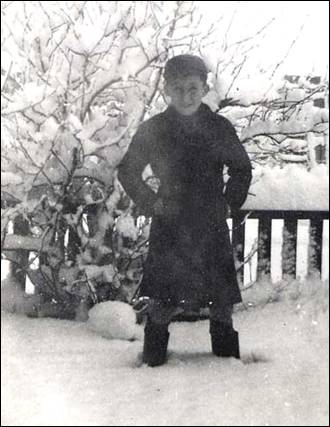
Dad
clears the drive with Mom’s encouragement and I get ready to build a snowman
Sadly, we have no photographs from the 1947 winter
when snow depths made those shown above quite trivial!
Fog was another winter evil in
cities in the 1940s and 1950s. All
factories, offices, shops and private houses burnt copious amounts of coal for
heating. In still winter weather the
pall of smoke hung in the air and drifted downwards, merging with any slight
mist, to cause an impenetrable fog with visibility cut to ten or fifteen
feet. It would penetrate indoors. Outside, it would paralyse traffic and even
make it difficult to find one’s way on foot.
Most traffic would cease and my father even had to walk ten miles home
from his office on one occasion. We
would be led from school in a crocodile on foot, although occasionally a tram
would crawl slowly through the streets.
A side effect of the fog was that the brick and stone of city buildings
became blackened, and it did not do to inspect one’s handkerchief after blowing
one’s nose!
During the hard winter of
1946-7 my school moved to larger premises, permitting a modest expansion in
numbers. The buildings were surrounded
by extensive grounds with shrubberies and winding paths, ideal for the
childhood games of hide-and-seek. Five
to eight year olds were taught in an imposing Victorian house but nine and ten
year olds were housed in a Nissen-type hut built in
the grounds for the Auxiliary Fire Service during the war. The two classes within the hut were
separated only by a pair of large hessian curtains, drawn back at play-time and
for lunch. A large coke boiler provided
the communal heat: a low railing prevented
us from coming into contact with its scalding sides and served as a clothes
horse for damp coats on wet days, thus ensuring that the hut was filled with
the objectionable smell of damp wool mingled with coke fumes. My school life in those days generally
lacked excitement; mile-stones included
the early, tentative, steps in writing and the daily recitation of
multiplication tables and imperial weights and measures (“22 yards make one
chain, ten chains make one furlong”, etc).
Writing at first involved using chalk on miniature slates, but later one
graduated to dip-in pens with which to practice “pot-hooks”. Reading found one exploring Nathaniel
Hawthorne’s Tanglewood Tales, and such old world delights as
Talbot Baines Reed’s Adventures of a
Three Guinea Watch. Art merged with
nature study as we produced seasonal drawings of catkins, sticky buds,
bluebells or autumn leaves. To
discourage us from developing a whiny Brummie accent
we had elocution lessons from the aptly named Miss Homfray. I remember the first poem she taught
us: A
little snowdrop grew in my garden bed,/ All dressed in white / She looked about
/ And shyly hung her head. Those who
pronounced the last line as “Shoyly ‘ung ‘er ‘ead”
failed to impress the demanding Miss Homfray (who
didn’t like being referred to as Miss ‘Um-free).
I managed with little effort to keep
at or near top of the form in most subjects and usually received good end of
term reports, even if they often described me as “fidgety”. The most critical observation (at ten years
of age) was that “he should learn not to make sotto voce remarks”: whatever had I been overheard saying about
one of the teachers? Hymns were
engraved in our minds at the morning assemblies: on the Wednesday nearest our birthdays we
were allowed to choose the hymn. The
girls usually went for “All Things Bright and Beautiful”, “There is a green
hill far away” (why was it without a city wall? – very puzzling when one is
eight or nine), or “There’s a friend for little children above the bright blue
sky”; but the boys generally favoured
“Onward Christian Soldiers”. These did
seem more lively than the dreary “The day thou gavest
Lord has ended” which so often turned up at Christ Church, Burney Lane which my
mother and I attended at rather irregular intervals. Christ Church was a modern building, far
less attractive than the parish church at Castle Bromwich, but much nearer to
home. A Midlands celebrity preacher was
Canon Bryan Green, Rector of St Martins in the Bull Ring in Birmingham, who was
a highly regarded evangelist. Mother
and I went to hear him twice at Christ Church and felt slightly cheated that he
preached the same (lengthy) sermon on both occasions! A local pillar of the Church was a prim
elderly spinster with the appropriate name of Miss Perfect. At about six years of age I was taken to be
introduced to her (rather like being ceremonially presented at Court) and she
commemorated the occasion by giving me a New Testament.
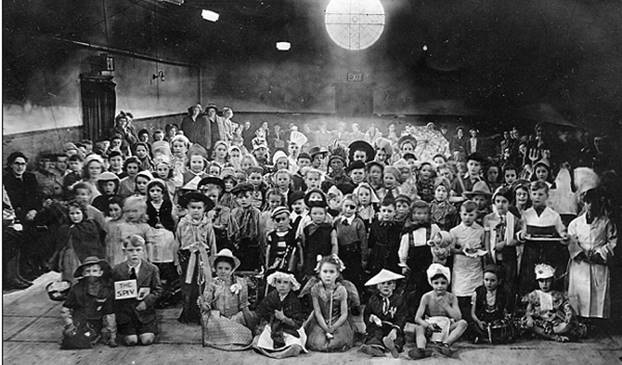
Amberley Preparatory School: Fancy Dress competition at the Church Hall on
Hodgehill Common, Christmas 1948
My mostly tranquil school
life suffered one significant interruption when a girl in the class complained
that another girl, called Yvonne, had stolen her fountain pen. The Principal, Miss Inshaw,
made enquiries and the pen was duly found secreted in the top of one of
Yvonne’s black woollen stockings. The
poor silly girl was expelled, causing a frisson of excitement through the
class. I had not previously encountered
the world of theft and expulsion, nor, come to that, the world of
stocking-tops: sensations all, to an
eight-year-old.
Manners were an essential part of
one’s education in the highly structured society of those post-war years. One did not speak until spoken to. As boys, it was impressed on us that we must
treat ladies with respect at all times, a practice still faithfully kept by
some of my generation. A gentleman
should raise his hat on meeting a lady, should hold the door open for her,
allowing her to go first, and should always stand whenever a lady entered a
room. On crowded ‘buses one should
always offer one’s seat to a lady.
Conversely, real ladies did not go into pubs without a male escort, nor did
they smoke cigarettes in public.
Elocution lessons ensured that we spoke correctly and avoided
colloquialisms, especially “O.K.”.
Swearing in company was almost a capital offence. One might just hear one’s parents say “damn”
or “blast” under serious provocation, but the words were not permitted in a
child’s vocabulary. “Bloody” was used
by men only in the most extreme situations and would certainly never have been
allowed on the wireless. Stronger
language still, nowadays common-place, was largely confined to the working man
in his own environment and would never be heard in public. Just once, a boy called Gilbert used such a
word to me. I asked my mother what it
meant, but she didn’t tell me. I was,
however, forbidden henceforth to go to Gilbert’s house, which was a pity as he
had a very good train set.
Although I had a small circle of
friends at Amberley, much of my leisure time was spent alone, contentedly
reading or playing with my Hornby Dublo electric
train set, or happily riding my blue Hercules bicycle around the quiet
suburban pavements. I am told I learnt
to read when I was three by finding Music
While you Work in the Radio Times!
After Rupert Annuals and Enid Blyton, I graduated to Arthur Ransome books, ‘Bunkle’
adventures and the ‘
My form at Amberley was quite small, about fifteen to twenty
pupils, of whom most were girls. One
young friend was J’Ann Page, who moved to Somerset about
1960, but with whom I re-established contact in 1985 through a neighbour of my
parents who had remained in touch. J’Ann was a lively girl and we often enjoyed a threepenny
ice cream as we walked home from the tram on the journey back from school. But
the world is not yet ready for the curious tale of how her socks came once to
be lodged high in one of Stechford Road’s sycamore trees. In the years 1949 – 1951 two boys in
particular were my firm friends: Derek
Silk and David Yates. On leaving
Amberley we inevitably drifted apart, but happily got together again on several
occasions in the 21st century, thanks to connections made through
the internet. At school, we tried to
pass ourselves off as a “gang”, modelled partly on Richmal
Crompton’s Just William stories and partly on Jennings, with a
dash of Dick Barton – Special Agent, courtesy of the BBC Light
Programme’s serial at 6.45 each evening.
We wore our fashionable “snake” belts, but of our daring exploits little
remains in memory. My most serious
misdemeanour arose when I was “dared” to knock on someone’s door near the
school and run away: I was caught and
Miss Inshaw duly administered a stroke with a ruler
on the palm of my hand, almost certainly the only time in my life that I suffered
such physical punishment. Truth to
tell, the public humiliation was the worst aspect of the incident.
(Schooldays continues below, after Dan Dare)
The view from 165 Stechford Road
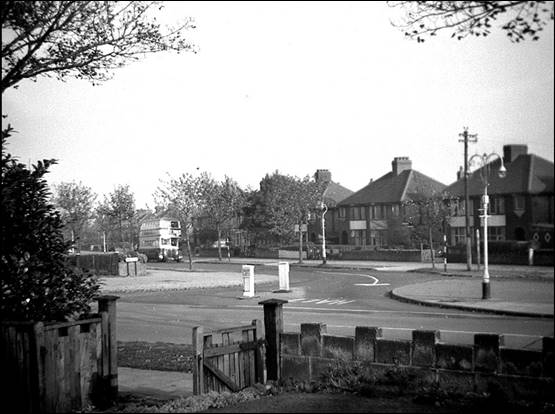
The view
looking into Hodgehill Road in the early 1950s, soon
after the introduction of the
55 ‘bus
service in October 1950, but before replacement of the 1930s-style lamp posts
by tall modern lighting. When my
parents bought the house in 1932 it faced open fields with a view to
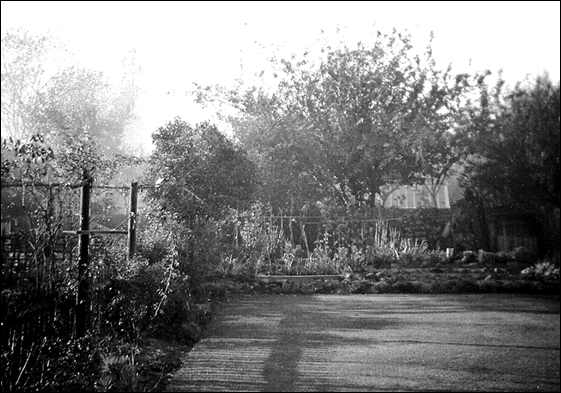
The view
of the back garden shows the lawn around which I rode my Hercules bicycle,
with the
rockery beyond (into which the air raid shelter had been built for the duration
of the
war) and behind which there was a small vegetable garden.
Some childhood souvenirs:
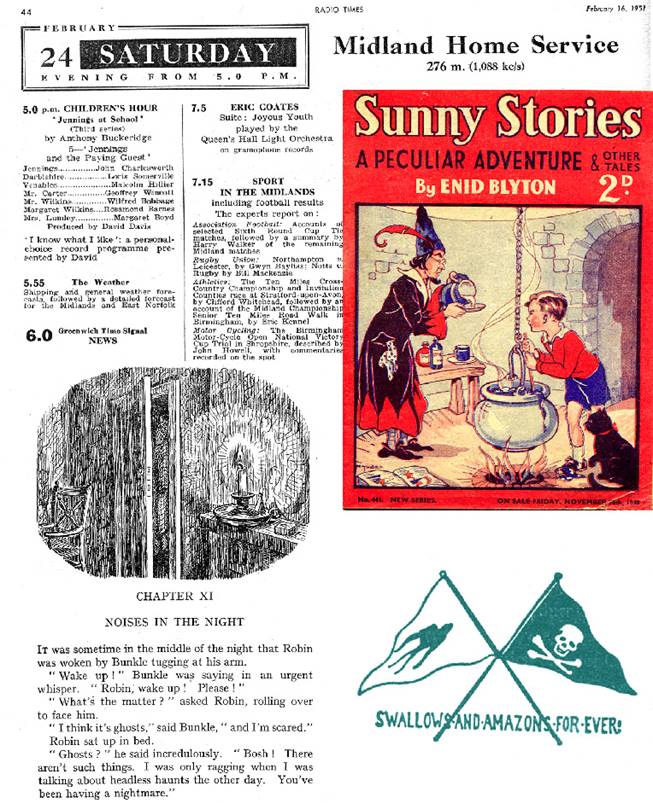
Clockwise from the top:
An
excerpt from Radio Times: wireless programmes for 24th
February 1951, including Jennings
at School;
the cover
of Enid Blyton’s weekly Sunny Stories for November 1948;
one of
Arthur Ransome’s decorations from the pages of Swallows
and Amazons;
a page
from Bunkle Butts In, by M. Pardoe
(1943), with illustration by Julie Nield [The
‘Noises in the Night’ were intruders in the secret passage!]
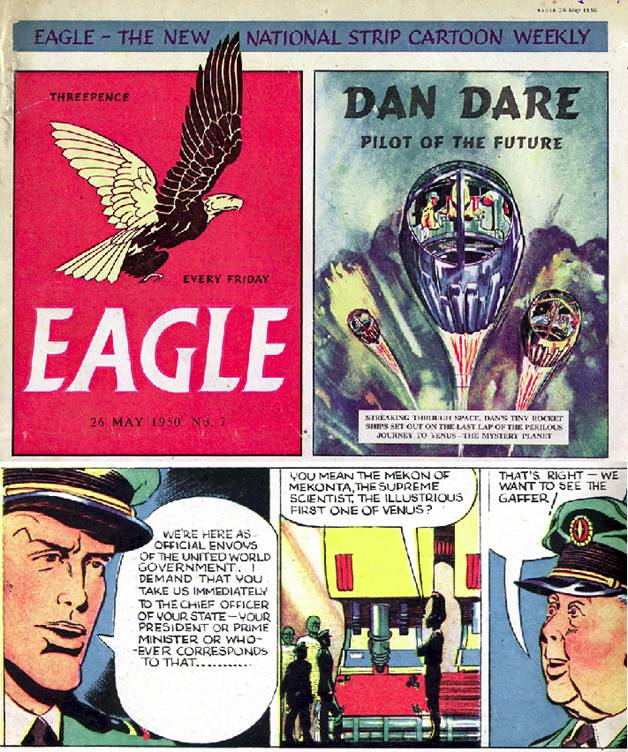
Extracts
from an early edition of Eagle, showing Dan Dare, Pilot of the Future.
Art work, by Frank Hampson, was always of a
high standard; the stories often
contained a discreet didactic element and schoolboys enjoyed the humorous side
as evidenced by the bluff Lancastrian approach of Digby, Dan Dare’s batman.
School days (continued)
Our ‘gang’ got into the local sand quarry one weekend when it
was closed, climbing through a fence near a sign saying “Trespassers will be
prosecuted”. But I was not cut out for
a life of crime and for weeks thereafter I was convinced that every knock at
the door would reveal the house surrounded by Scotland Yard men come to arrest
me for trespassing. In any case, with
my bouncing mop of unruly curls, big brown eyes and (in summer) white ankle
socks I never cut a very macho image.
Another boy in the class was Alan Smith but he was destined not to be
part of the ‘gang’. Sadly, he suffered
from Multiple Sclerosis so he wore surgical boots and walked with
difficulty. He was unable to join in
most of our games. His life was to be
short and sad, but to the rest of us his condition was a fact of life and we
selfishly continued with our games while he looked on. Only later did one begin to wonder what his
thoughts must have been.
Because of the small number of boys,
sport scarcely featured in the school curriculum and, although a few boys liked
to kick a ball about, football was not the obsessive interest it became in
later decades. As an only child I grew
up happily uninterested in games and other competitive activities. Dad did once take me to see Aston Villa play
when I was about seven, but I was hit painfully in the face by the muddy ball
when it strayed into the crowd. The
return home of a mud-splashed and blood-stained child incurred maternal
displeasure, so the trip was not repeated.
There were swimming lessons once each week, involving the tram ride to
Woodcock Street baths. By the time one
had changed – always two boys to a cubicle – there was time for only about
twenty minutes in the water. But
afterwards came the best bit, a cup of hot chocolate and a tiny slice of swiss roll in the café.
School P.T. exercises took place out of doors in fine weather only,
evoking the memory of the row of girls in front bending to touch their toes,
thus providing a momentary glimpse of their navy blue knickers as they leant
forward. A little more exciting was the
occasion during a game of ‘tig’ when I lunged to
touch Angela Moran and inadvertently (honest, guv!) succeeded in pulling off
her wrap-round skirt, thus revealing a tantalising hint of feminine delights –
though in those innocent times that was a country which would remain terra incognita, completely off limits
for twenty more long years.
At ten years of age I
suffered the first pangs of interest in the opposite sex. For a while I took to eating my sandwiches
with one of the girls and we would wander around the school grounds at break
and lunchtime having earnest discussions.
I endured some taunting from my two chums in the ‘gang’ who clearly did
not understand affairs of the heart.
Then, at the end of term, she broke the news that she would be leaving
and so the school “gang” member-ship went back up to three.
Meanwhile, childish fun went on as
before. Birthday parties continued
until I was eleven. Organised by my
mother, there were games, always including “pass the parcel”, then there was
tea (actually Corona “pop” and birthday cake), and then some wild
running about in the garden until it was time to finish. Parties were always mixed, but activities
usually seemed to divide into boys v girls. The girls always wore party frocks and had
ribbons in their hair, looking as pretty as a picture. They would surely have grown up into
wonderfully attractive young ladies, but by then our ways would have sadly
parted.
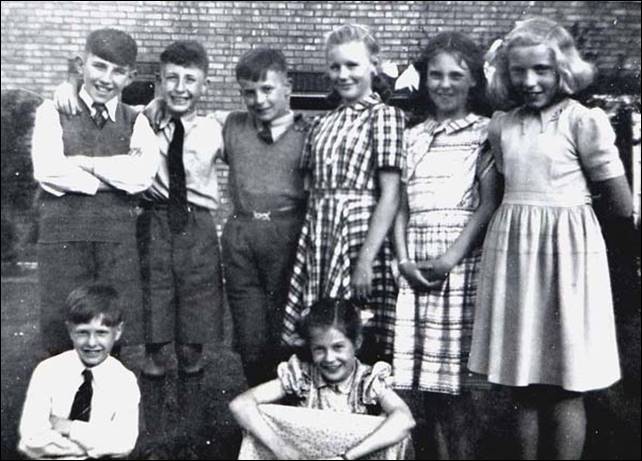
Birthday
party 1951: back left: Derek Silk,
RHD, David Yates,(“the gang”)
back
right: Norma Page, Stella Richardson, Myrtle Pridmore
front:
Keith Hickinbottom, J’Ann
Page
“ Children’s
Hour ”
Out of
school, music was my most lasting discovery of those early post-war years,
destined to develop into my life’s main leisure interest. Ours was not a musical household and I am
told that my favourite piece of music during the war was called “Pistol Packing
Momma”, long since erased from my memory.
But, like most contemporary middle-class children, I was an avid
listener to “Children’s Hour” on the BBC Home Service (no television in those
days!). Many of the items were
introduced by tuneful extracts from classical music, some of which etched
themselves permanently into the mind. Said the Cat to the Dog opened with an
extract from Walton’s Façade and
“Music at Random”, a series of talks by Helen Henschel,
began with the main theme from the last movement of Brahms’s First
Symphony. One serial used Sibelius’s En Saga.
Another drew briefly on the music of Shostakovich, and, with the help of
Radio Times, sent me on my first
voyage of discovery to the newly-developed Third Programme. (I remember, however, being seriously
bewildered by the music encountered there – not for the last time!) At Christmas 1948 I first heard John
Masefield’s Box of Delights with
music from Victor Hely-Hutchinson’s delightful Carol Symphony. Box of Delights was to be repeated in
1955, before being transferred to television in 1984, each time with the same
music. But the piece which I enjoyed
most was one used to introduce a children’s adventure serial broadcast in 1947
called Bunkle Butts In. I was hooked by the first “thriller” I had
encountered (I still have the book!).
The music, Elgar’s Chanson de Matin, entered into possession of my brain and started
me on a lifetime’s enjoyment of classical music. Thanks to the organisers of “Children’s
Hour”, music became an absorbing ingredient of my life when I was just seven
years old. I fear that today’s
youngsters lack such an introduction to the magic of classical music.
There was, of course, other, more light-hearted, entertainment
to be had from the wireless (as it was then called). A favourite was Much Binding in the Marsh with Kenneth Horne, Richard Murdoch, Sam
Costa and Maurice Denham. Lying in bed
on Sunday evenings, I would hear the voice of Frankie Howerd
in Variety Bandbox drifting upstairs,
accompanied by my parents’ laughter.
The most discussed show was probably ITMA
with Tommy Handley who died so suddenly aged 57 in 1949. During and immediately after the war ITMA had been a major factor in uniting
the nation: at a time when there was no
television, and wireless programmes were confined to the BBC Light Programme
and Home Service, choice was restricted and the majority of the population would
be enjoying the activities of Handley and his crew. Billy Cotton’s Band Show on the Light
Programme accompanied our lunch every Sunday, ensuring that I was soon
word-perfect with “I’ve got a lovely bunch of coconuts …”
Television broadcasts had
started in London in 1936 but were suspended for the war, restarting in June
1946. The service reached Birmingham in
1949 and was extended throughout the rest of the country in the 1950s. We acquired our first set in February 1951 at
a cost of 60 guineas (equivalent to £1623 in 2023). Early receivers came in vast wooden cabinets
but had tiny 9” or (for the affluent!) 12” screens. For many years programmes were broadcast
live and went out for limited hours only:
initially there were children’s programmes from 5 pm to 6 pm, and then
nothing was transmitted until evening programmes began at 8 pm, continuing
until about 10.15 pm. My first glimpse
of television was of an old Hopalong Cassidy western
film being shown in the window of a radio retailer: it may have been a flickery
black and white picture, but to me it was then the last word in sophisticated
entertainment. Other early delights
were “Mr Pastry” (remembered installing a TV aerial on the roof and falling
into a waterbut) and the 1951 studio-bound production
of E. Nesbit’s Railway Children – no
actual trains were shown, but steam might occasionally be blown across the
screen!
Evening programmes were
introduced by announcers dressed formally in evening wear: viewers were greeted by Sylvia Peters or Mary
Malcolm in elegant dresses and McDonald Hobley or
Leslie Mitchell immaculate in dinner jackets.
As programmes were broadcast live (even the Thursday repeat of the
Sunday night play was a second live performance) it meant that disasters great
and small reached the home screen. Not
infrequently the screen would go momentarily blank before an elegantly written
notice appeared:
“Normal Service
will be Resumed
as soon as Possible”
The first person I ever
saw drunk was Dr Glyn Daniel on the television programme Animal Vegetable and Mineral – he and his guests had evidently been
celebrating before-hand, rather too well.
My first hint that sex appeal might be of some significance came about
1952 in a live programme with the elderly artist Sir Gerald Kelly talking about
(I think) Fragonard's "Girl on a Swing": he suddenly turned to the camera with a
wicked twinkle to add a daringly unscripted remark: "Look at that lovely little
bottom". My mother laughed, then
remembered I was there and said "Well!!" in a certain tone of voice.
A sample of television programmes from 1951
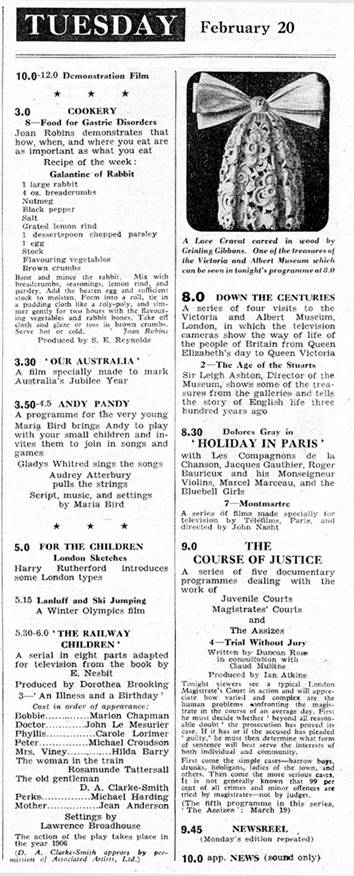
An
extract from Radio Times showing all the television programmes for Tuesday,
February 20th 1951
It will be noticed that no
programme were broadcast between 4.5 and 5.0 pm, or from 6.0 to 8.0 pm.
Following the News (sound only)
television closed down at about 10.15 pm.
The death of
radio’s Tommy Handley was an uncomfortable reminder of human mortality. During the 1940s two neighbours died,
comparatively young, raising in a child’s mind the question of our ultimate
destination. The mother of Juliet
Powell, a little girl with whom I had sometimes played, died in her 30s from
breast cancer, and “Uncle” Bill, our next-door neighbour died from pneumonia in
his mid-fifties. These events raised
uncomfortable questions, but children look ahead, not back, and the events were
soon all but forgotten. The equally
great mystery of birth surfaced from time to time: I remember asking my mother where I had come
from, but I cannot now recall her reply which was doubtless a masterpiece of
dissembling! But I was temporarily
satisfied, without the destruction of childish innocence which now seems to be
the rule.
Much of my knowledge of
life’s caprices came from unintentional eavesdropping on my mother’s
conversations with her friends. She led
a life ordered by routine: Mondays were
for washing (morning) and ironing (afternoon), Tuesday and Friday mornings were
for local shopping, Wednesday and Thursday mornings were for cleaning –
downstairs and upstairs, respectively.
Except on Monday, after an early light lunch she would change into a
smart day dress. The afternoon was then available for seeing
friends, equally elegantly attired in smart frocks, or for an occasional trip
to the centre of Birmingham. There she
would shop for clothes (although that was limited because of the need for clothing
coupons), or perhaps take me to a matinee at the cinema. When her friends came for tea I would often
sit quietly reading in a chair in the bay window while the ladies sat talking
by the fire. Perhaps I was invisible,
because I would hear remarks about life, husbands and acquaintances which were
surely not intended for me! There was
probably nothing slanderous, but I do remember being amused by mimicry of a
local lady with an affected way of speaking who was quoted as saying “My de-ah,
it took me two aahs to arrange the flaahs.” [Two hours to arrange the flowers.] I felt uncomfortable (and still do) on
hearing a woman complain about her husband’s alleged domestic
inadequacies. I have never heard a man
complain about his wife, suggesting that ‘cattiness’ is indeed a female
attribute! In the 1940s the two sexes
lived quite separate lives: it seemed
men went off to kill or be killed fighting wars or, if living at home, set off,
trilby-hatted to work from 7.30 am to 6 pm each day. On Saturday afternoons they went flat-capped
to football, and spent any remaining spare time caked in mud from digging the
garden or covered in oil after overhauling the car (which probably entailed
lifting out the engine). Women shopped
occasionally, cleaned from time to time, did a little knitting or embroidery,
dead-headed the roses and spent the rest of their time reading to their
children or drinking tea with friends:
it seemed to me an enviable existence compared with their husbands – but
things for me turned out differently and I have no cause for complaint!
In the 1940s and 50s ladies still
had a very different approach to life from men and they cherished attitudes
which their 21st century successors would repudiate. Like most of her sex, my mother, her sisters
and her friends all strongly disapproved of football and all other games apart
from tennis, which was enthusiastically supported. Cricket also enjoyed a limited following
amongst a few of the fair sex. Wives
reluctantly tolerated their men attending football matches on a Saturday
afternoon, but the male obsession with the game was regarded by them as a clear
indication of men’s inferiority to women.
Likewise, it was accepted that men drove cars, buses and lorries: but no self-respecting lady would allow
herself to be seen indulging in such activity.
Their avoidance of motoring was quite sensible in the 1940s as vehicles
were far from reliable and breakdowns and mishaps were commonplace with
“D.I.Y.” repairs often being the only practical solution, albeit tricky and
dirty. A few women did learn to drive,
but they were a tiny minority and regarded with acute distrust by men and even
by most other women!
Life continued with occasional unexpected
twists and turns. In the late 1940s I
experienced an encounter with the constabulary which was to make a lasting
change in my life – although happily without any charges being brought! During the course of a visit to the family
in South Wales, my father had the misfortune to run down a lady who foolishly
stepped off the pavement in Tonyrefail without first
looking to see if the road was clear.
Happily, the car was only travelling at about 20 m.p.h. and no serious
injury was caused. Nevertheless, it was
necessary for my father to call at the village police station to make a
statement. While he and my mother were
thus engaged I endured a very long and boring wait. The sergeant’s wife took pity on me and
brought me a mug of strong tea. This was
alarming, as I disliked tea intensely and never drank it. But clearly one did not argue with the
police. So I braced myself and took a
sip. Heavens! – I liked the stuff! From that day forward I have never refused
the chance of a cup of tea – thanks to the Glamorganshire Constabulary.
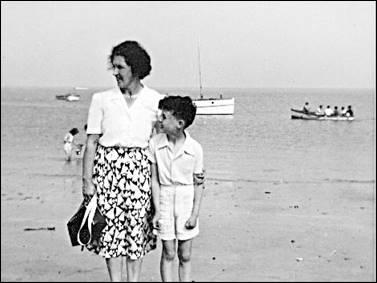
More memories of holidays in South Wales:
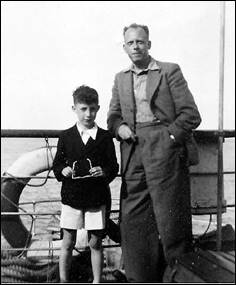
With Dad on board the Cardiff
Queen at
Ilfracombe 1949
and with Mom at Tenby after
a boat trip to
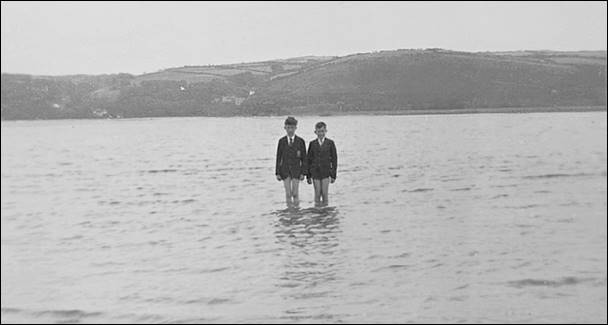
Paddling with cousin
David at Llansteffan, Carmarthen, 15th
August 1952.
School blazers and ties
are in evidence, - but not trousers!
When it
came to food there was no opportunity to indulge in the whims and caprices of
taste. Rationing and shortages
continued well into the 1950s and many popular items were simply unobtainable. One had what one was given or went without. Imports of bananas were discontinued
throughout the war and oranges were available only in very limited
quantities. I recall my first post-war
banana as a serious disappointment: I
think I was expecting a bigger, sweeter, more luscious orange. Domestic freezers and refrigerators were
almost unknown, so frozen foods were simply not available until limited
quantities of ice cream began to appear once the war was over: at first in vanilla flavour only; wafers three-pence, cornets four-pence, tubs
sixpence!
Dinner menus were limited in range. Beef, mutton and pork were the staples; lamb was seasonal and chicken a luxury for
Christmas only. Cod, tripe, hearts and
brains appeared occasionally. Meat was
accompanied by fresh vegetables according to season – my diet of green
vegetables was limited mainly to fresh peas out of the garden in July, runner
beans in August and cabbage for the rest of the year, varied only by occasional
carrots or cauliflower. Tinned peas were
available, but were not especially palatable.
In an era of shortages, leftovers were recycled so that yesterday’s meat
reappeared as rissoles, vegetables as “bubble-and-squeak”, and an unwanted tea
might re-appear as bread-and-butter pudding.
Cheese was rationed to two ounces (of non-descript Cheddar) per person
per week. Eggs were scarce, but dried
egg was available for cooking and could even be made into a sort of omelette,
though my mother looked down her nose at such contrived dishes. She baked her own cakes; otherwise we would
probably have gone without. The season
for locally grown fruits was extended by careful storage of cooking apples,
giving the spare bedroom a characteristic smell, and my mother would be busy
bottling plums and damsons in Kilner jars at the end of each summer. Imported tinned fruit was unknown and I did
not taste any until a rare tin of pineapple chunks, hoarded from before the
war, was produced at a family party, held at my father’s old home in Erdington,
for Uncle Cyril who was on leave from the Army. Foreign dishes such as pizza, lasagne, or
paella were quite unheard of; indeed, in
an era when foreign holidays were almost unknown our family would not have
recognised the words! By comparison
with present-day menus it seems a poverty-stricken up-bringing. But the choice was planned in response to
government dietary advice and ensured a generally healthy population. There was no chance of over-indulgence, so
my friends were a skinny and active lot, obese children being unknown!
Sweets were taken off the ration on 24th April 1949
(remembered as being my play-mate J’Ann’s birthday),
but before I could get to the corner shop for a quarter of Barker and Dobson’s
Barley Sugar or of Wilkinson’s Liquorice Allsorts, panic buying by the public
had cleared the shelves nation-wide.
This resulted in the government re-imposing rationing for three more
years, frustrating the dreams of many children who were thus strictly limited
to one or two sweets a day. But in
compensation there was Christian Kunzle’s restaurant
in Union Street with its delicious Swiss-style cream cakes rich with cream
inside a chocolate ‘boat’: one greedily
eyed a plateful but could seldom manage more than one! How strange that such indulgent fare has
long since vanished from the shops!
Food rationing continued with full
severity for several years after the war.
The system demanded that one was registered for food with a specific
shop. Making purchases elsewhere was
not permitted. We patronised Ehret’s, a small grocer (with a surprisingly Germanic name
for those days). There, my mother’s
order was taken over a long counter with a chair placed alongside for the
customer to rest her legs. Many items,
such as butter and sugar were parcelled up on the premises and biscuits
(plain; no cream varieties) were sold
loose from large biscuit tins, pre-packed goods being almost unknown. My mother’s purchases would be delivered
later by bicycle. I always wanted her
to call in at the Co-op, despite not being registered there, as the Co-op had a
marvellous aerial ropeway by which the cash was sent by the shop assistant to
the lady cashier who returned any change by the same means – a fascinating
contrivance for a small boy to watch in action! (The Midland Educational book shop in
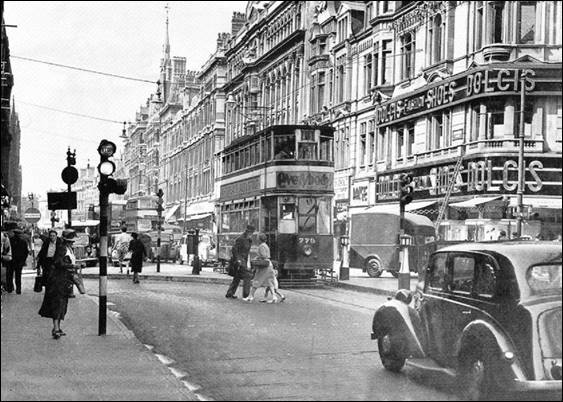
A postcard view of
Corporation Street, Birmingham, at the crossing with Bull Street, about 1949.
The buildings behind
and beyond the tram (which is heading for the Fox & Goose terminus at
Ward End, see below)
were replaced by Rackhams’ department store in 1960.
In the late 1940s our rations were slightly
supplemented – unofficially - with the help of Aunty Rene, a cousin of my mother’s who, like her, had left South Wales and settled in
Warwickshire. She and her husband ran
the village shop at Broadwell, near Southam and about twice a year we visited her, returning
laden with contraband packets of Weetabix, bags of sugar, slices of fresh ham
and pats of butter. Broadwell
was then a tiny isolated village lying in a hollow, populated mainly by
agricultural labourers who lived near the poverty line. Most houses were down-at-heel and there was
an overwhelming and unpleasant smell which offended the nostrils as soon as we
got out of the car. Explained by my
mother as “stagnant water”, I later discovered the smell was that of the
village’s cesspits. On our visits I
often played with Margaret, Aunty Rene’s granddaughter and my second cousin
once removed. She was a tall, lively
girl, only a little younger than me.
But in her twenties she suddenly suffered a brain haemorrhage and died,
leaving two tiny children. Aunty Rene
herself died in 1960 and thereafter we had no reason to return to Broadwell. But in
1990 I was driving nearby and decided to make the detour to see how the village
had changed. In thirty years the
down-at-heel cottages had been transformed into “desirable executive commuter
homes”, each with a BMW or Mercedes outside.
The old shop was no more, but was now the largest and most impressive of
all the houses. I might add that the
air was sweet and of the smell there was no evidence.
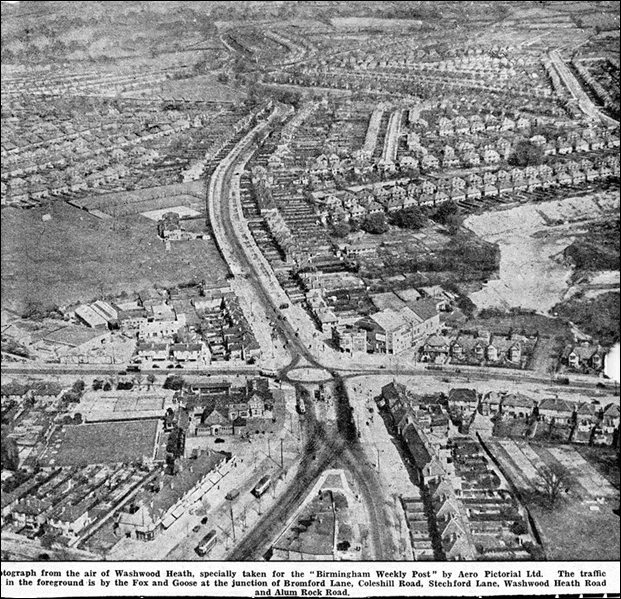
The Fox & Goose
shopping area, about 1949, from the pages of the Birmingham Weekly Post.
In the left foreground is the Washwood Heath Road with trams on their reserved
track. Alum Rock Road merges in the
right foreground. The Beaufort Cinema
is just above and right of the traffic island.
The Outer Circle route crosses from left to right and Coleshill Road
continues into the distance toward Hodgehill Common,
just visible where Coleshill Road bends left into the trees. Centre-left are playing fields, now occupied
by a super-market. The sand quarry is
visible right of centre: it was later
filled in and became Stechford Hall Park.
Rural Castle Bromwich stretches across the top of the photograph: Shard End was still just a planner’s dream.
Petrol was still rationed well into
the 1950s, so outings by car were strictly limited. On a couple of occasions, when my mother
evidently wanted an afternoon to herself, she would pack me off on the Outer
Circle ‘bus for the two hour circumnavigation of
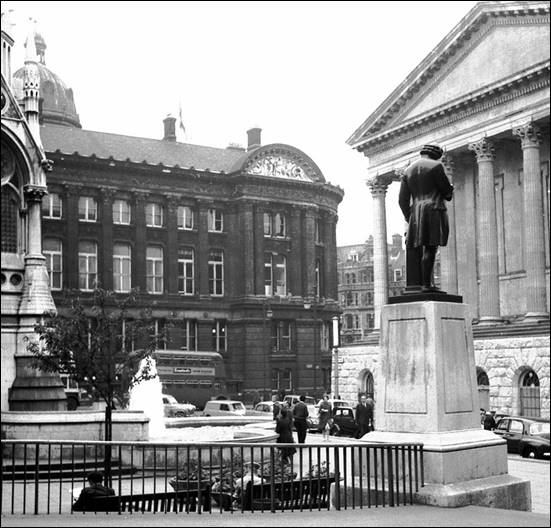
Chamberlain Place,
Birmingham: A Midland Red ‘bus passes
the smoke-blackened Council House as it approaches the Town Hall.
Most stone buildings were then blackened by the smoke in
winter fogs. As atmospheric pollution
diminished in the 1950s the buildings were cleaned, revealing that the stone
had a natural light colour - much to the surprise of my generation!
In the
late 1940s and 1950s the British Industries Fair (“BIF”) was held for two weeks
each summer at Castle Bromwich, only a mile from home. I was taken there on several occasions, even
though the displays of heavy engineering which were the essential feature of
the show were hardly riveting stuff, either for me or for my mother. But there was usually an exhibit featuring a
small gauge industrial railway, intended for use in quarries or on building
sites and the promoters were generally more than happy to demonstrate its cargo
carrying capacity with a load of small boys instead of the more usual tonnage
of granite. In 1947 the BIF was
officially opened by H.M. King George VI, and after the ceremony he was taken
by motorcade to join the Royal Train at Stechford station, so passing our
house. This was an occasion when we
watched from our front garden as the King drove past – I was surprised to find
that there were other, lesser, mortals whose front gardens were not thus
honoured by His Majesty. I will add
here, although it belongs to a slightly later stage of my life, that in 1956
the Russian leaders, Khrushchev and Bulganin likewise were driven past our
house when returning to catch their train to
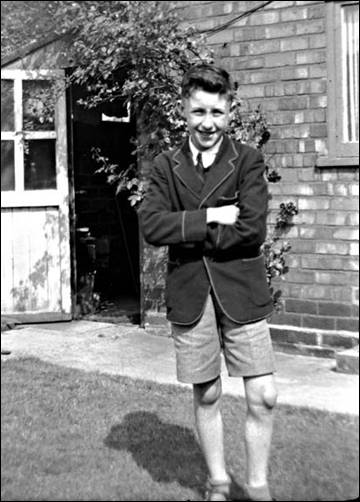
1950: 10th birthday
For
the most part, news in the 1940s passed me by, but from conversations overheard
between adults, from wireless news bulletins and occasional newspaper
headlines, I gained some vague impression of the drift of events. In 1945 I knew from the VE celebrations that
the end of the war with
In
1945 I had remained in ignorance of the general election which brought Clement
Atlee’s Labour party to power but I soon noticed some of the cosmetic aspects
of Labour’s policies and became familiar with such names as Stafford Cripps,
Herbert Morrison, Ernest Bevin and Aneurin
Bevan. My father admired “Ernie” Bevin,
but Bevan was especially unpopular with both my parents who referred to him as
“Urinal Bevan” although the joke was lost on me. Labour’s nationalisation of collieries and
railways first manifested itself to me by the closure of the tiny private
colliery known as “The Squint” in Gilfach Goch, near my grandparents’ home. Then the familiar chocolate-coloured paint
on Great Western Railway carriages gave way for a while to red, and I vividly
recall the first occasion when I saw a steam engine lettered “BRITISH RAILWAYS”
instead of the familiar “GWR” – much to the disgust of my father.
For
a decade after the war, paper shortages resulted in newspapers comprising no
more than six pages and there was thus room only for one or two
photographs. But the press could always
be relied on for front page pictures of a disaster, so air and rail crashes
seemed to loom large. The horrific air crash in March 1950 near Cowbridge in Glamorgan, when 80 rugby football supporters
returning from a match in
It
now comes as a surprise (even to those of us who were there at the time) to be
reminded how innocent and ignorant children in the 1940s and 1950s were about
matters relating to sex. Parents and schools
shyly dodged the issue. Newspapers,
magazines and the broadcast media never mentioned the topic. Nudity was quite unknown, save for
discreetly-posed black and white pictures in a few “pin-up” magazines which
were not widely available and certainly unknown to me. Boys and girls could thus grow up in a state
of blissful ignorance of the change adolescence would bring: nothing was said. My own innocence was signally disturbed at
ten years of age by a 19-year-old Italian film actress, Silvana
Mangano who appeared in an Italian film, Bitter Rice, released in Great Britain
in 1950. The publicity photographs for
the film included one reproduced in our Daily
Mail showing Miss Mangano standing in water,
wearing tiny shorts and a figure-hugging black sweater. Never before had I seen anything quite like
it: the picture fascinated me and
brought an exciting sensation, strange and delightful yet a little alarming; new to a growing boy. Thus began five years of change, as I
discovered delight in watching a pretty girl pass by.
Boyish curiosity and flamboyance amongst my contemporaries offered
patchy enlightenment (as well as worrying fables of blindness or worse) but I
was approaching fifteen years of age before the story took shape. Only then did I properly understand that
such bodily developments were to do with reproducing the species and so had
more significance than just to provide passing amusement for teenage boys. The years passed, and other sex symbols such
as Marilyn Monroe and Brigitte Bardot came to tantalise the mind and body of
this adolescent boy, but I shall never forget Silvana
Mangano oozing temptation in a rice field. What a contrast between our own ignorance in
the 1940s and 50s and the obsessive attitudes of the 21st century.
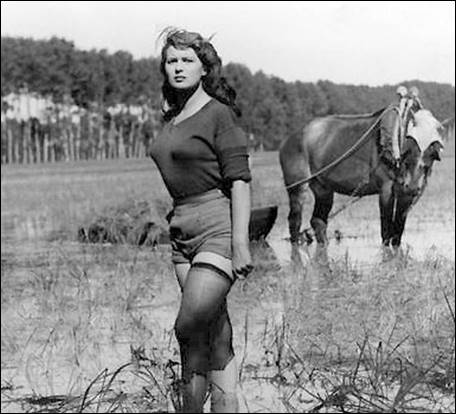
Silvana Mangano
in Bitter Rice, 1949.
She
appeared in several more films, of which the best known
was Death
in Venice in 1971. She died in
1987.
This was the
photograph which caught my eye in the Daily
Mail in 1950.
In 1951
I passed the “eleven-plus” examination for King Edward’s School, Aston, but was
also entered for the separate examination for the ‘parent’ King Edward’s School
in Edgbaston. This was a tougher
proposition but I passed and so the lengthy cross-city journey would be part of
my life from September. I would notice
a change: Amberley was a tiny, informal
affair, run by a handful of local ladies, of whom Mrs Bunker and J’Ann’s mother, Mrs Page, were my usual teachers, aided by
Mrs Woodwiss who taught History and Geography on
Thursdays and Fridays only. For a
couple of terms, there was a small sensation when they were joined by a man, Mr
Luby. At
Amberley I was a big fish in a very small pool, but at King Edward’s I would
find myself a very small fish indeed.
The culture shock would be significant.
Instead of the company of a small number of girls and an even smaller
number of boys, there would be 700 pupils, many already grown men over six feet
tall. Life at King Edward’s would bring
testing new subjects including Algebra and Latin to puzzle my mind, and games
such as rugger (about which I knew nothing).
But this new existence would one day cease to be strange and would
itself become second nature.
The early ‘fifties were marked by
three events of national significance:
the Festival of Britain in the summer of 1951, the death of H.M. King
George VI in February 1952, and the Coronation of Queen Elizabeth II in June
1953. These printed themselves on my
memory in different ways. I remember
the Festival firstly for the journey up to
The death of the King was, to a
child, quite unexpected, the news reaching my form at lunchtime as we waited to
go into the school dining hall. After
the colour and fun of the previous year’s Festival, the state funeral itself
had an overwhelming and numbing sombreness, awe-inspiring even to an
eleven-year-old. Monochromes dominated
everything, not just on the tiny black and white television, but in the whole
of that cold, grey, austere February world.
Gaiety returned the next year in time for the Coronation, even
if the weather itself famously failed to co-operate on the day. But with hindsight, I now realise that just
as my world was changing, so the further world beyond was taking on new and
different aspect. In watching the
splendid spectacle of Coronation Day I witnessed the finale of the British
Empire and of the Pax Britannica; the world of my parents and of my
grandparents; the world of my own
childhood; a world which I had foolishly
thought was permanent.
* * * * *
In Retrospect
The early 1940s was a
surprisingly good time in which to be born.
I was too young to be much concerned either by the war or by the
privations which continued for some years afterwards. I saw and experienced a world which still
depended on horse power and the steam engine, and when country life was little
changed from that which had obtained centuries earlier. My own childhood is now more than seventy
years in the past, amongst events far enough away to be deemed historic. But I well remember listening to relations
born in the 1860s. They had in turn
been brought up by a generation whose attitudes were formed in the 1820s and
30s, when misbehaving children were told ‘Boney’ (Napoleon
Bonaparte) would get them and when any journey, for those not lucky enough to
be part of the aristocracy, meant a long walk or an uncomfortable ride on the
local carrier’s cart. Just a couple of
generations back and one is lost in an era whose people could not possibly
conceive of the life we now lead. By
contrast, I was born in time to enjoy the increasing material prosperity of the
1950s and early 1960s, while still having the old-fashioned freedom to explore
my surroundings free from the fears of crime and violence which affect today’s
children. I was in time to benefit also
from the general availability of a wider and more attractive diet, and also of
improved medicine, especially antibiotics and better anaesthetics.
The full employment of the
post-war era meant it was easy to get a well-paid and interesting job with
security and also with prospects which were duly realised. Those who were born in later decades were
not to find employment so easy, and, for many of the rising generation, the
outlook for early retirement and a generous pension is much less promising than
for my generation.
It is easy and
commonplace for my generation to think back to our childhood days and to lament
the loss of innocence. We are now
immersed in a depressing climate of violence, of aggression and confrontation,
of tasteless and offensive talk. This
is evident in everyday life, in the press, in books, and especially on
television where we find many plays and so-called comedies quite
unwatchable. Tenderness and sympathy
are in short supply, as is true wit.
There are manifold petty restrictions and the absurdity of “political
correctness” and “woke” attitudes which limit cherished freedoms. Moreover, standards of public behaviour and
dress have slipped as ‘scruffiness’ has taken over. How one laments especially the loss of
pretty dresses for young women, replaced by dreary jeans and T-shirts (or by
barely decent brief shorts and tiny tops)!
But against that one must set today’s improved living standards,
especially dentistry and health care, and such material benefits as cars and
computers, refrigerators and televisions, central heating and air
conditioning; plus the travel and
holiday opportunities we now accept as commonplace.
I may have enjoyed
myself in the 1940s and 1950s, but I would not go back: there is so much in life to enjoy today!
Robert
Darlaston, February 2006
Updated, November 2008
Edited and updated,
October 2023
Part Two

King Edward’s
School
Birmingham
1951 – 1959
KING EDWARD’S SCHOOL, BIRMINGHAM
1951 - 1959
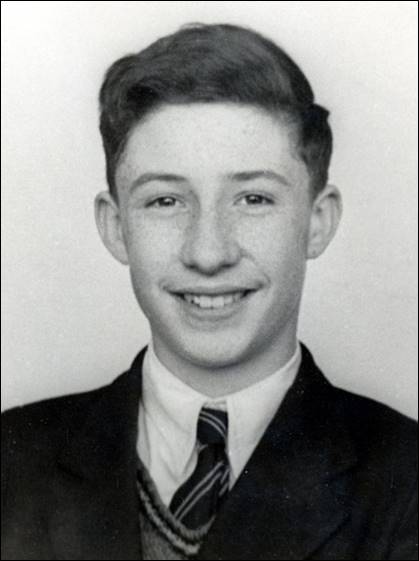
King Edward’s School:
Fifth form
school photograph, Summer 1955
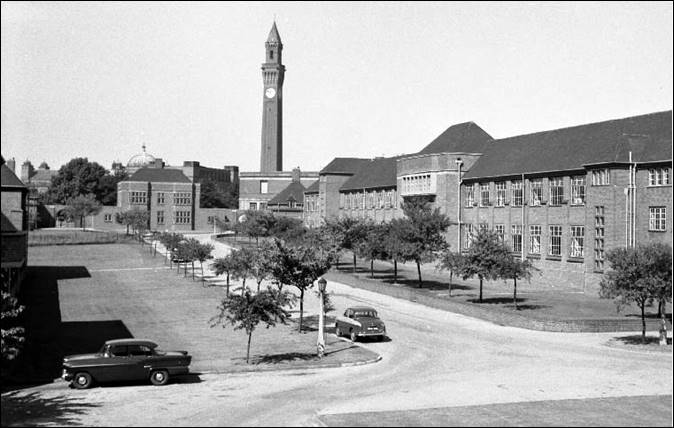
Looking up the Main Drive from Big School towards the
University with its splendid clock tower:
July 1959
= = i = =
|
M |
y
stay at King Edward’s spanned the years from the Festival of Britain in 1951 to
the wonderful summer of 1959, one of the sunniest of the century. It was a good decade in which to grow
up. My first few years had been set in
a world of bombs and rationing, where toys and sweets were almost as scarce as
penguins in the Sahara. Austerity had
continued after the war ended and, through the rest of the 1940s, life retained
a dreary greyness aptly portrayed by the monochrome newsreels of the period. But to a child it seemed, superficially at
least, that the arrival of the ‘fifties had brought a fresh wind to blow away
the horrors of the previous decade.
Rationing was rapidly dismantled.
Luxury goods began to appear in shops.
Newspapers enthusiastically proclaimed a new Elizabethan age. With Sir Winston Churchill as Prime
Minister, Everest newly climbed and the new Comet
jet airliner briefly dominating the skies, such claims for a while appeared
true. To a schoolboy it seemed one was
participating in real progress. In that
decade of full employment the motor car, television and the foreign holiday
became (for better or worse) part of everyday life. It was against that background that I spent
my time at K.E.S..
I started at King Edward’s School on 13th September
1951. I knew I was fortunate to secure a place at a
school which had provided education to the great and the good in Birmingham for
four hundred years and which was unquestionably one of the finest academic
establishments in the kingdom. Famous
alumni of the twentieth century in whose steps I was following included J.R.R. Tolkein, Field Marshal Viscount Slim, and the Rt Hon Enoch Powell.
Other pupils who became household names for a time included a brace of
bishops, the journalist Godfrey Winn (a favourite in women’s magazines in the
‘fifties), comedy actors Raymond Huntley and Richard Wattis, atomic spy Alan
Nunn May and maverick drama critic Kenneth Tynan (who was alleged to be the
first person to use the ‘f***’ word on the B.B.C.). Further back, the school had produced the
artists David Cox and Edward Burne Jones, as well as
E.W. Benson (who was Archbishop of Canterbury from 1883) and an assortment of
professors and clergy.
The school was a rich foundation which lacked for nothing and had,
only recently, moved from the bustle of the city centre to sumptuous new
premises in sylvan Edgbaston. The
facilities ranged from laboratories equipped to the latest standards to a small
cinema with tiered rows of blue plush tip-up seats. There were parquet-floored corridors, which,
to an eleven-year-old, seemed to stretch to infinity, and an assembly hall,
known traditionally as Big School, with a fine organ and one of the largest oak
hammer-beam roofs in England. The stage
in Big School was dominated by Sapientia (Latin for wisdom), an impressive carved and
canopied oak throne for the Chief Master, designed by Augustus Welby Pugin. The beams for the roof had been delivered
before the war and remained for the duration lost amongst long grass and
builders’ junk. A government inspector
had arrived to sequestrate them for the war effort, but the site caretaker had
denied any knowledge of them, and so they had survived to provide the school
with a magnificent setting for morning prayers and formal occasions.
The
contrast from my tiny previous school could not have been greater. To a small eleven-year-old somewhat lacking
in self-confidence the sheer size was bewildering and I duly got lost on my
first day when searching for room 72.
New boys were known as “Sherrings” (a
contraction of “Fresh Herrings”), which could occasionally be a term of mild
abuse when used by boys who had risen to the dignified height of the second
year. On arrival at K.E.S., I was
placed with 22 other boys in Shell ‘C’.
We were seated in alphabetical order and I teamed up with my neighbour,
whose surname was Cork. Like me, Cork
was somewhat overawed by our new surroundings, so it was good to have an ally
in those early days. His family was to
move away after a few years and he vanished from my modest circle: later I heard that he made something of a
name for himself in Jazz circles. Our
form master in Shell ‘C’ was Mr L.K.J. Cooke, a kindly man with a velvet toned
voice and a leisurely speech delivery.
In consequence, unkind schoolboys had nicknamed him “Slimy”, but he was
an expert at easing new boys into school life.
His roll-call of our names in alphabetical order stays in mind many
decades later: “Beard, Berry, Birch,
Brown, Clark, Cork, Darlaston,” and so on, ending with “Strange, Viggers, and Wilson”, recalling the sinister television
drama set in a boys’ school: Unman, Wittering and Zigo,
where the title was similarly derived.
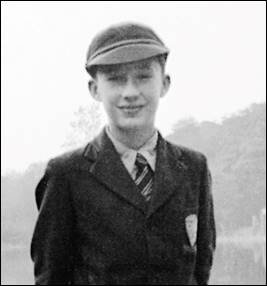
Left:
Official School Photo 1953 – detail
(Back row (l-r) Sessions,
Edwards, Mitchell; Front row (l-r) Birch, Darlaston,
Robertson
Right: Darlaston in
school uniform of blazer, tie, grey shirt and school cap, 1953
The use
of surnames accorded with long-standing tradition at boys’ schools. Today such usage is
widely thought of as unfriendly and first-name terms have become general, even
with people one has never met. But it
was long the customary form of address amongst males at school, in the Services
and in the professions. Christian names
were confined to family, a few close friends and, of course, girls. For a boy starting at secondary school,
being addressed by his surname was a badge of pride, showing he was growing
up: besides, one was following
time-honoured custom, as set out in novels about school life from Tom Brown’s Schooldays to Jennings at
School. To use a Christian name
was seen as over-familiar and disrespectful.
At school, boys kept their Christian names secret and, if discovered,
unusual or old fashioned names such as Harold or Cyril were a cause for mild
teasing. We knew girls at the adjacent
school by their Christian names, but they would mostly refer to us by our
surnames. When I went to tea with my
school chum Kite, his mother and sisters would call me Darlaston: it was normal usage. A few boys abbreviated my name to
‘Darly’ for a while, but happily that never caught
on! I was slightly bothered that a few
of the masters stressed the middle syllable of my name, thus: Darl-ASS-ton: I hope such emphasis was not meant to be
significant. Happily, their colleagues
and my form-mates addressed me conventionally as DARL-us-t’n. If two or more boys shared the same surname
they just were known by their initials:
in my year the Smiths were D.B., G.M., and R.J., always known thus. Boys, incidentally, were never referred to
collectively as such in official pronouncements, but always as
“gentlemen”; as in “Gentlemen will not
show any hair beneath the peak of their caps” or “Gentlemen will not display
pens in the outside pockets of school blazers.”
Caps and navy blue blazers were the main element of uniform
throughout the School. There seemed to
be an unwritten rule that until boys entered the Upper Middle in their third
year short trousers were worn, shirts were grey, and raincoats were navy
blue. Thereafter, one graduated to the
dignity of long trousers, white shirts and fawn raincoats. Similarly, the satchels of the first two
years suddenly became quite passé and were replaced by smart leather brief
cases in which to carry one’s ‘prep’.
For some boys, brief cases gave way in turn to C.C.F. packs or duffel
bags which were popular towards the end of the ‘fifties. In my first year at K.E.S. sixth formers
were permitted to wear sports jackets with flannel trousers and to leave off
the school cap. This gave them, in the
eyes of boys in the ‘Shells’, a somewhat awesome appearance whereby they were
difficult to distinguish from young masters.
That sanction was withdrawn in 1952 when caps and blazers became
required wear throughout the school – a rather unpopular change in the sixth
form as it diminished their apparent majesty.
School continued until 3.45 p.m.
only on Mondays and Wednesdays. On
other days lessons finished at lunch time, but that did not mean one could go
home. There were compulsory games for the first three years and these could be
on Tuesday or Thursday afternoon.
Friday afternoons were reserved for cadet force and scout group
activities, with non-participants being labelled “Remnants” and consigned to
the Art Room where Mr J.Bruce Hurn
presided. There was also morning school
on Saturdays. The school was a single
sex establishment, but there was an adjacent girls’ school (K.E.H.S.). The authorities required that there should
be no mixing between the boys and the girls, and the starting and finishing
times were staggered by 15 minutes to discourage the evils of fraternisation on
the trams and ‘buses. Unsurprisingly,
this policy was not entirely successful.
During my own early journeys across the city to school a fifth-former,
Stevens, who later went into the medical profession, kept a friendly eye on me,
supported by a couple of Upper Middle boys, and there were also two girls from
K.E.H.S., Ann and Margaret, who initially tried to mother me. On Friday morning journeys in that first
year, Darlaston’s Eagle comic was
enthusiastically borrowed by the rest of the party, especially the girls, so
that everyone could keep up to date with the adventures of Dan Dare, Pilot of
the Future.
At my junior school I had always
been a relatively big fish in a very small pond and was usually top or second
in the class. At K.E.S., by contrast, I
was to be in the company of some very bright pupils and consequently seldom
rose above the bottom third. At least I
usually enjoyed subjects such as English, History and Geography. But Mathematics was a real struggle. When I was about thirteen, the Maths master,
Mr Skinner, was explaining to the form some recondite algebraic formula which
was taxing my limited faculties. My
face clearly betrayed my total and utter bewilderment. Suddenly he broke off in mid-sentence and
said: “Darlaston; when you look at me
like that, you make me feel an absolute cad!”
I confess to remembering that incident better than any of the algebra he
struggled to impart.
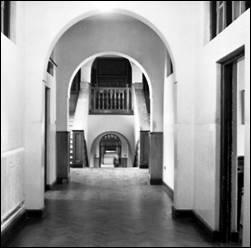
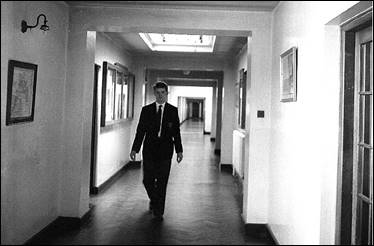
Left: Classical corridor, looking towards Big
School
Right: Upper Corridor: L.P. Walker passes the Library
One of
the most significant changes I found on starting at K.E.S. was compulsory
participation in games. I was allocated
to Mr Leeds’s house, later known as Jeune house, to
commemorate a 19th century master.
I fear my sporting contribution to the house was to be negligible,
although Mr Leeds was surprisingly kind to me.
Classes at my previous school had comprised about fifteen children, of
whom the majority were girls, so organised games such as football and cricket
had been non-existent. Moreover, there
were no boys of my own age living very close to home. Consequently, as a somewhat timid only child
I grew up to be rather self-sufficient and quite ignorant about team
games. K.E.S. attempted to teach me the
rudiments of Rugby football, but wrongly assumed I had some existing
knowledge. This became all too evident
in one of my early attempts at Rugby. I
tried to keep as far away from the ball as was possible, but on one occasion it
landed right by me, so I did as I had seen others do and picked it up. The master acting as referee (Mr J.F. Benett) promptly went puce in the face, blew his whistle so
long and loud that trains stopped all over Birmingham and he bellowed at
me: “Darlaston: you are off side”. I hadn’t the heart to tell him that I did
not have the slightest idea what he meant, - I never did get the hang of
it. My self-sufficient approach to
leisure together with my lack of confidence in my own ability contributed to an
absence of any competitive spirit when it came to games. Rugby, like the weekly gym lessons, was
followed by showers. I soon overcame
the affront to the modesty I had cultivated as an only child and cheerfully
mingled with the crowd of boys who emerged from the steam looking like a shoal
of slippery pink prawns. The showers
were gloriously hot, but when the master in charge decided we had had enough
time he quickly switched the thermostat to ‘cold’ ensuring our hasty emergence
with squeals of anguish. Although I
happily accepted the showers, I did draw the line at sharing the (off-) white
tiled bath at the Eastern Road pavilion with its thick muddy water, heavily
occupied by thirty adolescent sportsmen variously celebrating or lamenting
their performance on the rugger pitch.
At the time I started at K.E.S. the
Headmaster was Mr T.E.B. Howarth. I
only had one encounter with him. He was
showing some guests around as the bell went for the end of school at 3.45
p.m. My form made a rush for the door
and the leaders became momentarily wedged there until pressure from behind
caused them to burst in a heap onto the corridor floor at the feet of Howarth
and his guests. He looked down at the
eel-like writhing pile of pupils and with exaggerated bonhomie said “Little
horrors!” Had there been no guests
present I feel that his comments would have been decidedly sharper and
detentions might have been mentioned.
Detentions, it should be added, could be awarded by Prefects and by
Masters. The former involved standing
to attention from 4 p.m. to about 4.45 and were usually punishment for such
misdemeanours as running in the corridor or (my own speciality) talking in Big
School before prayers. Masters’
Detentions were infinitely more serious and kept one in school for the whole of
Saturday afternoon. Happily, my
Saturdays remained free from such interruption throughout my school career,
although it was a close run thing once or twice.
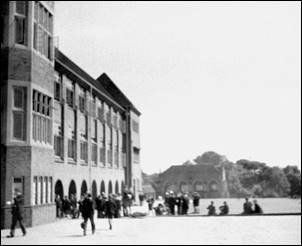
Left: The South Front during break: the Chapel is in the distance
Right:
the view down
Park Vale drive from the East Door. The
Howarth left the school in April
1952, moving on successively to Winchester, St. Pauls, and Magdalene College,
Cambridge, besides making a career as a writer. His successor, Canon R.G. Lunt, was an Old
Etonian, who was to remain in office for 22 years until his retirement. Lunt was not generally popular, either with
staff or pupils – he would not have seen popularity as any part of his
function. Some viewed him as an
unrepentant snob; he was autocratic in
an era of rising democracy; and he embraced
earnestly the classics and arts, while showing less obvious interest in the
developing world of science. But he
significantly raised the profile of the school in the city, helped, one must
add, by the presence of H.M. the Queen who paid a brief visit one wet day in
1955 belatedly to commemorate the school’s 400th anniversary.
In the 1950s Lunt taught Classics to Sixth Formers, Divinity to
some forms in the middle school and English once a week to boys in their first
year. This showed a commendable concern
to see that nobody could regard him as a faceless administrator. I encountered him in the course of English
lessons as an eleven year old – “one of the toddlers” to use his own somewhat
damning phrase. I prided myself that I
did not have a whiny Birmingham accent, but my enunciation was clearly not up
to the standards of Lunt’s Etonian and Oxonian delivery. In reading from “A Midsummer Night’s Dream” I referred to ‘Mustard-seed’, pronounced
as spelt. I was directed to spend the
weekend saying over and over again “I MOSST
remember to say MOSSTard-seed”. He himself affected an eccentric speech
accent with such phrases as “Yer will find yerself gowin’ up the drive fer the last time” (said to boys in disgrace). In his clerical garb, he certainly
presented a commanding figure in Big School as he addressed us from the oak
throne of Sapientia. After prayers, Lunt often had announcements
to make: an almost imperceptible motion
of his hands would indicate that the school was to be seated. Sometimes there would be a list of names of
boys whom “I wish ter see in my study” – a worrying
fate I happily avoided. Occasional
outbreaks of petty vandalism or graffiti would be condemned as “foulin’ yer own nest”. Amongst other routine topics, Lunt would
touch on a wide range of subjects in his customary superior manner, as when he
made a passing topical reference to the newly launched Russian Sputnik,
dismissed as a “hunk of Soviet ironmongery”.
A fine example of the Lunt
approach to school life was his ceremonial creation of prefects. After morning assembly, he would summon boys
so honoured up to his presence in Sapientia. He would
take the appointee’s right hand in his and then intone the prefect’s name in
full: “Gerald Aloysius Fothergill”, or
suchlike, – and seventy impertinent Upper Middles would think “Gosh! Who’d have guessed Fothergill was called Gerald Aloysius of all things” – while
Lunt continued: “I, twenty-fifth Chief
Master of King Edward’s School, hereby give unto you the position and
traditional powers of a prefect, entrusting to you
a share of the leadership and governance of the boys brought up in this
place: see that yer
wield this power with justice, loyalty and discretion.” Those
three nouns resounded with truly frightening emphasis around Big School and
each was accompanied by a vigorous shake of the appointee’s hand. The newly created prefect was then expected
to reply: “I will so do, God being my
helper”, usually doing so in a slightly husky and embarrassed voice. Those words soon became engraved in all our
minds. And to this day, throughout the
land, when an Old Edwardian is asked by his wife to pass the salt or put the
cat out, he will reply “I will so do, God being my helper.”
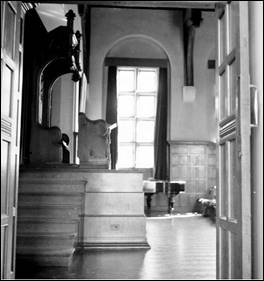
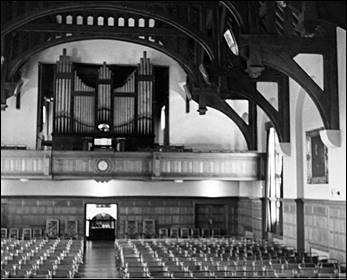
Left: Sapientia from the side entrance to Big School
Right: Big
School from the stage showing the organ and hammer-beam roof
One of Lunt’s more endearing eccentricities was his attachment
to a Rolls Royce motor car, dating from the 1920s and which had previously
belonged to his father, the Bishop of Salisbury. He doubtless felt that it was the only make of
car appropriate to one of his standing.
He always drove it to school, perhaps a half mile by road, despite
having a private path about 200 yards long from his house to the school. Vintage cars are not always reliable. On one occasion the Rolls broke down while
delivering a guest speaker from the station to the school, no doubt a cause of
considerable embarrassment. Sadly, the
Rolls was soon to reach the end of its career, as during a severe frost its
cylinder block fractured and it had to be ‘put down’. Thereafter, Lunt was reduced to motoring in
more proletarian vehicles.
His unashamedly elitist attitude
enriched the school in a variety of minor ways, as “old traditions” were
re-discovered – or invented, as some cynics would have it. He invoked a title from past years to insist
that instead of being called Headmaster, he should be known as “Chief Master” –
after all, St Pauls had a High Master.
In summer boys were encouraged, but not compelled, to wear boaters. I duly complied and found it fun overhearing
the comments – not always entirely complimentary – passed by other passengers
on the ‘bus as it made its way through the less well-heeled districts of
Birmingham. One elderly gentleman came
up to me in Corporation Street to congratulate me on my turn out and insisted
on shaking my hand. That was an
occasion when I was also wearing a rose in my button-hole: by no means an unusual practice in the 1950s
amongst professional men and, curiously, railway guards in rural areas.
My second year was spent in Remove C
where the Form Master was Mr J.D. Copland.
He cultivated an eccentricity of behaviour which was often quite extreme
and resulted in him earning the nickname “Coco”, after the popular clown of the
day. He muttered to himself as he
walked down the corridor, and was quite liable to stop abruptly, cry out
loud: “Ha!”, wrap his gown tightly round
himself like an Egyptian mummy, turn round and walk back whence he came. A deaf aid added to the impression of
eccentricity, as, when bored by a boy’s long-drawn out and inaccurate
explanation of a point, he would fiddle with the volume control, causing high
pitched screeching sounds. On snowy
winter days he would wear Wellington Boots in which he would squelch audibly
and happily along the corridors. The
unconventional behaviour masked a sharp mind and a sympathetic interest in the
boys in his form which only became apparent after the passage of time. His main punishment weapon was gentle
humiliation. If one dared to talk to a
neighbour in a lesson, Copland would interrupt his own sentence: “How dare you talk while I am speaking? Stand on the desk, boy.” As one self-consciously climbed up on the desk,
watched by all the form, he would wait until one was almost in position and
then say: “What are you doing up there boy?
You look stupid – get down at once.”
This always provoked laughter amongst the rest of the class. An alternative punishment sometimes hurled
at one was “Write out the first 500 lines of Tennyson’s The Revenge.” Later, he would suddenly turn to the
offender and say: “Make it the first 200 lines”, and later still “make it the
first 50 lines.” One might end up only
doing the first ten lines. If he
thought one was getting too familiar with The
Revenge, Coleridge’s Ancient Mariner
might be substituted.
When marking essays from junior boys
Copland was quite kind, and I usually scored 15 to 18 out of 20. But he also taught ‘A’ level History, where
the demands were far more rigorous, with a requirement to discuss and analyse a
topic, rather than to give mere description.
My first such attempt was not up to scratch. As he handed out each boy’s essay, he would
comment briefly. When he reached me he
lingered on my name and the mark he had awarded, as if to emphasise the
enormity of my failure, before adding some very back-handed encouragement: “D-a-r-l-a-s-t-o-n: – two-oo-oo-oo, out of twenty:
but don’t despair, boy, you will find it easy to improve. A fifty per cent improvement will take you
to three out of twenty, and a one hundred percent improvement will take you to
four." This was something of a blow
to my limited self-confidence, but I struggled up to eight or nine with
subsequent essays which was, from him, quite a healthy mark!
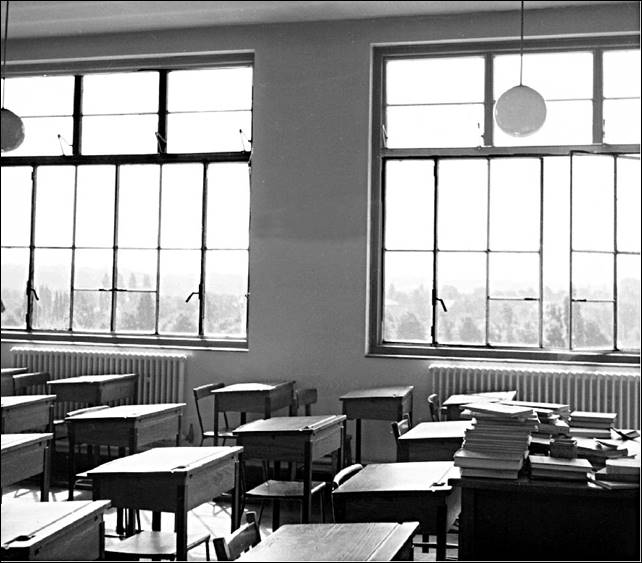
Room
149: Mr J.D. Copland’s room and my form
room in Remove C and History Division.
In both
years I sat by the radiator at the left:
very comforting in winter. Beyond
lies sylvan Edgbaston.
= = ii =
=
1952 was
the year of the school’s 400th anniversary. It was commemorated by the opening of the
chapel, with adjacent outdoor swimming pool, as a memorial to former pupils who
had been killed in the two world wars.
The chapel was a fine reconstruction, using the original stone, of the
splendid gothic upper corridor from the former school building in New Street. It had been designed by Charles Barry
(architect of the Houses of Parliament) but had been demolished in 1936, making
way for shops, offices and the cultural delights of the Odeon cinema. The memorial Chapel was to be used for early
morning Holy Communion on Tuesdays and for Evensong after school on
Fridays. Services were normally
conducted by the Chaplain, the Rev. F.J. Williams, who taught Classics and was
generally known to his pupils as “Stuffer”.
There was something especially atmospheric about attending Evensong at
dusk in the late autumn months, as mist gathered over the nearby playing
fields. The voluntary early Communion
service was followed by a splendid cooked breakfast in the Dining Hall. Often there was a guest celebrant, which is
how I once came to spend breakfast chatting with the Bishop of Birmingham.
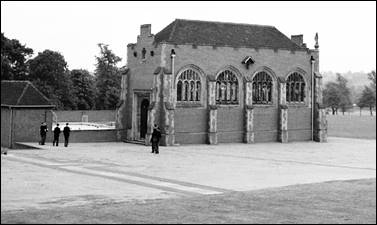
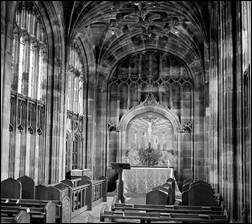
The Chapel, seen across the Parade
Ground, with the pool beyond, and the interior
The Swimming Pool, which was adjacent to the Chapel, had
attractive sandstone cloisters for changing, but was unheated in its early
years and thus had relatively little use.
I wanted to learn to swim, but, because of my general lack of
self-confidence and the short time available each year for lessons, even when I
reached the Sixth Form I had still not succeeded. We were only allowed in if the water
temperature reached 63°F, when swimming would take the place of gym
periods. Even in June, a cold night
might knock the temperature down below 63°. Conversely, one sometimes found that
swimming had unexpectedly replaced a gym lesson after a couple of mild days in
May. Lack of swimming trunks was no bar
to participation on such occasions, or, indeed, at other times such as a sunny
lunch-hour when an impromptu dip could be rather pleasant. Many boys equate excessive modesty with
vanity and so one participated happily on such occasions, unconcerned whether
outsiders should look over the wall.
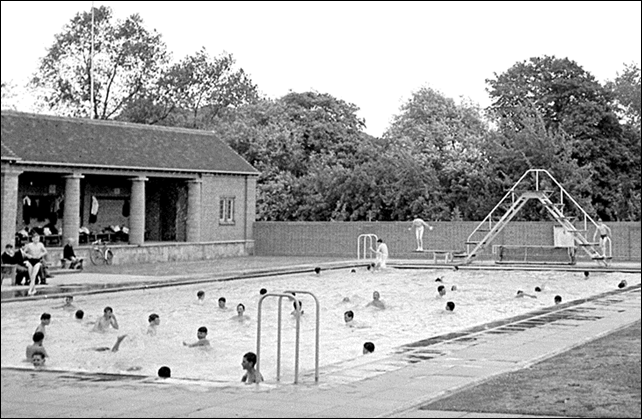
A Summer’s lunch hour at the Swimming
Pool, July 1959.
The boy on the spring board is one of
several present who did not let lack of suitable attire prevent him from
enjoying a cooling dip.
The Swimming Pool is an aspect of the school which features
amusingly in Jonathan Coe’s Rotter’ Club,
a fine novel based on life in 1970s Birmingham and especially at K.E.S., thinly
disguised as “King William’s”. Coe was
a former KES pupil in that decade. In the
tale, a well-endowed boy flaunts his impressive nude physique from the top
diving board where he is seen by passengers on the upper deck of a passing 62
bus. Several passengers contact the
Chief Master, mostly to complain, but one eager lady is keen to obtain the
boy’s telephone number. Sadly, the
truth, as so often, is less interesting;
passing buses are at least 200 yards away, so passengers wishing to
admire the school’s finest would need good binoculars and a steady hand.
The next
year took me to the Upper Middle with F.L. “Freddie” Kay as form-master,
followed by a year in the Fifth form with A.J. “Gozzo”
Gosling. “Freddie”, who taught English
and History, was unlike the general run of schoolmasters at K.E.S. He was short and ebullient to the point of
chirpiness. He was also a keen
motor-cyclist and would arrive at school heavily disguised in black leathers
with goggles, looking more like a despatch rider just in with news from El
Alamein. “Gozzo”
was, by contrast elegant and laconic with a neat but sarcastic school-masterly
turn of phrase. One of his lessons was
interrupted by a practical joke which misfired. Two boys, Payne and Rogers, had rigged up a
device with a ruler, elastic and string, which they meant to go off, making a
rat-tat-tat noise inside a desk, after the lesson had finished. Unfortunately it went off unaided while “Gozzo” was in full flow. He stopped, tapping his fingers
while the noise continued, his face growing steadily more flushed. When the noise eventually ceased he barked
that the whole form would be in detention the following Saturday, but the
perpetrators owned up and the rest of us escaped. [Addendum:
since writing the above, S.P. Tyrer, one of
twins in our year, has claimed responsibility for this modest outrage. I trust it is not libellous to say that it
would not have been entirely out of character for Payne and Rogers!]
There were other masters encountered
through these first four or five years, many of whom are easily remembered for
individual characteristics. G.C. Sacret (“Sacco”) taught Latin to younger boys. A big man, he had easily the loudest voice
in the school, heard to best effect across the South Field on a summer’s
afternoon when the windows were open.
He had memorable ways of emphasising points of Latin grammar. “A gerun-dive is
an adjec-tive which takes the subjunc-tive”; “didicissem? – iubet” (“did ‘e kiss ‘em? – you
bet” - though what that was supposed to illustrate I cannot remember). “Sacco” was generally of a cheerful and
sunny disposition and a splendid teacher for small boys, but if he were in a
bad mood he would draw a flagpole up the side of his blackboard with a red flag
at the top. This warned that anyone
who larked about did so at his peril.
As a housemaster, his stentorian voice was used to good effect on the
touchline to support the house team. An
early initiative by “Sacco” to encourage new boys to take an interest in their
surroundings was “hunt the motto”. Some
areas of the school had large skylights, incorporating Latin mottoes in a
pattern around the border. Sixpence
(2½p) was offered to the boy who could find Mens sano in corpore sano (a healthy mind in a healthy body). No one could, for that motto was very high
up in the skylight over the steps down to, appropriately, the Gym.
Latin was also taught by Tom
Freeman, known, presumably for alliterative reasons, as “Ferdy”. My encounter with him was during the time
when the Cartland Room was being built above the Classical corridor. The construction work involved a rope and
pulley system outside his window for hauling up building materials. To a bunch of fourteen-year-olds this was
inevitably of more interest than Caesar’s exploits in Gaul. “Ferdy” stopped
the lesson and made us all face left and solemnly watch the bucket going up and
down for five minutes until we were so bored with it we were glad to return to
our copies of Latin for Today, the
covers of which were often so cleverly amended to Eatin’ Pork Today.
“Jack” Hodges was the patient and
helpful master who ensured that I developed a basic understanding of
French. Many years later, his former
pupils were amazed to read Hodges’s obituary in which his remarkable military
service was summarised. He had had a
distinctly ‘exciting’ wartime career as Officer Commanding the 3rd
King’s Own Hussars, experiencing action at Ovieto in
Umbria and Monte Cassino as well in Egypt (after El
Alamein) and in Palestine. Few could
have guessed that this charming, self-effacing man had such a distinguished
military record, culminating in the award of the Military Cross. Other masters also had distinguished wartime
military careers, including Canon Lunt who was awarded M.C. for service with
the Parachute Regiment in the Western Desert in 1942. One of the Maths masters, Mr J.C. Roberts,
suffered appalling medical problems for several years having been a prisoner of
the Japanese and who had been numbered amongst those labouring on the Burma
Railway.
“Spike” Jackson was a charming and
kindly man, who took Holy Orders on retirement.
He was, however, sadly incapable of maintaining discipline in class and
his maths lessons could be turned into a shambles by a determined form of
troublemakers. On one occasion he
arrived to take a lesson to find that all the desks had been turned to face the
wrong way. By contrast, Mr W. Traynor (Physics) tolerated no trouble. A small man with gingerish
hair, he gained the nickname “Cocky”. As
Flight Lieutenant he led the R.A.F. section of the cadet force. They possessed a curious manned glider kit
which could be assembled and, in theory, launched for a few yards of flight
from a kind of catapult which seemed to rely mainly on elastic and brute
force. In practice it seldom left the
ground, but on one occasion the school magazine reported that the Officer
Commanding had succeeded in getting a few feet off the ground. The report added “He should not get too cocky over this flight in the trainer.” This was then thought to be quite daring.
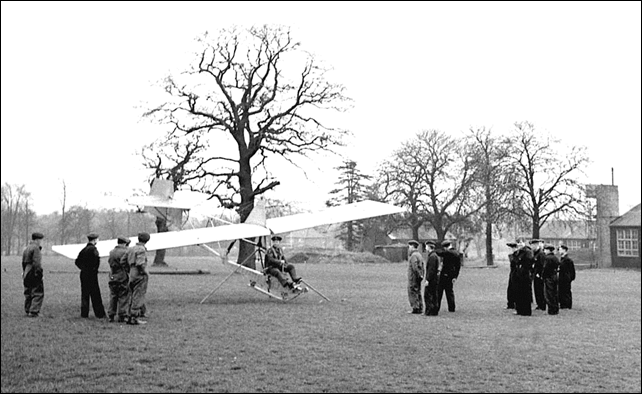
The CCF Glider on the South Field in March 1957
The Temporary Buildings, used while the new school was
under construction, are at the right
Other
members of the Science Department whom I encountered were Mr S.D. “Slasher”
Woods and Dr R.S. Allison. “Doc”
Allison was a forthright Lancastrian who once caught me pouring a small
quantity of acid into a test tube without having first measured it. “Dorn’t joost lob it in laddie” he shouted at me. The chemistry laboratory was the scene of my
greatest inadvertent attempt at mayhem.
I lit a Bunsen burner with a spill of paper, threw the paper away and
walked to the balance room down the corridor to weigh some chemicals. When I returned three minutes later everyone
was running round in chaos, the air was thick with smoke and all the windows
were all open. My spill of paper had
not been completely extinguished and had set fire to the contents of the waste
bin to quite spectacular effect! I
succeeded in having accepted my plea of not guilty to attempted arson.
The teaching staff was all male, but
there were three females on the premises.
Miss Chaffer was the long-serving chatelaine of the kitchens, and there
were two secretaries, of whom Miss Minshull was the
senior. For a short time there was an
extremely attractive assistant secretary called Wendy. She was about nineteen and was immediately
appropriated by Wilkins, the deputy School Captain, who thus became an object
of great envy by the rest of the older boys.
It was hardly surprising that Wendy did not remain long at K.E.S.: the pressures on her must have been
enormous! It would have been about the
same time that I was sweet on a rather pretty girl from the adjacent
school. Even though I occasionally sat
next to her on the ‘bus and spoke to her from time to time, I was far too shy
to mention such matters and she presumably remained forever ignorant of my
brief infatuation. It was often said by
opponents of single-sex schools that they encouraged relationships between boys
which were then deemed ‘unnatural’. I
recall no evidence in my day of any serious examples of such activity, although
there were some superficial and unsophisticated associations between individual
boys, discovering new bodily delights as they grew to maturity.
There was, of course, no formal sex education in those innocent
days and boys acquired an often garbled knowledge of the subject from their
contemporaries. I initially held out
against believing the information I gained in this way as the procedures in
question seemed to me utterly bizarre and quite absurd. One of my classmates who clearly had a
bright future in business acquired a pin-up magazine with some discreetly posed
black and white photographs of unclothed females, which he hired to his fellows
at two pence a go. He did a brisk trade
but I failed to take up the offer, whether through prudery or because I feared
a maternal audit of my pocket money expenditure I cannot now recall. But in the chaste atmosphere of the 1950s
such distractions were little more than a passing fad to naïve fourteen-year-old
boys who found sport or such popular hobbies as philately, train-spotting or
ornithology offered greater fulfilment in their everyday lives. Swearing too was far less evident in
conversation in the 1950s than was to be the case in later years. I had already encountered the ‘f…’ word when
about eleven years of age but dutifully followed the convention that it was
never to be used. But I remained
completely unaware of the existence of the ‘c…’ word until enlightened by a
form-mate when I was fourteen. I
remember asking him what it meant: his
reply was an indication of our innocence in those years: “Oh, it doesn’t mean anything” he said
airily, “it’s just a swear word”.
Music
was a feature of importance at the school, but with what would now be regarded
as a decidedly elitist approach. The
Director of Music was Dr Willis Grant who later left to become Professor of
Music at Bristol University. He was
especially interested in Church Music and extracted phenomenally high standards
from the Choir. He was supported in my
time by one of my Sixth Form contemporaries, J.W. Jordan, who became an Organ
Scholar at Cambridge and was to be Director of Music at Chelmsford Cathedral
while still in his twenties. Jordan was
a truly remarkable organist, accompanying morning prayers on most days. He could extemporise freely and on the
morning in 1957 that Sibelius’s death was announced his voluntary was a set of
improvisations on Finlandia. Another musical contemporary was David Munrow who became a performer and broadcaster of
international note before his tragic early suicide.
My own
contact with Willis Grant and his Music Department was negligible apart from
the weekly school hymn practice sessions, although he did once tell me to stop
whistling in the corridor: it was, he
quite correctly remarked, “antisocial”.
He showed relatively little obvious enthusiasm for music beyond his
specialist field, and displayed a strong disapproval of any form of popular
music. There were, however, occasional
concerts named after Julian Horner who had evidently bequeathed money to
promote music at the school. From time
to time afternoon school would be suspended and everyone directed to Big School
for a concert provided by an ensemble of “semi-professionals”. I enjoyed music but have to admit that the
baroque ensembles which seemed to provide the usual fare at Julian Horner
concerts did little to encourage my interest.
There was, however, one occasion when a group of singers, with piano
accompaniment, came to give a “potted” version of a Mozart opera. Excerpts would be sung and then one of the
characters, in costume, would come in front of the curtain to set the scene for
the next excerpt. But on one occasion,
after explaining what was to come, he could not find the gap in the curtain to
return to the stage. He chased
backwards and forwards in mounting panic, tugging vainly at the curtain to find
the gap. Clad in 18th
century wig, jacket and breeches, the poor man looked increasingly absurd as he
darted to and fro while his neck became redder and redder. Titters began in the audience and before
many seconds had passed the entire school was paralysed with laughter, the
masters joining in with great gusto.
Eventually, he found the gap and retreated to loud cheers. At the next break he prudently held the edge
of the curtain to ensure safe passage after his speech, and he departed to
great applause.
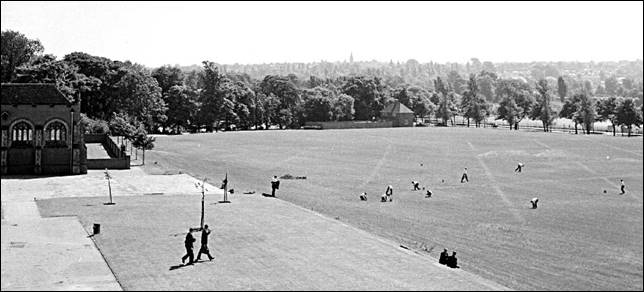
South Field from the Library, July 1959:
stone-picking in progress on new rugby pitches.
The Chapel is at the left.
Until I was about fourteen my
knowledge of classical music was negligible and confined mainly to a handful of
pieces used as incidental music on wireless or television. The impetus to broaden my knowledge came one
sunny Friday afternoon in May 1954, a few weeks before my 14th
birthday. It was half term weekend and
school had finished at lunchtime. Most
boys had gone home but I had arranged to meet my parents in the centre of
Birmingham late in the afternoon before driving to South Wales for the
weekend. To while away the time, I sat
reading in the sunshine on the South Field.
In school, another boy who had remained behind was practising the piano
and the sound was drifting through the open windows into the warm spring
air. He was a competent player, but
repeated the same magical theme several times.
I had no idea what it was but soon learned that it was the piano part of
the first movement of Grieg’s Piano Concerto.
I could understand why it was one of the most popular works in the
classical repertoire. This encouraged
me to listen to broadcast concerts where I was to discover a world of endless
delight and fascination. I also found
that several of my friends had a similar embryonic interest in classical music
and this led to interesting discussions during our leisure time which, in turn,
developed one’s interest still further.
Music is a delight which has remained with me ever since.
Pop
music, as known today, simply did not exist in the early 1950s and so it was
not difficult for Willis Grant to maintain the purity of classical music in the
school. In pop terms, neither the
market nor the product existed. Things
began to change later in the decade, especially under the influence of Bill
Haley’s “Rock around the Clock”. Cliff
Richard arrived on the scene and a phenomenon called ‘skiffle’
was introduced. By now Willis Grant had
moved on and his successor, Thomas Tunnard,
recognised that a more flexible attitude was appropriate. For a while a ‘skiffle
group’ was established in break, performing in the tuck shop. It was all very low-key by the standards of
later decades, but made a musical change from the break-time practice of the
cadet force band who only knew one tune, endlessly repeated over the
years. The skiffle
era coincided with the rising popularity of the Espresso Bar. One such establishment was El Sombrero in Bristol Street. It was popular with a group of rather
maverick boys who could be found there on half-days, capless
and smoking cigarettes. Eventually, the
Bar was placed out of bounds by Lunt.
Another place which neither boys nor staff were expected to patronise
was the Gun Barrels public house on Bristol Road. There is an apocryphal story that a boy and
a master met in the Gun Barrels on one occasion. Each is reputed to have said to the
other: “If you don’t split on me, I
won’t split on you.” Further up Bristol
Street from El Sombrero, on the
opposite side of the Horse Fair, was another
The school tuck shop was run by
Allard, the Head Porter. His
predecessor, Kelly, had ruled the shop in the days of sweet rationing. The only ‘sweets’ not on the ration when I
started at K.E.S. were very strong ‘Troach’ cough
sweets to which I became slightly addicted until rationing of other delights
was ended. Sweets were loose in those
days and paper bags very insubstantial.
Thus my mother regularly found in my blazer pockets a solid wedge of
sticky sweets, all covered in navy blue fluff, the paper bag having
disintegrated long ago. Allard was a
former policeman of substantial build and conducted himself accordingly. His chief assistant was Cradock, a bluff
individual with a sharp sense of humour, essential in his job. He had an artificial leg, which gave him a
characteristic gait, as he hurried on his business about the premises. When a new porter, Hewlett, started who,
like Allard, was a retired policeman, Cradock was heard to mutter “place gets more like a bloody police station
every day.”
In an era of military conscription
it was customary for most boys to join the cadet force in their third year, as
it would advance their chance of officer status in the forces. I was not keen (albeit for probably all the
wrong reasons) on the idea of “playing soldiers” and rather taken aback when my
parents supported me. They felt that
there were already too many other activities which tempted me away from those
studies with which I was experiencing difficulty. I thus joined a few dozen other boys as
“Remnants”, usually spending the afternoon doing Art, or, in later years,
revising.
When I started at K.E.S. I travelled
by tram, a means of transport to which I was then devoted. But after a year the trams with their solid
timber bodywork and brass fittings were replaced by ‘buses which I found bland
and lacking in character. I soon
transferred my interests to trains. On
half-days when there were no games my form-mate Marks and I, clad in school
caps and full length navy blue belted raincoats, would drop in at Snow Hill
station for an hour or two on the way home to collect steam engine
numbers. We usually waited until 4
o’clock when the Cambrian Coast Express came
through on its way from Aberystwyth to London, usually pulled by an immaculate
locomotive of the Great Western Railway’s Castle
class. After a year or so the
numerological fascination of engine-spotting withered away, but my interest
broadened to travelling by train to out-of-the-way places served by remote and
attractive branch lines, often unchanged since Queen Victoria’s heyday. Thus, on occasional Tuesday or Thursday
afternoons two or three like-minded sixth-formers might be found in delightful
west Midland market towns such as Bromyard and Much Wenlock where rail services
are now but a memory. I usually took a
camera on those expeditions, little knowing that some of the resulting
photographs would be published over fifty years later in books on railway
history. That interest in railways,
their history and operation, has remained with me throughout that time.
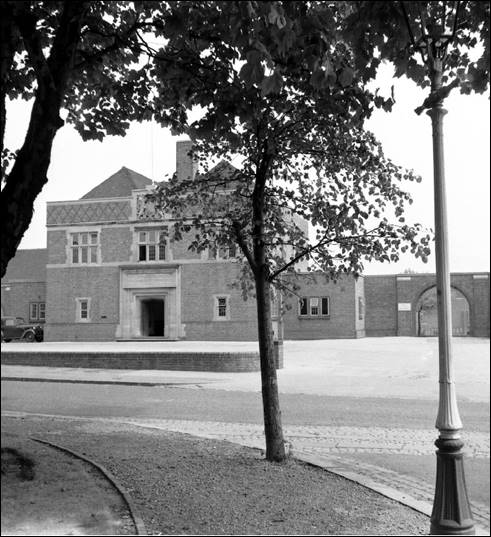
The entrance from
gas-lit Edgbaston Park Road, showing the Governors’ Offices.
= = iii =
=
The outside
world impinged on our lives at school to only a modest extent. Perhaps the greatest impact was that of the
Hungarian Revolution in 1956 when boys were encouraged to devise fund raising
ideas to support refugees. General
elections, won in 1951 by Winston Churchill and in 1955 by Anthony Eden,
provided brief excitement and boys with access to the not-very-portable radios
of the day found themselves in great demand.
The 1955 election coincided with subsidence by the left-hand gate as one
left school by the Main Drive. This
necessitated the temporary closure of the gate and replacement of the sign
urging one to keep left by one requiring motorists to “Keep Right”: a demand which then seemed to coincide with
the political allegiance of most (though certainly not all) the boys! The Suez crisis of 1956, however, brought
about more sophisticated political argument as heated exchanges raged over the
government’s intervention in Egypt.
On
Thursday, 3rd November 1955 H.M. The Queen and H.R.H. The Duke of Edinburgh
braved torrential rain to visit the school, belatedly to commemorate the 400th
anniversary of its foundation. An
exhibition of school activities was laid on for the edification of the Royal
party. One display related to the
School’s Meteorological Station which was my responsibility. I was required to stand alongside, ready to
enlighten the visitors. But school
plans required that the exhibition must be finished and all charts mounted on
display a few days in advance of the royal tour — i.e.,
before the end of October. In
consequence, the rain and temperature details for October were not included. On the big day, H.M., smiling serenely, was
escorted by the school’s Chief Master, honouring the display with the briefest
of glances. A few paces behind came the
Duke who halted and eyed the display up and down. Then came the awkward question: “Where are the figures for October?” A reply was stammered about lack of
time. The Duke swept on. The smart reply might have been “I will have
the figures sent round to the Palace this evening, Sir”, but such thoughts only occur after the
event! The royal visit concluded with a
visit to the school Chapel where the
choir appropriately sang William Byrd’s anthem “Make thy servant Elizabeth to
rejoice …”. While the royal party was
in the Chapel, members of the girls’ school, who had been standing dutifully in
the rain to line the royal route through the school grounds, spectacularly
stampeded through the waiting motorcade to take up new positions to watch the
royal party depart, causing the raising of a few eyebrows!
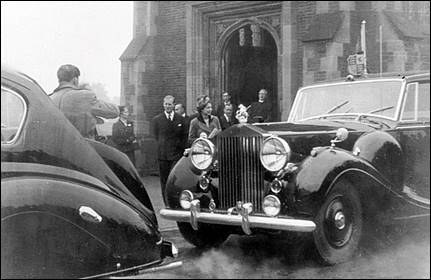
This photo, taken by my one-time school chum I.F.
Colquhoun who was waiting with other boys in the pouring rain, shows the Duke
of Edinburgh and the Queen leaving the Chapel, prior to their departure for
lunch with the Lord Mayor. The School
Chaplain, the Rev F.J. Williams is at the right of the group, in the Chapel
doorway. Note the exhaust fumes from
the leading vehicle in the motorcade!
As boys progressed up the school, so
they encountered different masters.
Older boys were taught Geography for ‘O’ and ‘A’ level by J.F. (“Uncle
Ben”) Benett, and by W.L. Whalley. The former was fairly volatile, striding to
and fro as he spoke. In the process, he
often caught his gown on his chair, with the result that the gown was slowly
but surely being torn to ribbons. Whalley appeared the gentler character but was no soft
touch. On one occasion in my ‘O’ level
course he was talking about grain production on the Canadian prairies,
supported by illustrations from a projector.
He showed a picture of a tall grain elevator alongside a river and asked
the form what we could see across the river.
Convinced of the genius of my wit, I shouted out, accurately but
unhelpfully, “A bridge”. The rest of
the form were kind enough to laugh moderately at my contribution but Whalley was less impressed:
“Darlaston - out” was his terse response, and so I spent the rest of the
period contemplating the architecture of the corridor. Echoing the words of Sir Isaiah Berlin, “Wal” would on such occasions describe teaching as “casting
sham pearls before real swine”.
My facetious answer was somewhat out
of character, as Geography was my best subject and so I was generally held in
reasonable favour by the masters. I
was, moreover, one of the team of weather observers who ran the school
meteorological station, supplying readings to the Meteorological Office, then part
of the Air Ministry. This entailed
someone attending the school every day, including Christmas Day. Entries had to be made in monthly returns
which stretched my modest mathematical abilities when it came to producing
figures for total rainfall and average maximum and minimum temperatures. I rose to the position of School
Meteorologist for my last two years, having the privilege of keeping the school
barograph during the holidays. This
gave me a fascination with these beautiful brass instruments which culminated
in the purchase of a barograph some forty years later, after my retirement.
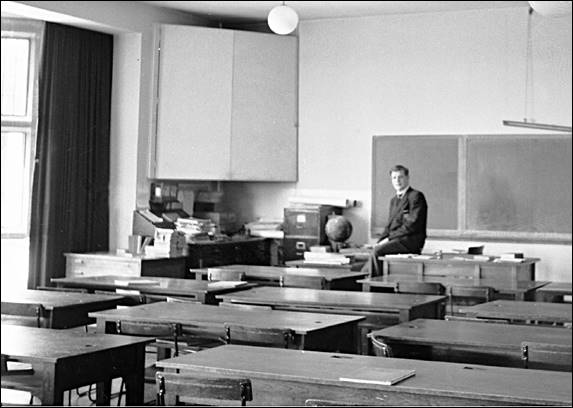
Geography Room ’A’: the
empire of Mr W.L.Whalley, but J.M.H. Parke seems to
have taken over for the moment! The
barograph can be discerned just below the folding projection screen
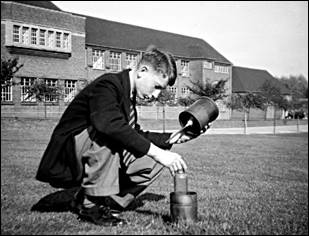
The School Weather
Station: the thermometer screen (left)
and Cartwright demonstrates the rain gauge!
(These photographs were taken for the display
mounted on the occasion of the visit by H.M. The Queen in 1955)
Mathematics was proving the weakest
of my subjects and it was becoming evident that unless something dramatic was
done I would fail my ‘O’ level. Credit
for remedying this position must be given to Mr G. Cooper. A quiet man of infinite patience, he
regularly sat down at an empty desk by me and explained things repeatedly until
I had understood them. I was always to
be grateful for his work in getting me through ‘O’ level, although some boys
had their suspicions about him as he used hand-cream after handling chalk!
After my third year games ceased to
be compulsory. This was, to me, a
welcome change after plodding round a Rugby field.
Cricket enjoyed a glorious reign in
my time at school – although, sadly, I made no contribution to that
success. Contemporaries at school
included O.S. Wheatley, who was to become captain of Glamorganshire Cricket Club,
and A.C. Smith who became captain of Warwickshire and an England Test Match
player. I liked cricket and, for once,
understood the rules of the game. My
enthusiasm was probably based largely on an aesthetic approach to the game,
which presumably accounts for my rapid loss of interest in professional cricket
in more recent times! With friends, I
made several visits to the County Ground at Edgbaston on school half days. One match to remember was the First Test
against the West Indies in 1957, where I witnessed the record partnership of
411 by May and Cowdrey. This was followed by the spectacular
collapse of the visitors (including Sobers) to 72 for 7 at the hands of Lock
and Laker, before the match ended in a draw.
But the simple fact is that I was no good at cricket. I could neither catch the ball, nor could I
synchronise the bat in such a way as to hit the thing. My recollections now of school cricket are
of long spells fielding in the hot sunshine while sucking Spangles or Refreshers. On one occasion, by pure chance, I made
a catch to dismiss the opposing team’s last batsman, thus securing my house’s
victory. So, just once in his career
Darlaston was chaired off the pitch by the rest of the team in traditional
style, but the action was somewhat ironic.
In some schools there is no doubt
that my general lack of interest in sport would have made me a marked man. But at K.E.S. there was a broad church of
pupils so that different attitudes and enthusiasms were happily accepted. The football cult that rules in other
quarters today was quite unknown.
Moreover, bullying, the bane of pupils at so many schools, was almost
totally non-existent and quieter boys or those with unusual interests were
happily accepted. Boys’ diverse
interests were well served by the wide range of societies which met after
school, often with interesting guest speakers.
Such societies included, inter
alia, Debating, Photography, Music, Railways, Drama and Archaeology,
although I did not participate in the activities of the last two and my
contribution to debates was minimal to say the least. In my last year I also joined the
Shakespeare Society which met to read plays on Saturday evenings in the relaxed
red leather comfort of the Cartland Room, where I like to think I contributed
near Gielgud qualities to such distinguished roles as Third Messenger and
Second Page.
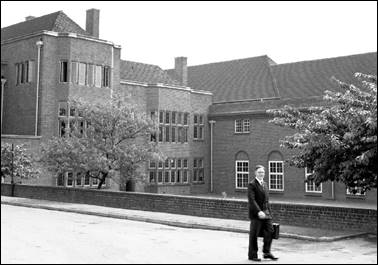
The
England Garden: B.R. Steventon
passes by
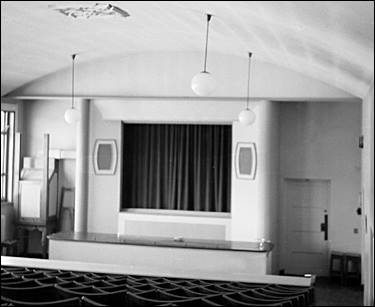
The
Ratcliff Theatre, complete with blue plush tip-up seats –
and a
fume cupboard at the left!
In 1956
I took my ‘O’ levels, gaining reasonable passes in Geography, Maths, Chemistry and
Physics, and just scraping through the rest of the subjects apart from
Art. It was assumed that I would choose
to do Physics, Maths and Geography, a popular combination at ‘A’ level. But, I found Physics and Maths
unrewarding. Literature and History
seemed more worthwhile and so I went into History Division to study History and
English along with Geography. Only one
other boy, Brown – known to all as D.G. to distinguish him from I.W. of that
ilk-, had chosen the same combination and the rest of the form did French
instead of Geography. This resulted in
the two of us having to do certain subjects in different groups from the main
body of the form. I was thus able unofficially
to drop the hated Gym altogether on the basis that one P.E. master thought I
was in the History and French set and the other thought I was in the Physics
and Maths set. At last I had escaped
from the torture of hanging like a trussed turkey from the wallbars,
or, worse, vainly trying to leap over the vaulting horse. The latter activity never seemed possible
without a pain-inducing collision, the suffering varying in intensity according
to the delicacy of the portion of my anatomy involved. To be fair, the usual Gym instructor, “Sam”
Cotter, was a genial man. More agile
than his short, barrel-like figure suggested, he usually stood still while
issuing orders, military-style, but occasionally surprised us by leaping into
action. He reluctantly accepted the
ineptitude of the unathletic with a resigned
tolerance.
I was taught English Literature for
‘A’ level by Mr A.J. “Tony” Trott and by K.G. Hall, a
young master, christened with the infinite wit of schoolboys as “Albert”. Tony Trott, who
was Head of the English Department, showed no false modesty and had an encyclopaedic
knowledge of literature. He responded
to a challenge by the form and identified correctly an obscure couplet from
Henry VI Part 3. A natty dresser, with
a taste for exotic shirts and ties, he was very much the aesthete. His moment of glory in the 1950s was
undoubtedly his starring role in the Common Room performance of Peter Ustinov’s
Romanoff and Juliet. Trott played the
indecisive president of an impoverished central European state being wooed by
Russia and the United States whose scheming ambassadors were played
respectively by Messrs Leeds and Hodges.
Some years later Trott achieved more permanent
fame by writing an excellent and entertaining history of the school. Nothing would stop Keith Hall talking. He seemed to know everyone of note in the
world of literature (“As Lord David Cecil told me over sherry…”). He would quote the opinions of unknown
American Professors of Anglo-Saxon literature, and never ceased to remind us
that he had studied Beowulf in the
original. (Didn’t all English
undergraduates at Oxford do so?) The
main problem was that he never seemed to mark or return essays we had handed
in. Although Hall was clearly highly
gifted, he was later to leave K.E.S. rather abruptly amidst a spate of
rumour. Another English master was
Peter Robbins, the England Rugby Football player. He had a disconcerting habit of doing his
exercises while lecturing, so that he would sit talking while raising and
lowering his legs, a heavy brief case being balanced on his feet.
I was now studying European History
with Charles Blount (who was to be my form master in History VI the following
year). He became a good friend in later
years. Studying with him gave a real
insight into the subject, with fascinating diversions into side issues. It was only appropriate that part of the
syllabus he covered included the Renaissance, for he was surely Renaissance
Man, knowledgeable on a host of topics both in the arts and science. Unlike many other masters, he was able
succinctly to explain a topic in a perfectly formed grammatical sentence,
comprising subject, verb and object, and without hesitation, repetition or
deviation. This skill may have been
aided by his successful career as an author of history textbooks.
In most forms throughout the school it was necessary for boys to
“give a talk” on a chosen subject once in the year. In my year in Charles’s form I chose to talk
on the music of Elgar. When he knew of
my topic, Charles expressed great interest and provided invaluable technical
help in preparing musical examples.
Thus, I made the first of many enjoyable visits to his home, on that
occasion to copy old 78 r.p.m. records onto tape to
provide illustrations for the talk.
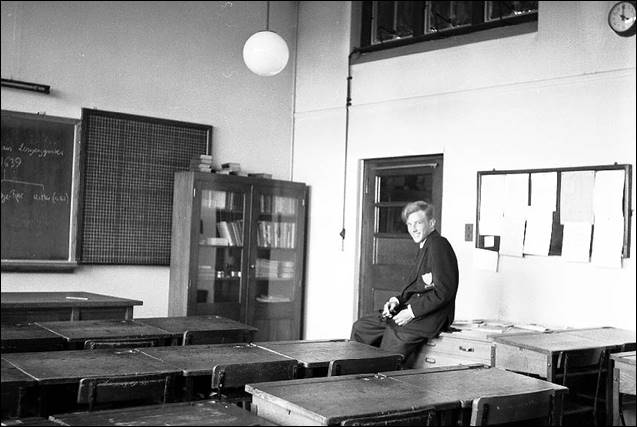
Room 174: Charles
Blount’s History VI form room: R. Molineux relaxes at
4 pm!
The blackboard
displays in Charles’s handwriting the family tree of the Leszczynskis,
a noble Polish family who occupied a variety of government posts in the 17th
century and ultimately provided a king (Stanislaus) and also a wife for Louis
XV of France..
Several good and lasting friends
were made in the Sixth form, and the use of surnames in addressing them began
to give way out of school to the initially daring use of Christian names. Such friends included Roger Guy (a
geographer and later to be my Best Man), with Jim Parke and Anthony Mills
amongst the historians. Bill Oddie and David Munrow were also
close contemporaries, but I did not keep up the friendship with them after
school days. Oddie
was a prefect and always immaculately turned out – quite unlike the image he
was later to adopt on television. In
addition to his interest in natural history, he was a competent artist, specializing
in cartoon posters for school events, and he had an enthusiastic interest in
jazz. Although Munrow
was a keen and successful practitioner of music, he showed few indications then
of the tremendous success he would achieve in his tragically short career as
performer, composer and B.B.C. ‘personality’.
In my last two years at the school I
was School Librarian, which also involved working closely with Charles
Blount. He had overall responsibility
for the library and my duties were to organise rotas of junior librarians and
ensure that the shelves and indices were kept in order and records of books
lent and returned were maintained. The
routine work thus involved was good experience for later years working in
banking. Acting as School Librarian
gave me very valuable privileges. I had
immediate access to all new books, but, best of all, I shared a small but
elegant office with Charles Blount which became my ‘study’. With carpet, damask curtains, desks and
green leather armchairs, and access to a vintage typewriter I had excellent
facilities for personal study in free periods.
During my two years in office there were a few other boys entitled to
share access to the Librarian’s Room.
We turned the room into a very homely base, even succeeding in making
toast on the electric fire, although on one bitter winter’s day it was
necessary to open the windows to let out the smoke from burnt toast before
Charles came back!
The
Library: Darlaston in action!
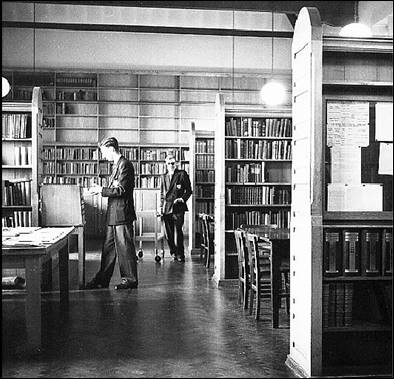
Darlaston at the card index while
Molineux, apparently in mafia guise, has him covered
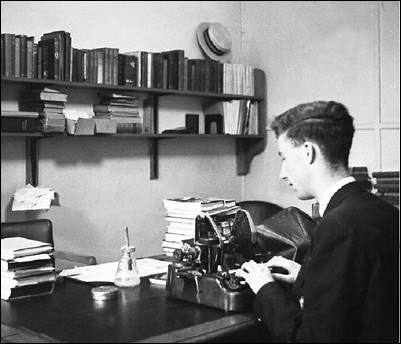
In the Librarian’s Room, with vintage
typewriter;
Note the book suppliers’ bills on the spike, Gloy for attaching book labels, and the inevitable boater.
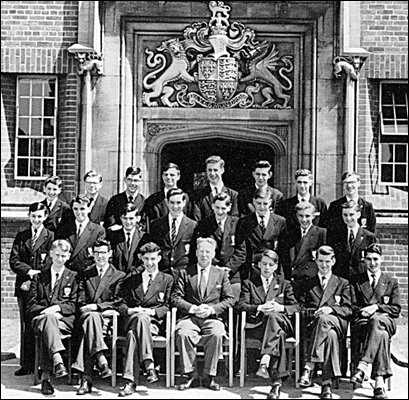
Librarians Line-up, 1958
(front row) Cartwright, Birch, Darlaston, Mr C.H.C. Blount,
Coombes, Walker, Bryant
(Photo by R.F.L.
Wilkins)
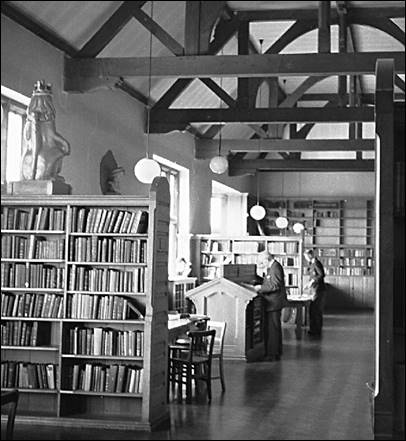
The Library: Mr J.D. Copland stands at the Heath Memorial Library desk
Note also the ‘Queen’s Beast’, carved
for the 1955 Royal Visit, and the bust of Edward VI
Saturday
mornings in the Sixth Form concluded with a lecture given by an outside
speaker. Many well-known and
entertaining people came – and some who were, to me, neither well known nor the
least bit entertaining. The most
enjoyable by far was the percussionist James Blades who assured us that
although he had provided the sound effect for the gong which opened J. Arthur
Rank films, the torso in the film sequence belonged to a mere actor. Less enjoyable was the gentleman from the
Amateur Athletics Association whose speech was like a Rolls Royce (almost
inaudible and seemingly capable of continuing for ever). He appeared set to keep going for the
afternoon, but was eventually interrupted by Lunt in characteristic
manner: “I’m afraid I shall have ter stop yer there, as parents
will have soufflés waiting on the luncheon table.”
Speakers on Sixth Form Speech Day at
the end of the summer term were more illustrious. Memorable visitors in the late 1950s
included Roy Jenkins, and Lord Denning who opened his speech by telling the
gathering that while he did not mind the audience looking at their watches when
he spoke, he would be hurt if they held them to their ears and shook them. After the formalities of Speech Day,
everyone adjourned to the playing fields for the annual cricket match between
the school and the old boys, with accompanying strawberry tea. This was essentially a social event where
mothers showed off their hats, fathers watched the cricket and boys tried not
to look too embarrassed by their parents.
The last day of the summer term
provided leavers with an opportunity for high spirits with no fear of reprisal
by authority. Most of the activities
were harmless fun, but a few involved minor vandalism or graffiti and thus
provoked official displeasure. Even
worse, it was not entirely unknown for young ladies from the girls’ school to
insinuate their way into proceedings.
The most entertaining episodes involved senior boys arriving in a
variety of eccentric means of transport.
In 1957 these included a ‘tandem’ for three, a pony and trap, and a
short convoy of disreputable cars with an escort provided by the U.S.
Army. This episode offended Canon
Lunt’s sense of dignity as he was at pains to ensure that nothing disrupted the
sacred end of term routine. This
culminated in the singing of “God be with you till we meet again” and the
rousing School Song, beginning “Where the iron heart of England throbs beneath
its sombre robe/Stands a school whose sons have made her great and famous round
the globe/Great and famous round the globe…”
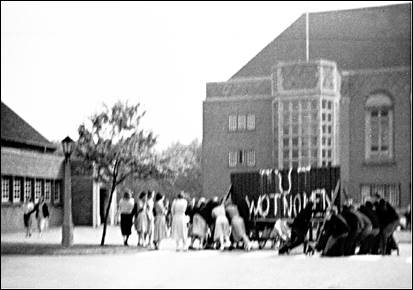
End of Term, Summer 1955: the girls of KEHS invade.
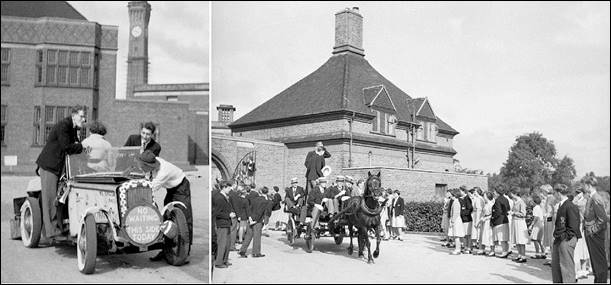
End of Term, Summer 1957
My ‘A’
level results in 1958 were, alas, disappointing and inadequate for university
entrance. I therefore stayed for an
extra year for another attempt, but it soon became clear that there would not
be a place for me at university. I
stayed to complete the year, retaking my ‘A’ levels, as by now a career in
banking was looming and better examination results would ensure a higher
starting salary. But to a large extent
the pressure on me during my last year at school was lifted. I had been at K.E.S. for almost eight years
and the experience had changed me from a child to someone equipped both to make
a contribution to life in the outside world, and to appreciate what the world
had to offer. Moreover, associating
with boys and masters of fine ability had taught me a great deal about
self-assurance. But above all, I had
been privileged to receive (in those days at no cost to the family) a first
rate education in a delightful environment with facilities and amenities of the
highest standard.
With examination pressures largely
removed, my last term at school remains in memory as one of elegant ease,
enhanced by one of the finest summers of the century. I sauntered to school wearing a boater and
occasionally with a rose in the buttonhole of my double-breasted blazer. I was lord of the library and enjoyed my
privileged use of the Librarian’s Room.
If not unwinding in the comfort of its armchairs, I could read in the
sunshine on the South Field or overlooking the swimming pool in the shade of
the Chapel – perhaps even occasionally joining others for an impromptu dip in
the pool. Occasionally, with friends,
one would take a relaxed afternoon stroll through the sunlit horse-chestnuts
and copper-beeches of Edgbaston, animatedly discussing music, or literature, or
the best trains to Much Wenlock. There
were still, of course, some lessons to attend.
One might have to dash off an essay on the domestic policy of Louis XIV
or the nobility of human nature evident in “King Lear”, but on the whole, life
seemed to be a sweet succession of free periods and sunshine. Cold reality would catch up with me before
long, but that enchanted summer of 1959 remains a grateful memory of another
world.
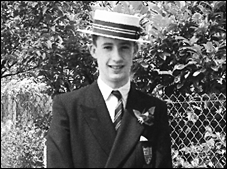 Darlaston with boater – and Rose in button-hole
Details from the School photograph taken in June 1959
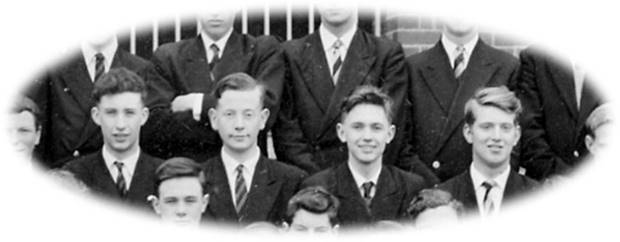
Four
Sixth-formers. Left to right: Darlaston,
Mills, Jordan, Walker
How well I remember this occasion when the four of us, good
friends, clambered onto the trestles set up for the photograph, chatting
amiably as we did so.
Mills became a solicitor in Manchester; Jordan became Director of Music at Chelmsford
Cathedral before moving to South Africa;
Walker became a Director at Manchester University.
Sadly, those three all died in the first two decades of the
21st century.
A reminder of the
glorious summer of 1959:
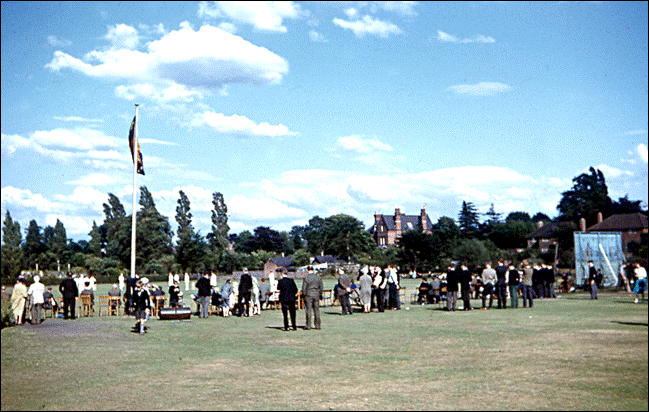
School v Old Edwardians, Eastern
Road, Speech Day July 1959
Part Three
Reflections on a
Banking Career:

Some Light-hearted
Incidents
1959 – 1997
BARCLAYS BANK
1959 - 1997
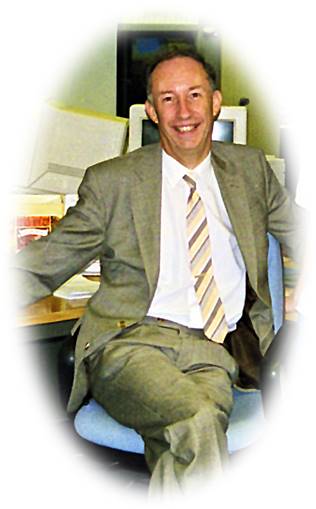
“The Manager”
(in relaxed mood!)
1 - The
Birmingham Years – 1959 - 1972
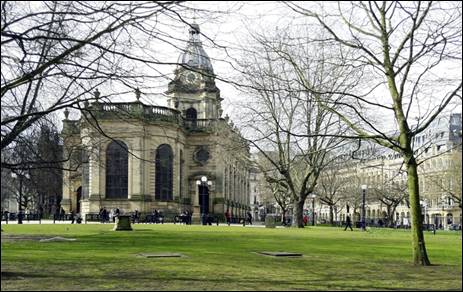
Colmore Row: the St Philip’s Cathedral with the bank
frontage at the right
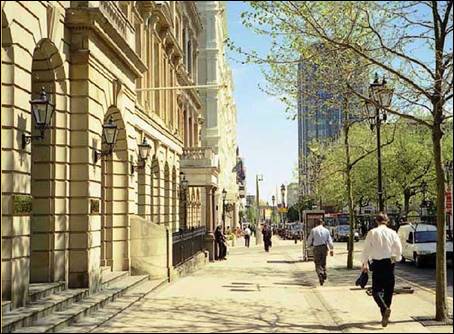
Colmore Row looking towards Snow Hill
station with Barclays at the left.
On Monday
7th September 1959, I joined the Trustee Department of Barclays Bank
(later, Barclays Bank Trust Company), in Colmore Row,
Birmingham at a salary of £350 p.a..
The Manager was Lt Cdr J.B. Dale, R.N. Ret’d,
a man whose mood could switch in a moment from great charm to seriously brusque
with more than a hint of naval discipline!
The bank occupied a rambling old building with a delightful view across
to St Philip’s Cathedral. It had
recently been refurbished and the staff assured me that I would have things
easy, as, following the recent introduction of central heating, there was no
longer any need for the male office junior to carry up coal to the office
fires. Hours were 9 a.m. to 5 p.m. on
Mondays to Fridays, and 9 a.m. to 12 noon on Saturdays with one Saturday in
four off. Over the years Saturday leave
increased to 1 in 3 and then 1 in 2, until, in July 1969 Saturday closure became
a reality. Holidays were two weeks and
one “travelling day” per annum. The
latter was intended for use on the Saturday prior to one’s main holiday, but in
practice could be taken at any reasonable time.
My initial duties were somewhat
puzzling as I was to be responsible for the waste. It was re-assuring to find that the work
involved neither litter collection nor plumbing. Nevertheless, writing on one sheet of paper all
debit entries and all credit entries and totalling them to produce the same answer to both columns was no
mean task for someone who had dropped Mathematics three years earlier amidst
scenes of great rejoicing by the school staff.
In those days, the office had no mechanical aids to arithmetic. There was one huge adding machine, probably
constructed by a firm which had built military tanks in the war and still had
parts left over; use of this machine was
strictly forbidden unless a paper list of items was absolutely essential.
The
office was divided into two groups, each with a team of administrators and
supporting staff to deal with the estates of deceased customers. Each group was supervised by its own Trust
Officer, a management appointment. Most
of my thirteen years at Birmingham were spent on ‘B’ group, then under the
control of Mr E.W.P. Grice. For several
years after I joined the Bank, Christian names were not acceptable when
addressing older staff and it was many years before I dared address Mr Grice as
‘Eric’. Staff were addressed by
surname, with the ladies being additionally awarded the courtesy of the prefix
‘Miss’ or ‘Mrs’, as appropriate. The
regular use of unadorned surnames amongst older male staff was still customary
into the mid-1960s. Memos to managers
at other branches would begin “Dear Jones”. Junior staff used Christian names amongst
themselves, usually in diminutive form, so, for the first time in my life, I
had to get used to being ‘Bob’ rather than ‘Robert’. I strongly disliked being called ‘Bob’ which
was, to me, a dog’s name, but as a mere teenager I felt it inadvisable to stand
on my dignity. I would have been happy
to continue simply being called ‘Darlaston’, having been known thus for almost
a decade by anyone who wasn’t family.
But I eventually came to accept being ‘Bob’ without responding “Woof”
when my name was called.
Protocol
was important when dealing with the management:
one of my junior colleagues once acknowledged an instruction from
the manager by saying “Right ho, Mr Dale.” He was quickly and tartly told that the
correct response was “Yes, sir.” He had
three ways of addressing me: for normal
business conversation I was ‘Darlaston’, if he needed a personal favour then I
was ‘Robert’, but if I was to be reprimanded for a shortcoming, then I was
‘MISTER Darlaston’. In his managerial
role he regularly toured his office firing questions at staff about progress
with cases. When the question had been
satisfactorily answered he would bark “Right, carry on” in best naval style
before continuing to the next individual.
The
management was entirely male in those days and the trust administrators
substantially so, but the clerical staff was largely female. Coming from a boys’ school I was largely
unfamiliar with the female of the species and, initially at any rate, rather
unimpressed. They stayed together in
chatty groups and were mostly cocooned in voluminous thick woolly jumpers, and
hairy tweed skirts, the ensemble generally completed by a full-length nylon
overall for which mauve was the most popular of a particularly bilious range of
colours. It was to be almost a year
before I conquered these initial disconcerting prejudices concerning the female
sex!
One young
lady whose presence helped me overcome those reservations was Vivienne Morgan,
a 15-year old girl who was transferred from Aberdare branch in Wales as her
father, who worked on the railway, had been moved in his work. Vivienne was a pretty little girl with an
attractive Welsh accent and a cheeky personality. She was the giggliest girl I ever recall encountering
and was for the short duration of her banking career in Birmingham a strong
distraction to the male staff. She
often wore skimpy low-cut blouses with a short flared skirt. On one occasion when so dressed, she leaned
back in her chair, as many folk do, but leaned too far. The chair tipped backwards with an enormous
crash and Vivienne was upended. Her
legs waved shamelessly and delightfully in the air. She clearly relished the experience (as did
I) and she didn’t hurry to remedy her position, giggling infectiously and so
affording good opportunity for all to survey the scene. In those days before tights, I was
interested to note that she wore stockings secured by pretty garters, something
quite new for the Darlaston gaze to feast upon.
Thereafter, I thought of her as
Polly Garter, the rather forward young lady in Dylan Thomas’s Under Milk Wood.
Mr Dale, known behind his back as
‘Dickie’, was almost certainly the most dynamic individual I ever encountered
in the bank. He was clearly regarded
very highly in the bank, as in the late 1960s he was taken from Trustee
Department and given the responsibility for setting up Barclaycard, the U.K.‘s
first credit card, also the first such card outside the United States, and a
major achievement both for him personally and for the bank.
My own career moved quickly, if less
spectacularly than that of Dickie.
After a few weeks grappling with the waste and writing out cheques (for others
to sign!) I graduated to hand-posting ledgers which were permanent
records. Neatness was always demanded,
though not always produced at times of high volume. After nearly a year I progressed to the
securities desk, a demanding role, involving listing investments in new
estates, safe custody of certificates, deeds and recent wills, buying and
selling stocks and shares through local stockbrokers, and correspondence with
company registrars. The scope for error
and consequent financial loss to the bank was huge and the task initially
rather daunting. After a few
weeks I discovered that I knew what I was doing (most of the time!) and I
started to enjoy the lively action, in particular dealing with the local
stockbrokers who were a friendly bunch.
The first few years of my career
were punctuated with periodic courses in London. The first was for three weeks starting
immediately after Christmas 1959. As I
was under 21 the bank boarded me with a bank family, the manager of Caterham
branch and his wife. I thus spent three
bitterly cold weeks commuting on the Southern Region between Caterham and
London Bridge, whence I walked across the bridge to the old Head Office
building in Lombard Street. In those
days,
Learning the vast range of skills
required for trust administration was very demanding and it was necessary to
study for the Institute of Bankers Trustee Diploma. This was no sinecure, including papers on
Law of Wills and Intestacy, Investment, Taxation, and Law of Real
Property. The latter proved an especial
bugbear, but eventually I achieved the Diploma in 1967. At this stage I reported to Eric Grice. With his bristling moustache, he brought a
clipped military approach to management when compared with the naval attitude
of Dickie Dale. He was a master of
using silence as a conversational gambit, occupying the time by filling his
pipe while one waited anxiously for his pronouncement. His silences, when combined with his
frequent use of the negative, could prove daunting to staff and customers
alike. A typical conversation might run
thus:
Customer: “Can you pay me
£1000 from the estate?”
E.W.P.G.: (after
long pause to fill pipe) “No.”
Customer: “Why not?”
E.W.P.G.: (after lengthy drawing on pipe) “Out
of the question”
Customer: “When will I
get some money?”
E.W.P.G.: (after
further pause attending to pipe) “Difficult
to say.”
And so the verbal fencing would continue. After the customer’s unhappy departure Eric
would grin broadly beneath his moustache:
“That’ll teach the bugger to come begging for money!”
My first trip
out of the office on business was to assist a colleague to gather information
following a testator’s death late in 1963.
Early on a cold December 27th we went to interview a widow,
with the unlikely name of Amelia Parrott.
This lady was elderly and trembly, with an all
too obvious liking for the bottle. Her
first action was to offer us a drink, and it appeared that the choice available
straight after Christmas was down to just brandy. I had never had brandy before, but decided
to give it a go. Mrs P. went in search
of glasses, but the best she could do for me was a wineglass which had lost the
foot from its stem. This she filled to
the brim. As I was supposed to be
taking notes I would need somewhere to rest this eccentric glass – so I was
given an old jam jar in which to stand it.
I gradually developed a taste for brandy – which was just as well, as
Mrs Parrott refilled my glass as soon as the level dropped slightly. Eventually, the meeting concluded and we
walked uncertainly to my colleague’s house half a mile away, where we sobered
up slowly before returning by train to the office late in the afternoon.
During the nine years in which I
dealt with trust administration in Birmingham I handled a very wide range of
estates and met a variety of individuals as beneficiaries. Strange names remain in mind: the lady Christened Fanny Evangeline, the
sisters Hattie, Mattie and Iseult, and the popularity (long ago) of William Ewart Gladstone as Christian names. There were the strange bequests such as “my
ferrets equally between…” – happily it was not necessary to divide a
ferret! Some families fell out over the
terms of a will: one brother and sister
quarrelled over who was to take their father’s lawn mower. Other families became quite close friends
for a time, including a one who had a chain-making business in Cradley Heath which supplied anchor chains to the R.N.L.I.,
but who moved to a farm in Dorset when it finally became necessary to close the
business.
Another connection with a
traditional local industry involved control of a Birmingham jewellery
manufacturer from whom I was able to purchase Barbara’s engagement and wedding
rings. There was involvement too with
the copper trade, coal merchants, a grubby back-street pub called the
“Oddfellows Arms”, and, memorably, with a local chain of butcher’s shops. These were to pass to the son on his 21st
birthday but his inclinations lay elsewhere.
Despite being apprenticed to the trade, he defected, first to be a
ladies hairdresser, and subsequently to be a ballroom dancing instructor. He regularly telephoned to ask for
money: one knew he was on the line
before he spoke as quick tempo dance music was to be heard immediately one
picked up the telephone. His mother
regularly appeared in the office, demanding money with menaces backed up by an
ample frame squeezed into a colourful frock, wearing enormous diamante
earrings, and with an overpowering smell of cheap perfume.
Not all beneficiaries were
friendly. One who was a thorn in the
flesh was a Mrs S who lived in York.
She had some very hostile correspondence with the Assistant Manager of
the office, Alfred Took. Now it was one
of his jobs to review the carbon copies of all letters leaving the office, but
on the day after they had been
sent. Eventually, Took was promoted to
be Manager of the branch in York, and so a letter was typed to Mrs S giving her
this information and telling her that any time she had any queries or problems
to discuss (which was all the time!) she was welcome to drop in on Mr
Took. The top copy was duly destroyed
but the carbon was left in the filing.
It was a somewhat distraught Alfred Took who came rushing into the
administrators’ room to demand whose silly idea this was. Another obnoxious pair were brothers who
were let out of
I was introduced to the complexity
of human relationships by a case which called for delicate handling. The testator was a man whose work took him
away from home during the week, and he returned to his
wife each weekend. After his death the
widow was horrified to find his will left her a life interest only in one half
of the estate, with the other half held for the benefit of a hitherto unknown
lady in North Wales. After their
respective deaths the whole capital was to pass to the children of the Welsh
lady – of whom the testator was the father.
In an era of traditional morality such circumstances were a cause of
much excitement, but great care was necessary in dealing with the two ladies!
A widow living in Knowle asked me to visit her to discuss her husband’s
estate. She wanted to deal with a
property in a manner not permitted by the will, so I politely refused to
cooperate. By the time I had returned
to the office, she had telephoned the Manager to complain. I was, she said, “nice, but
ineffective”. It sounds like an
epitaph!
Mention must be
made of the two Bank Messengers who served the office. Fred Trubridge was
a large and loud ex Royal Marine whose main aim in life was to drink tea and
regale anyone in earshot with his service stories, described in colourful
language. Trubridge
wore a navy blue belted raincoat and a huge Bowler hat, necessary to cover his
generous cranium. It was regularly
donned in his absence by my contemporary Roger Guy and by me for general
amusement as it covered both ears and also one’s nose! When not in use, the Bowler hung on hook in
the Gents. One of the most bizarre
sights was Roger wearing it whilst standing at the urinal, singing “My old
man’s a dustman, he wears a dustman’s hat…”
The hat came down well below the eyes and one hoped Roger could see
where he was pointing. Trubridge was succeeded by Tom Wilks, a small industrious
ex-military man, with a turn of language even more salty than his predecessor
when in conversation with male staff members.
Every noun was preceded by an unprintable adjective, even if he was
quoting alleged instructions by the manager’s somewhat matronly secretary,
Muriel Harman, always addressed as ‘Miss Harman’ but generally referred to
behind her back as ‘Mu’ or ‘Moo’, depending on whether the speaker was on good
terms or not.
In 1970 the office moved from the
front of the building in Colmore Row to the side in
Church Street. We thus lost our
splendid view of Birmingham Cathedral and instead looked out onto the side of
the Grand Hotel. This had its
compensations for the male members of staff, when some of the bedrooms across
the street were used as changing rooms by models putting on fashion displays of
lingerie and swimwear!
Meanwhile, in September 1969, I had
been appointed Trust Officer, at the then generous salary of £2015 p.a., the
youngest person so appointed in the whole of the newly formed Trust
Company. There now began one of the two
happiest periods of my career. I had
been dealing with trust administration long enough to feel confident in the job
(although there is always something new to learn). I got on well with the new Manager, John
Raby, as well as with the staff as a whole and the group ran well and generally
happily. I was also fortunate in
enjoying excellent relations with many customers and professional contacts
(e.g., solicitors, stockbrokers and estate agents) which resulted in lunch
dates and enjoyable socialising at Christmas.
Life, however, moves on. The
Bank decided that I should be moved to its office in Princes Street, Ipswich. After thirteen years in Colmore
Row it was to be a wrench moving on, but I had been appointed Trust Controller
at Ipswich starting on 13th August 1972 and the promotion was a fine
career move.
2 -
South to Suffolk: Ipswich
Interlude 1972 – 1974
In my East Anglian
contacts I became aware that there was often a noticeable suspicion of one
whose origins lay outside Suffolk.
Nevertheless, there were aspects of my stay in Suffolk which were highly
enjoyable. Once or twice each week I
would be out of the office on business.
Such trips in Birmingham had seldom taken me beyond the suburbs, but
distances from Ipswich were such that I would often combine two or three visits
in a particular area on the same day, not visiting the office at all. On such occasions Barbara would accompany me,
strolling around the town or village while I interviewed a customer. In addition to visits to attractive Suffolk
destinations, including Lavenham and Long Melford with their half-timbered properties, or Southwold and Aldeburgh on the coast, there were trips over
the border into Essex, including classy Frinton, and
to Mersea Island where a tide table was necessary as
the road vanished under water at high tide.
Gradually, I
found I was getting acquainted with Suffolk.
The event which perhaps most impressed the staff was certainly
strange. The beneficiary of one estate
was a decidedly eccentric woman, who spent periods in an asylum. She had a habit of visiting the office
unannounced, and once she had got inside the office no one seemed able to get
rid of her. The first time she came to
visit me, she was shown into my office and I took her coat and gave her a
seat. She claimed that she had evidence
that someone was embezzling the Royal funds at Buckingham Palace. After a short discussion, I thanked her for
the information, promised to get onto the Palace straight away, and held up her
coat for her to put on, a trick I had seen John Raby use when he had had enough
of an interview. Like a lamb, she put
on her coat and left. It was the
shortest time anyone had known her to be in the office, and my technique was
for a time the talk of the staff!
Meanwhile, the
bank had plans for centralising certain functions and had acquired Radbroke Hall in Cheshire where some activities were to be
concentrated. A year to the day after
moving into our Suffolk house I was asked to move to Central Administration
Office at Radbroke Hall, so, after less than eighteen
months, the interval in Suffolk was abruptly and prematurely over.
3 –
North to Cheshire: Radbroke
Hall: 1974 - 1987
Central
Administration Office was in ‘Block 8’, one of nine 1940s vintage blocks built
under government auspices when Radbroke Hall had been
occupied by the Nuclear Power Group.
Needless to say, the French chateau-style hall itself was occupied only
by the upper echelons of management.
Around the Hall were some twenty acres of grounds with a wide range of
sports facilities including tennis courts, a putting green and a croquet lawn
as well as attractive rose gardens and areas given over to a large variety of
rhododendrons. There was also a bar.
The Chief
Manager, R.O. Smith (usually referred to in his absence as Ronnie, or as R.O.)
made a magnificent job in setting up the complex structure of the new
office. He had, however, an
enthusiastic adherence to rules and procedure which was not always shared by
the rest of the staff. All letters were
to be signed by the manager controlling the group regardless of who dictated
them. This required a quick response
when the recipient of a letter telephoned next morning to discuss it, expecting
the signatory to have a full, in-depth knowledge of the matter. Special rules applied when decisions were
called for which were beyond the discretionary limits allocated to the Trust
Controller. Each successive tier of
management had its own limit and full documentation was to be passed up for
authorisation at the appropriate level.
The highest levels were reserved to R.O. Smith himself and to Head
Office. This somewhat military
procedure could take several days, while, perhaps, a beneficiary would be
waiting for a reply to his request for an advance. It contrasted with the approach at Ipswich
where I was often the only member of management in the office and so reached my
own decision which would be retrospectively agreed by the Manager if required!
Staff hard at work:
Karen, Doug Couling (then with inevitable
cigarette), Jean, Sarah, Diane
A minor example
of R.O. Smith’s heavy-handed style of management arose when one of my
administration team, Jim Bottomley, made an afternoon trip to the dentist. Jim returned to the office to find there was
no parking space available in which to leave his VW ‘Beetle’. He, therefore, parked in a “Visitor’s”
space, in clear contravention of an R.O. Smith edict. When R.O. noticed the transgression he
immediately circulated the entire office to demand who owned the offending
car. Jim, who would have owned up like
a lamb, must have been in the loo at the moment the question was asked, as, to
R.O.’s fury, no one owned up. To pin down
the miscreant, he therefore parked his own car adjacent to and almost touching
one side of Jim’s car and ordered Les Knight to park his car in a similar style
on the other side. R.O. then sat back
to wait for the offender to come once 5 o’clock passed. But he had reckoned without Jim’s
transparent innocence. Jim emerged from
the office, looked at the cars and thought how inconsiderate some motorists
were when it came to parking. Being as
thin as a lath he was able to squeeze between the cars and to take advantage of
the ‘Beetle’s’ old fashioned running board which enabled him to open the door a
crack, to post himself inside, and to drive off, leaving R.O. to wait, … and
wait … and wait.
Another member
of my team, Colin Soden, pinned on the office notice board
a montage from three Financial Times headlines (which had originally referred
to terrorism in Rhodesia as well as financial dealings in the City). It read:
Smith hangs eight Trust
Controllers
R.O. Smith entered into the spirit by adding his own footnote :
“…and justice was seen to
be done”
Initially, the
administration staff of the office comprised trained personnel transferred from
other offices of the Trust Company.
Junior staff were all recruited locally by R.O.. New entrants were almost entirely female and
it was widely held that they were selected chiefly on account of their
looks. Certainly, in the days of
mini-skirts and flimsy blouses the office was a delightful environment in which
to work, even if it could at times be difficult to concentrate on the more
mundane aspects of work as a succession of goddesses wafted past one’s
desk. It should be added that the girls
also worked extremely well and without any of the petty backbiting which had
often been evident in my years at Birmingham.
There were a few male entrants, but by and large (and with only a couple
of exceptions) they were a poor lot, showing up badly when compared with the
girls, and mostly they left after a short time to pursue such careers as
car-salesmen.
Feminine attractions
were not lost on my colleague Doug Couling, who
shared my delight at the presence of pretty girls on our group. This led me into trouble one icy winter’s
morning when I commented quietly to him that Cindy, a young lady whose
skin-tight jumper emphasised every detail of an eye-catching figure, appeared
to be “feeling the cold today”. Doug
did not catch what I said and asked me to repeat it. Foolishly, I did so, a little louder. Several of the girls overheard the remark
this time, and promptly fell about laughing.
Darlaston wasn’t to be allowed to forget this indiscretion. So, when the time came for me to leave the
group, in the course of an evening’s general mayhem and hilarity I was duly
presented with a “custard pie” in satisfaction of the debt I owed! The staff also arranged to inflict on me
(during working hours) a ‘kissagram’ who arrived in
the disguise of a disenchanted trust beneficiary.
Mayhem at Christmas 1984:
1: Thanks
from a grateful ‘customer’! (photo ©
J. Worrall)
Darlaston seems to be
enjoying some unexpected attention!
2: Diane and Sarah offer encouragement
3: Darlaston’s Gorgeous Harem; Christmas 1984
In relaxed attitude with
Karen, Sarah A., Diane, Sarah W., and Elaine.
4. The “demure and innocent” Lindsay looks on as
Darlaston pays
the price for his momentary indiscretion.
Inset: The lovely Cindy who set off the chain of
events (photo © Colin Soden)
The typing
system at Radbroke Hall was quite different from any
in my previous experience. Typists no
longer came to your desk to take dictation;
one did not even hand a cassette tape to a girl. Instead one dictated over the telephone to a
machine in another building, the typist removing the tape to type the letters
which were sent back to one by internal delivery. The system was efficient, but lacking in
personal contact. This probably
contributed to an increased howler rate as these memorable examples show:-
“We
are investing the money wildly” (instead of widely)
“Crude”
instead of accrued “income”
“short
comedian turn” (instead of short to
medium term)
“we
wish to construct a solicitor” (instead
of instruct)
“Please
repair a Deed of Appointment” (instead of prepare)
“Fat
Fee” (a heading in a letter to a solicitor, instead of Flat Three)
“Sweet
Sixteen” in an address, instead of Suite Sixteen)
My first
business trip out from Radbroke Hall was with a
colleague, Bill Cowmeadow, to meet Mrs A**** and her
family in the north of England. Her
husband had died young and left the house in trust for Mrs A for life and
thereafter to their five children. Mrs
A wanted to move house and had gathered the children, then aged from about 23
down to 16, in order to discuss the matter.
It was not long before Bill and I could see that in making an early
departure from this life, Mr A had made a wise decision. We were all wedged in a small room, with
Bill and me facing each other across the family circle. The discussion started quietly, but the
excitement level soon rose in crescendo.
Unanimity was lacking to the extent that there seemed to be a different
opinion for each participant. With
hindsight, I should have said to Bill “Let’s go and look at the flowers in the
garden: we shall return when you have all agreed want you want to do.” But as the aggression level rose, so we
found the ‘discussion’ developed a hypnotic fascination. Daughter called mother a “silly booger”,
brother called sister a “stupid sod”.
Eventually the storm blew itself out, and I was able to suggest some
compromise which, in the end, seemed acceptable to all. But it had certainly been a wonderful study
of ‘happy families’ in action. The
eldest daughter seemed a friendlier person than her siblings and she lived
alone at a cottage in Anglesey. She
often telephoned me to invite me over, saying she would put on lunch and we
could discuss the trust, adding that the cottage was by the sea with access to
a secluded beach. There was really
nothing to discuss so I could see no valid reason to accept the invitation –
but I often think I might have missed an interesting afternoon.
One visit to
Manchester produced a surprise when I was propositioned by a prostitute in
Oxford Road at four o’clock in the afternoon.
She asked if I “would like some fun with me and me
friend”, but I seem to recall apologising to her that I had a train to
catch. She was scarcely an attractive
advertisement for her profession, being clad in scruffy jeans and T-shirt with
a denim bomber jacket. I would rather
have taken a vow of eternal celibacy than spend a moment in intimate contact
with her. In retrospect I found the
encounter quite hilarious, which is more than can be said for the occasion when
I was in my late teens and was propositioned by a young soldier in the ‘Gents’
on Bridgend station in South Wales. I
fled in alarmed haste (no, I didn’t stop to wash my hands) and hurried to hide
in the crowds waiting for the train.
That encounter did, however, give me much sympathy with blameless young
women who get unwanted attention from men.
During my years
in the bank I dealt with many Jewish customers. Most were no different from any other
customer; but a few had that special
Jewish sense of humour, and one in particular seemed to have modelled himself
on the prototype music hall Jewish comedian.
He used to ring me regularly and I quickly learnt to recognise his
querulous central European accent.
Initially he was always in a hurry:
“Mr Darlaston – can you ring me back? – I’m in a payphone and I’ve got
no change.” After this had been going
on for some months, I said to him, sympathetically, “It must be very
inconvenient for you, having to go out to a call box when you need a telephone.” His reply:
“Oh no, it’s not a public phone – I have a payphone in my hall.” He had an unusual technical estate planning
problem in which he tried to involve us, but which was, happily, not the Bank’s
business. He had married under Jewish
law but this was not recognised under Christian practice. He thus discovered to his horror that the
Inheritance Tax exemption on funds passing to a widow would not apply on his
death, as his widow would not be recognised as such by the Inland Revenue. The amount of tax at
stake was significant and so he was bombarding his M.P. on the unfairness of
this rule. His M.P. was none other than
Margaret Thatcher, then Prime Minister.
R.O. Smith
retired in 1979 and was succeeded by Geoffrey Gardiner, M.A. (Cantab), who had a keen interest in economics and business
practice. Like me, he had started in
Birmingham where he had attended the same school as me. He had moved on later to spells in Head
Office and as Manager of Cambridge office.
After the rigid and inflexible policies pursued by his predecessors,
Geoffrey brought a complete change of direction. When R.O. Smith was asked to exercise
discretionary powers under a will the first answer was invariably ‘no’. Later, under pressure from beneficiaries he
might concede, but only with full indemnities from the parties concerned. When asked to agree a release from a case,
soon after his arrival, Geoffrey surprised everyone by looking at the papers
and saying “I see no point in continuing with this trust: it has outlived its purpose. I suggest you offer them the lot.” With Geoffrey’s encouragement, in 1982 I
referred some anomalies regarding taxation of trusts to the local M.P., Jock
Bruce-Gardyne, which led to an interesting meeting
over lunch. There was lively and
fascinating discussion, but the wiles of H.M. Treasury were not to be
undermined by mere logic.
A popular
diversion for winter lunch hours was the “Brain of Radbroke”
general knowledge competition. The quiz
comprised team rounds, individual questions and a ‘buzzer-round’ where speed
was of the essence. Sections of the
various offices at Radbroke would enter teams of
four, usually under a pseudonym. My
group entered a team on a number of occasions, and in 1980, under the title of
“The Carbolic Smoke Ball Company” (recalling the name of the defendant in a
case well known to all legal students) we won the competition. I joined a team comprising Doug Couling, and Colin and Brenda Soden. It was an undeniable achievement for us to
win the final, after eliminating teams drawn from the many departments at Radbroke, especially as the teams entered by the sections
dealing with the bank’s computers included some very high-flying university
graduates. Winning the competition gave
us a moment of glory, followed by a year of agony, as the prize was a bottle of
champagne plus the job of running the following year’s competition, including
setting a total of 1500 questions! Much
effort was put into compiling questions that provided a balance of general
knowledge, history, the arts, elementary science, and sport. The burden was eased a little by including a
current affairs round which could be compiled quickly the night before by
reference to the television news. We
tried to lighten the atmosphere with mildly humorous questions and occasional
traps, but it was always necessary to ensure a balance between sides. The occasional wicked juxtaposition of
apparently non-related questions introduced some elements of fun, sometimes
bringing the house down, as when a question about a well-endowed lady Wimbledon
player was followed by an ornithological question to which the correct answer
was “Great Tits”. I usually seemed to
act as question master, relishing my moment of power. I persuaded Cindy to keep the score as I
knew that any awkward squad contestants would succumb to her undeniable charms
and refrain from querying the result.
The operation was on the whole good fun, but I was rather relieved when
my second career, as a Robert Robinson / Bamber
Gascoigne substitute, finished.
Brain of Radbroke Winners, 1980:
Doug Couling, Brenda and Colin Soden, RHD
In January 1985
I was promoted to Manager responsible for three separate groups. The promotion and status were welcome, and I
was nominally responsible for over 40 staff administering 4000 trusts. One of my responsibilities was to read all
the incoming post before giving it to the groups, but it was only necessary to
follow up items which seemed to cause (or have the potential to cause)
problems. This task was occasionally
enlivened by the unexpected, as when a retired naval officer wrote that he
wished in future to be known as Daphne X instead of Digby X as he had
“undergone a programme of gender re-assignment”. Such was the unique quality of that request
in the 1980s that I had to read the letter twice before I absorbed its
import! Some of the requests for the
bank to exercise its discretion as trustee in order to make payments to a
beneficiary were clearly inappropriate.
One wealthy family demanded that I agree to exhaust their son’s small
legacy fund in order to meet his school fees.
I refused, explaining the factors a trustee should consider before
making such a payment. The family
complained in very strong terms to the financial editor of The Times about the bank’s attitude: I was delighted to find that the newspaper
totally vindicated my stance. The
management at Head Office was also pleased, as it was not often that a
newspaper would miss an opportunity to criticise a bank. From time to time litigation would arise in
a case. Often this would be
non-contentious, arising because of a wish by a family to vary the terms of a
trust, but requiring application to the Court under the terms of the Variation
of Trusts Act 1958. An appearance at
the High Court in London would be necessary, preceded by meetings with Counsel
in Chambers in Lincoln’s Inn or New Inn.
Such occasions were endlessly fascinating, and I was always impressed firstly
by the gothic architecture of the Courts, but especially by the sharpness of
Counsels’ minds, which contrasted with the Dickensian atmosphere of their
Chambers, lined with leather-bound Law Reports dating back over a century.
An odd (and
very boring) aspect of my role as manager was checking the output of the
computers. In 1977 the routine book
keeping had been computerised. The
computers in question were primitive by modern standards and comprised a number
of machines, each the size of a piano, fed with discs about 18” in diameter and
2” thick. They produced long rolls of
paper listing all the programs run during the day, and it fell to me to check
these hieroglyphics to ensure that no improper programs had been run. I never found a mistake, whether because
there were none, or because I missed them through sheer boredom I cannot
say.
4 – Gadbrook Park:
Decline and Fall: 1987 - 1997
For some years
the office had been known as Central Trust Office, abbreviated to CTO. This caused confusion with the Inland
Revenue’s Capital Taxes Office so a new name was sought. I achieved a temporary glory by suggesting
“Trust Management Office” , which was at least an accurate description, and
that was the name which was to be used until the mid-1990s. In addition to a name change there was a
move of location. The staff who
occupied the nine other blocks at Radbroke Hall were
largely employed in the bank’s ever-growing computer activities. Eventually they decided to expand into Block
8 and so we were evicted. We were moved
to a building at a site with a confusingly similar name, Gadbrook
Park, on the outskirts of Northwich.
Gone were the lunch time walks past the croquet lawn to the Rose
Gardens: instead we had a pleasant view
one way over fields to Davenham Church and a less
pleasant view the other way to Roberts’s Bakery. A Head Office dignitary visited the new
premises on opening and chanced to ask me how it had affected my travelling. I told him, truthfully, but with tongue in
cheek, that it had virtually doubled my journey time. He looked shocked. I added that a journey which formerly took
me eight minutes now took fifteen! The
move was overseen with splendid thoroughness by a Manager, Werner Dengler-Harles, who had settled in England after serving in
the post-war Luftwaffe. In dress and
manners he was in many ways more anglicised than the English, but retained a
Teutonic thoroughness in his work which was seen to best effect on occasions
such as the office move. The move, in
October 1987, coincided with severe gales in the south, which caused extensive
damage to trust properties, and with a major stock market collapse. We were thus inundated with telephone calls
at a time when all our files were in crates in course of transit.
There was still
fun to be had on occasions. Peter
Hopkin, an Assistant Manager, had, at a particularly busy time, taken on a
trust distribution himself and was rightly very proud of the efficient way in
which he had carried it through. On April
Fool’s Day I slipped into his post a letter purporting to come from one of the
beneficiaries, the Bishop of Winchester.
Signed by “Erasmus Brown-Windsor” as the Bishop’s
“Canon-in-Extraordinary”, the letter, couched in gushing language based on that
used by the curate in the contemporary comedy programme “All Gas and Gaiters”,
offered Peter fulsome compliments on the high standard of his work. The “Canon” went on to say how “my thoughts
flew to you” in planning a seminar and then invited Peter, “as a distinguished
lay person” to address the Bishop and his fellows, after which he was invited
to join them for a “wafer or two in the vestry”. Peter proudly read the letter out to the
whole group, his voice steadily becoming more and more puzzled as the absurdity
became more apparent and the group’s laughter increased: happily Peter was a good sport and shared the
joke.
Christmas 1989: L-r: Sharon, Jane, Jeff Burgess, Nicola, Peter
Hopkin, Anthea
But the
1980s were the “Thatcher” era.
Increased efficiency was expected in all quarters and no one embraced
the philosophy more enthusiastically than the banks, notwithstanding the
continuous criticism they received from the government. To Weary Bankers size matters, and the new
Chairman of the Bank was credited with devising a slogan “number one by
ninety-one”. Some staff countered that
by adding “... in the poo by ninety-two”.
As the 1980s drew to a close a billion pounds was raised from
shareholders, ostensibly to finance the expansion of the bank. In fact it was largely and unwisely lent to
businesses which went bust so that by 1992 most of the extra funds had, indeed,
been written off as bad debt. The Trust
Company was not a suitable candidate for major expansion, so the policy was to
increase profits by cutting costs. This
was partly effected by a major reduction in the office management team. Thus, on three occasions between 1989 and
1996 all management jobs at the office were abolished and the existing
incumbents had to apply for a smaller range of new appointments.
The first of
these sessions of “musical chairs” resulted in my appointment as Manager of a
different section of the office.
Amongst other changes, this led to a variety of business trips across
the country. These ranged from visits
to farms in the Lake District which made Wuthering Heights seem hospitable, to
a former artist’s studio in West Brompton to interview an aged and deaf couple
in a room replete with artist’s effects including a skeleton, various stuffed animals
and an ill-disciplined (live) cat.
But for a time most trips seemed
to be in response to problems in trusts in Wales and my Wellington Boots became
an essential travel accessory with numerous trips to muddy farms. There were visits with Jane Kerr to the Gelli estate in Glamorganshire to inspect a crumbling
retaining wall just about holding up the mountainside, to Llanwrda
in Carmarthenshire to view a farmhouse so derelict that a substantial tree was
growing out of the chimney, and to Pembrokeshire to sort out a bankrupt toy
shop. Another destination was Cwmllynfell on the Carmarthenshire border, there to inspect
the re-instatement of fields following a period of opencast mining. On arrival at the latter site with my
colleague Geoff Ambrey, we duly met the land agent
who I was amazed to discover remembered my grandfather from pre-war farming
days when he (the agent) had been a young man.
On rural visits far from the office there was often a desperate need on
arrival for a ‘comfort break’ and there would generally be a suitable hedge to
provide cover for furtive relief. But
the bleak newly restored and levelled fields at the windswept open spaces of Cwmllynfell offered no such screen. Our land agent was, however, a man well
accustomed to protocol on such occasions.
We came to a brook crossed by a rudimentary bridge of old timbers where
our delegation quickly lined up three abreast to make our long delayed but
triumphal contributions, releasing three glorious liquid arcs to swell the flow
of the stream below. We must have been
a bizarre sight but the local sheep raised no objection. It’s lucky we were an all-male contingent
that day.
Left: a rare picture of Darlaston at work (?) in
the office.
Right:
Jane struggles with a map on a
breezy day whilst inspecting a Welsh farm.
Another
Welsh business trip found us visiting a family for earnest discussions about
their family trust. After a lengthy and
distinctly tiresome lecture from an ample Welsh lady beneficiary, she leaned
back in total satisfaction, forgetting that she was seated on a stool and not a
chair. Jane Kerr and I were thus
surprisingly confronted with a waving pair of legs encased in thick black
woollen stockings. Maintaining a
sympathetic and suitably solemn face was, for a moment, far from easy. Happily for the lady concerned, no lasting
damage occurred, but we felt that justice (and other more surprising sights)
had clearly been seen to be done.
In 1993 came
the second game of managerial musical chairs when the number of groups was
reduced from six to four and I found myself moving to yet another section of
the office. In this role I was
splendidly assisted by Barbara Killey but it was not
an easy task for us to maintain staff morale after so many changes and in the
face of creeping computerisation.
Unpaid overtime, including Saturday working, became normal, leading in
my case to health problems including migraines. My involvement in the detail of trust work
had to compete for time with gathering statistical information required by Head
Office officials who had no understanding of the nature of the work at the
office. Delays in administration work
mounted and it was only through the sharpness of the staff in spotting
potential problems that the number of complaints and losses was minimised.
With the enormous
expense of the computer and its support staff and of burgeoning Head Office
departments it was hardly surprising that the Trust Company decided that costs
must be cut even further. So, in 1996,
we entered the third game of musical chairs with the trust establishment
reduced from four to two very large groups.
Once more my fellow managers and I faced interviews as we all competed
for a smaller number of jobs. This time
I lost. So did Barbara Killey. In the
spring of 1996 Barbara and I found ourselves forming a new Business Support
section dedicated to writing circulars and procedures, keeping returns,
centralising complaints records and other routine tasks. After the frantic spiral of managing the
trust groups the new job was something of a rest cure.
More lovely
ladies: Karen, Gill and Barbara; Christmas 1995
But after twenty-five years of
the cut and thrust of managing a trust group and of dealing with real
customers, I felt something had gone out of life. Boredom and frustration crept in. I began to feel I could live very happily
without the Trust Company. After about
a year in the new job I enquired if early retirement terms were still
available. They were, and so on 30th
September 1997 I bowed out after a career of 38 years and 24 days. Although in many ways I emerged rather
battle-scarred from my banking experience, I had acquired on the way a
wonderful wife, a generous pension and several fine friends, so it was, on
balance, all a worthwhile experience!
Darlaston’s Swan-Song
Last day at the
office: 30th September 1997, with
colleagues Barbara and Jane.
POST
SCRIPT
The narrative above describes my
early childhood, schooldays and adds some tales from my banking years. But there is more to the story ….
Barbara came into my life on Monday,
25th January 1965, when she joined me on the staff at Barclays in Colmore Row, Birmingham.
I well remember my first glimpse of a pretty eighteen-year old with a
delightful retroussé nose and a winning smile.
We soon started visiting concerts and plays together, and on 9th
March 1968 we were engaged. We married
on 11th June 1969 at
I look back with gratitude on a life
of fun and happiness (though I will concede that, like all lives, there have
been those occasional unwelcome interruptions, of which root canal surgery
springs rapidly to mind). But for the
most part one remembers years of joy and gaiety. Life in an English village is a delight,
even if one admits that in Cheshire the sun doesn’t shine all the time. Around us lies glorious countryside giving
opportunities to explore the landscapes, towns, villages and pubs of England
and Wales. There has also been plenty
of overseas travel, including cruises to places ranging from the Fjords and St
Petersburg in the north, to Rhodes and Istanbul in the east, Morocco in the
south and to New York and Quebec in the west.
Our love of the arts has been a great joy with
wonderful opportunities for attending concerts and for theatre-going, mostly in
Birmingham and Manchester (plus very occasional trips to London, Cardiff and
Liverpool). Looking back we remember an
amazing range of programmes including works by Beethoven, Shakespeare, Elgar,
Noel Coward, Mozart, Ibsen and others, served up by superb artists including
such names as Sir Adrian Boult, Paul Schofield, Artur Rubinstein, Sybil Thorndike, Daniel Barenboim, Jacqueline
du Pré, Mike Gambon and Sir Simon Rattle - giving
just a hint of the splendours we have enjoyed.
Leisure time is happily shared with our daughters and their husbands as
well as with fine friends, many of whom date from schooldays and from life in Barclays.
Looking back, I am conscious of having enjoyed
a life mostly of ease and comfort, prompting thoughts of the vastly different
experiences of the generations to which my parents and grandparents
belonged. They suffered two devastating
world wars, the inter-war depression and post-war austerity. How would I have coped with such
experiences, ranging from unemployment, severe food shortages and air raids to
possible military service overseas in the terrifying conditions so graphically
portrayed in old newsreels? Merely
viewing such film evokes feelings of horror and despair. Had I been born just fourteen years earlier
I might well have been an inept and expendable participant in the D-day
landings, gun in hand. These thoughts
prompt gratitude to providence for its kindly treatment of me and my
family. Furthermore, I owe an enormous
debt to my parents who ensured my early years were passed in an atmosphere of
calm and security despite the wartime terrors which affected their lives. Later, as I grew up, I was lucky to sit at
the feet of fine schoolmasters who taught me not just their own subjects, but
much about the world in general, its history and its arts. Some of those men remained friends for life. Marriage to Barbara has brought more than
half a century of joy and companionship, not forgetting the company of our two
delightful daughters and our many friends gathered over the decades. Blessings indeed! Some family photographs from those years
follow.
Robert Darlaston, October 2023
E-mail
address: robertdarlaston@btinternet . com
(For
anti-spam purposes, this is not a link:
please retype direct into the address box omitting spaces)
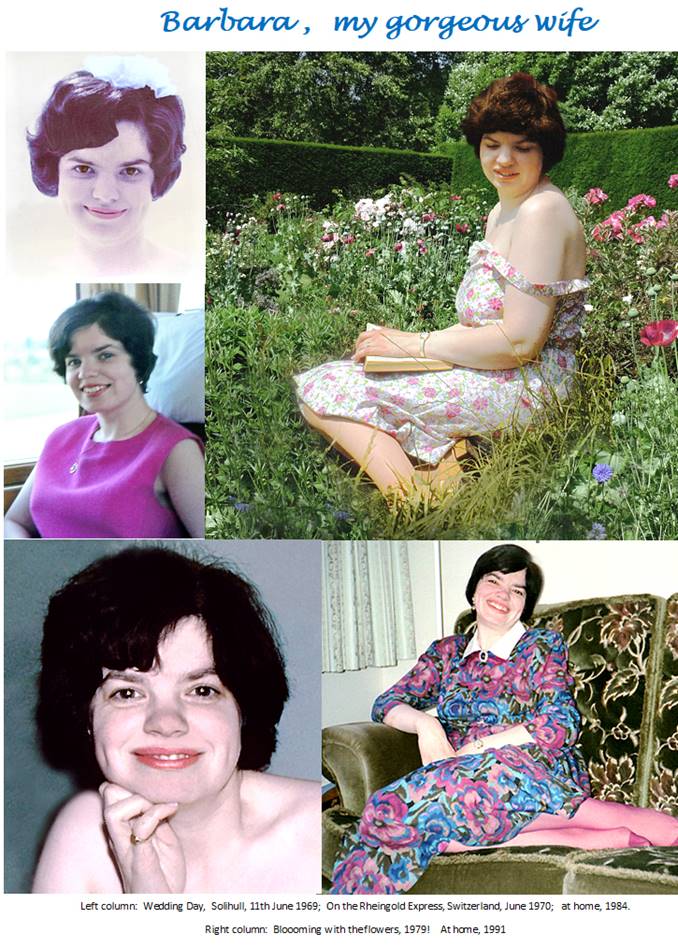
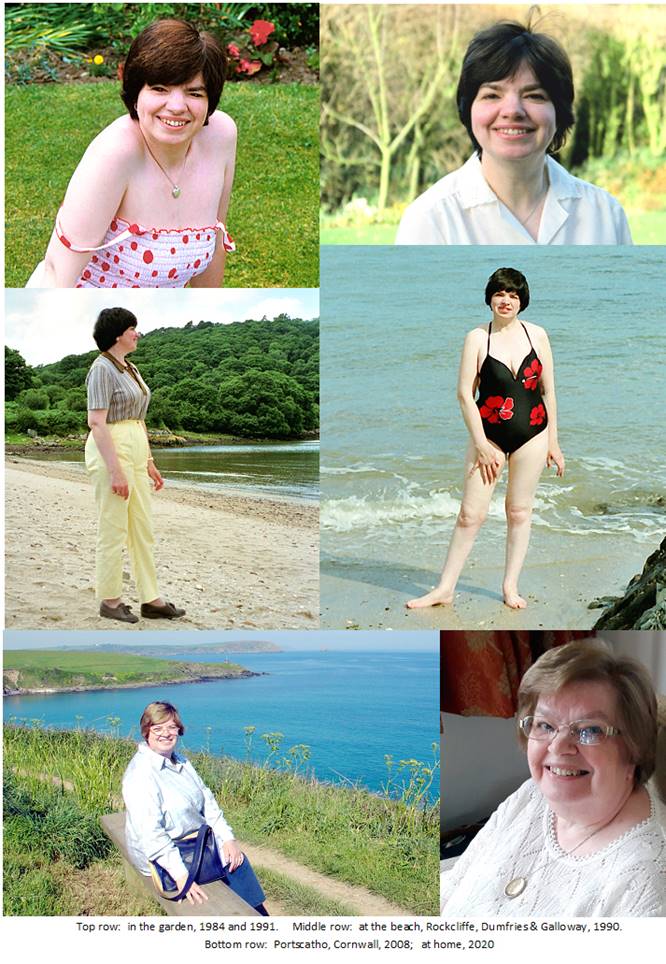
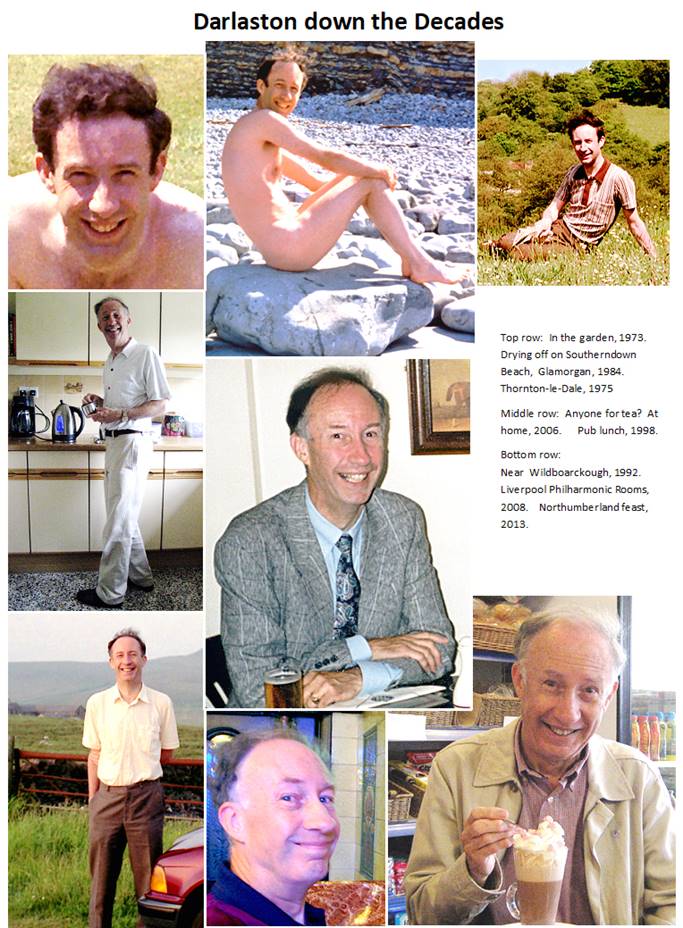
Together!
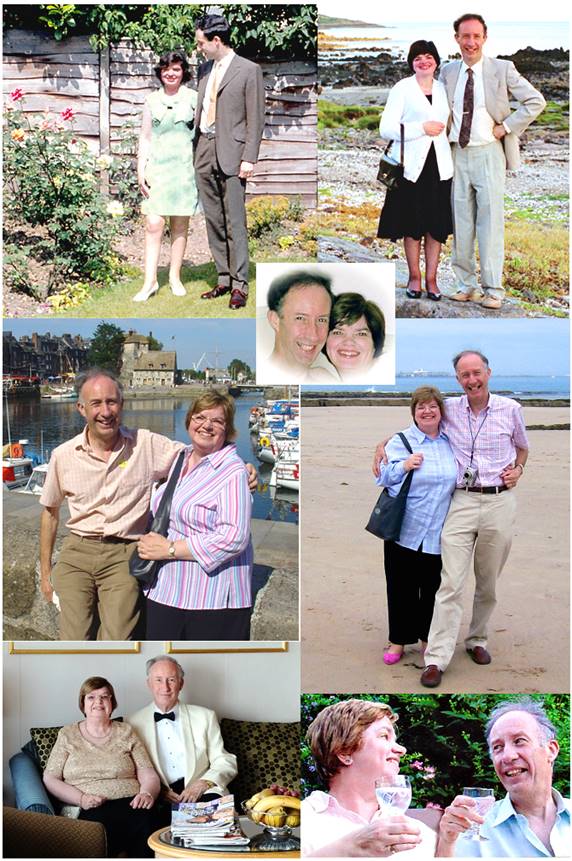
Clockwise from top
left: Four Oaks, 1970; Evening stroll at Rockcliffe,
Dumfries & Galloway, 1990; Bamburgh Beach, 2007;
Toasting the future, at
home, 2005; Cruising, 2016; Honfleur Harbour,
2007. Inset: at home,1991.
All the Family
A wide range of family
photos can be seen at www.robertdarlaston.co.uk/Family
Photos.htm ,
together with details of
“Darlaston’s Desert Island Delights”