This Web Page is: King Edward's School (Last revised 1/2/09)
Note: This page includes many
photographs which may take some time to load.
The following
narrative gives an account of my school days at K.E.S. in the 1950s – to the
best of my memory! It was originally
written for the benefit of our daughters, but subsequently expanded and a
version was serialized in the Old Edwardians’ Gazette in 2001-02. I am indebted to the late C.H.C. Blount and
to many Old Edwardians for comments and corrections. This is, of course, a personal memoir and
others may well have subtly different view of the years I describe!
Photographs © Robert Darlaston except where indicated
KING EDWARD’S SCHOOL
1951 – 1959
Robert Darlaston
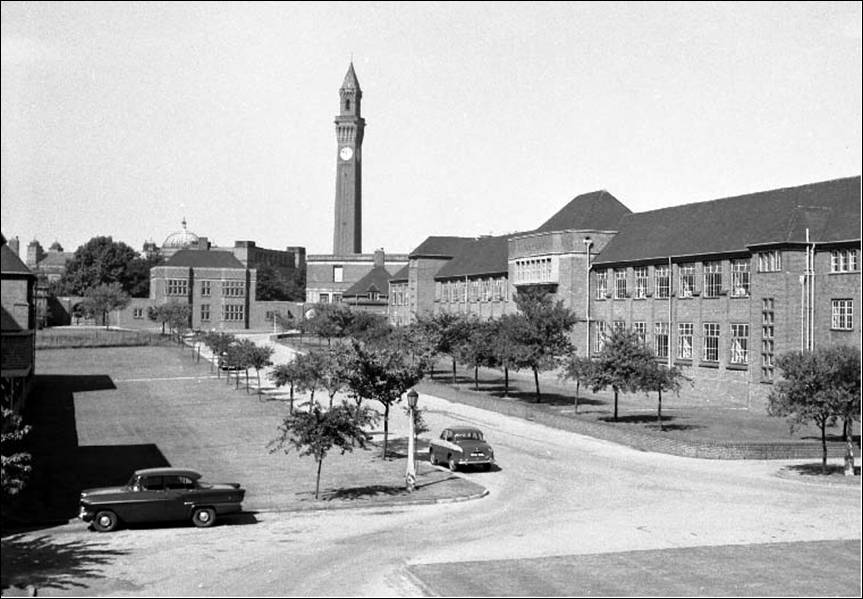
Looking up the Main
Drive from
= = i = =
|
I |
spent most of the 1950s at King Edward’s, - rather longer than
the majority of my contemporaries, as I had a second shot at ‘A’ levels. My stay thus spanned the years from the
Festival of Britain to the wonderful summer of 1959, one of the sunniest of the
century. It was a good decade in which
to grow up. My first few years had been
set in a world of bombs and rationing, where toys and sweets were almost as
scarce as penguins in the Sahara.
Austerity had continued after the war ended and, through the rest of the
1940s, life retained a dreary greyness aptly portrayed by the monochrome
newsreels of the period. But to a child
it seemed, superficially at least, that the arrival of the ‘fifties had brought
a fresh wind to blow away the horrors of the previous decade. Rationing was rapidly dismantled. Luxury goods began to appear in shops. Newspaper “hype” proclaimed a new Elizabethan
age. With Sir Winston Churchill as
Prime Minister, Everest newly climbed and the new Comet airliner briefly dominating the skies such claims for a while
appeared true. To a schoolboy it seemed
one was participating in real progress.
In that decade of full employment the motor car, television and the
foreign holiday became (for better or worse) a fact of everyday life. It was against that background that I spent
my time at K.E.S.. This narrative
gathers some recollections of those years.
My original aim was to give my children an insight into my own
schooldays, but the text might also provide some entertainment to other
contemporaries.
I started at King Edward’s School on 13th September
1951. I knew I was fortunate to secure
a place at a school which had provided education to the great and the good in
Birmingham for four hundred years and which was unquestionably one of the
finest academic establishments in the kingdom. Famous alumni of the twentieth century in
whose steps I was following included J.R.R. Tolkein, Viscount Slim, and the Rt
Hon Enoch Powell. Other pupils who
became household names for a time included a brace of bishops, the journalist
Godfrey Winn (a favourite in women’s magazines in the ‘fifties), comedy actors
Raymond Huntley and Richard Wattis, atomic spy Alan Nunn May and maverick drama
critic Kenneth Tynan (who was alleged to be the first person to use the ‘f***’
word on the B.B.C.).
The school was a rich foundation which lacked for nothing and
had, only recently, moved from the bustle of the city centre to sumptuous new
premises in sylvan Edgbaston. The
facilities ranged from laboratories equipped to the latest standards to a small
cinema with tiered rows of blue plush tip-up seats. There were parquet-floored corridors, which,
to an eleven-year-old, seemed to stretch to infinity, and an assembly hall,
known traditionally as Big School, with a fine organ and one of the largest oak
hammer-beam roofs in England. The beams
for the roof had been delivered before the war and remained for the duration
lost amongst long grass and builders’ junk.
A government inspector had arrived to sequestrate them for the war
effort, but the site caretaker had denied any knowledge of them, and so they
had survived to provide the school with a magnificent setting for morning
prayers and formal occasions.
The contrast from my tiny previous school
could not have been greater. To a small
eleven-year-old somewhat lacking in self-confidence the sheer size was
bewildering and I duly got lost on my first day when searching for room
72. New boys were known as “Sherrings”
(a contraction of “Fresh Herrings”), which could occasionally be a term of mild
abuse when used by boys who had risen to the dignified height of the second
year. On arrival at K.E.S., I was
placed with 22 other boys in Shell ‘C’.
We were seated in alphabetical order and I teamed up with my neighbour,
whose surname was Cork. It was good to
have an ally in those early days, but Cork’s family were to move away after a few
years and he vanished from my modest circle:
the last I heard was that he made something of a name for himself in
Jazz circles! Our form master in Shell
‘C’ was Mr L.K.J. Cooke, a kindly man with a velvet toned voice and a leisurely
speech delivery. In consequence, unkind
schoolboys had nicknamed him “Slimy”, but he was an expert at easing new boys
into school life.
In accordance with tradition at boys’ schools we all called each
other by our surnames. (See
panel below). If two or more boys
shared the same surname they were known by their initials: in my year the Smiths were D.B., G.M., and
R.J., always known thus. Christian
names were regarded as “cissy” and kept top secret until any lasting
friendships were formed, usually in the later years of one’s school
career. Meanwhile, if, in the first
year or two, one’s Christian name was accidentally discovered by another boy it
might become a topic for fun. The only
boy in my day habitually known to his contemporaries by his Christian name had
the unusual name of
Modes of
address: “Call me Darlaston” Today the use of surnames is seen as curt and
unfriendly and first-name terms have become widespread—even with people one
has never met. But until the mid-sixties, surnames were the usual
form of address amongst males at school, in the Services and in the
professions. Christian names were
confined to family, a few close friends and, of course, girls (although
females in the services and professions such as nursing also used
surnames). For a boy starting at
secondary school being addressed by his surname was a badge of pride,
showing he was growing up: besides,
one was following time-honoured custom, as set out in novels about school
life from Tom Brown to Jennings
at School. To use a Christian
name was seen as over-familiar and disrespectful. Boys initially kept their Christian
names secret and, if discovered, unusual or old fashioned names such as
Harold or Cyril were a cause for teasing.
We called girls at the adjacent school by their Christian names, but
they would refer to us by our surnames (unless the relationship was
becoming close!) and when I went to a school friend's house for tea it
would be usual for his mother and sister just to call me Darlaston. Later, after starting work in banking, I found use
of surnames amongst staff was still customary into the mid-1960s. Memos to managers at other branches
would begin “Dear Jones”. Ladies
were, of course, always properly addressed by their title as Miss or Mrs X,
a custom which has sadly been neglected in newspaper usage in recent times.
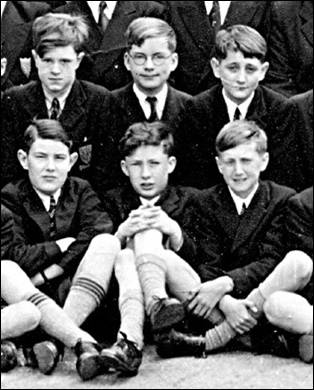
Back (l-r)
Sessions, Edwards,
Mitchell
Front (l-r) Birch, Darlaston, Robertson
Caps and navy blue blazers were the main element of uniform
throughout the School. There seemed to
be an unwritten rule that until boys entered the Upper Middle in their third
year short trousers were worn, shirts were grey, and raincoats were navy blue. Thereafter, one graduated to the dignity of
long trousers, white shirts and fawn raincoats. Similarly, the satchels of the first two
years suddenly became quite passé and were replaced by smart leather brief
cases in which to carry one’s ‘prep’.
For some boys, brief cases gave way in turn to C.C.F. packs or duffel
bags which were popular towards the end of the ‘fifties. In my first year at K.E.S. sixth formers
were permitted to wear sports jackets with flannel trousers and to leave off
the school cap. This gave them, in the
eyes of boys in the ‘Shells’, a somewhat awesome appearance whereby they were
difficult to distinguish from young masters.
That sanction was withdrawn in 1952 when caps and blazers became
required wear throughout the school – a rather unpopular change in the sixth
form as it diminished their apparent majesty.
School continued until 3.45 p.m.
only on Mondays and Wednesdays. On
other days lessons finished at lunch time, but that did not mean one could go
home. There were compulsory games for the first three years and these could be
on Tuesday or Thursday afternoon.
Friday afternoons were reserved for cadet force and scout group
activities, with non-participants being labelled “Remnants” and consigned to
the Art Room where Mr J.Bruce Hurn presided.
There was also morning school on Saturdays. The school was a single sex establishment,
but there was an adjacent girls’ school (K.E.H.S.). The authorities required that there should
be no mixing between the boys and the girls, and the starting and finishing
times were staggered by 15 minutes to discourage the evils of fraternisation on
the trams and ‘buses. Unsurprisingly,
this policy was not entirely successful.
During my own early journeys across the city to school a fifth-former,
Stevens, who later went into the medical profession, kept a friendly eye on me,
aided by a couple of Upper Middle boys, Davis and Allen, and there were also
two girls from K.E.H.S., Ann and Margaret, who initially tried to mother me: (Christian names for the girls, but surnames
for the boys in those days, be it noted!).
On Friday morning journeys in that first year, Darlaston’s Eagle comic was enthusiastically
borrowed by the rest of the party – especially the girls - so that everyone
could keep up to date with the adventures of Dan Dare, Pilot of the
Future. [See illustration in the “Memory Lane” page]
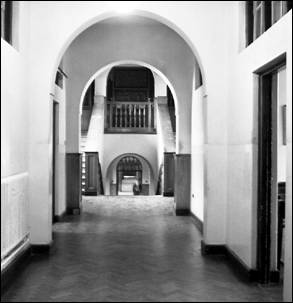
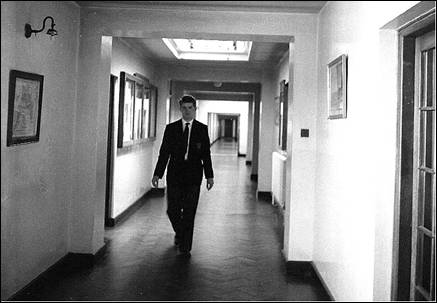
Classical corridor, looking towards
Big School. Upper Corridor:
At my junior school I had always been
a relatively big fish in a very small pond and was usually top or second in the
class. At K.E.S., by contrast, I was to
be in the company of some very bright pupils and consequently seldom rose above
the bottom third. At least I usually
enjoyed subjects such as English, History and Geography. But Mathematics was a real struggle. When I was about thirteen, the Maths master,
Mr Skinner, was explaining to the form some recondite algebraic formula which
was taxing my limited faculties. My
face clearly betrayed my total and utter bewilderment. Suddenly he broke off in mid-sentence and
said: “Darlaston, when you look at me like that, you make me feel an absolute
cad!” I confess to remembering that
incident better than any of the algebra he struggled to impart.
One of the most significant changes I found
on starting at K.E.S. was compulsory participation in games. I was allocated to Mr Leeds’s house, later
known as Jeune house, to commemorate a 19th century master. I fear my contribution to the house was to
be negligible, although Mr Leeds was surprisingly kind to me. At my previous school classes comprised
about a dozen children, of whom the majority were girls, so organised games
such as football and cricket had been non-existent. Moreover, there were no boys of my own age
living very close to home.
Consequently, as a somewhat timid only child I grew up to be rather
self-sufficient and quite ignorant about team games. K.E.S. attempted to teach me the rudiments
of Rugby football, but wrongly assumed I had some existing knowledge. This became all too evident in one of my
early attempts at Rugby when the master acting as referee (Mr J.F. Benett)
shouted at me “You are off side”. I
hadn’t the nerve to tell him that I did not have the slightest idea what he
meant, and I never did get the hang of it.
My self-sufficient approach to leisure together with my lack of
confidence in my own ability contributed to an absence of any competitive
spirit when it came to games. I failed
to see the point of running round chasing an oval ball, getting covered in
mud. The mud meant that games, like the
weekly gym lessons, concluded with showers.
I soon overcame the affront to the modesty I had cultivated as an only
child and cheerfully mingled with the crowd of boys who emerged from the steam
looking like a shoal of slippery pink prawns.
Although I happily accepted the showers, I did draw the line at sharing
the (off-) white tiled bath at the Eastern Road pavilion with its thick muddy
water, heavily occupied by fifteen or more adolescent sportsmen celebrating (or
lamenting) their performance on the rugger pitch.
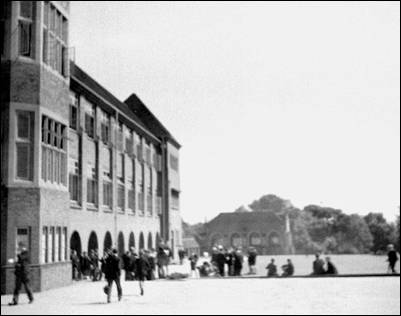
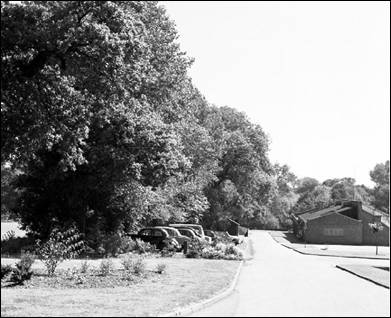
Left:
the South Front during
break: the Chapel is in the distance
Right:
the view
down Park Vale drive from the East Door.
The
At the time I started at K.E.S. the
Headmaster was Mr T.E.B. Howarth. I
only had one encounter with him. He was
showing some guests around as the bell went for the end of school at 3.45 p.m. My form made a rush for the door and the
leaders became momentarily wedged there until pressure from behind caused them
to burst in a heap onto the corridor floor at the feet of Howarth and his
guests. He looked down at the eel-like
writhing pile of pupils and with exaggerated bonhomie said “Little
horrors!” Had there been no guests
present I feel that his comments would have been decidedly sharper and
detentions might have been mentioned.
Detentions, it should be added, could be awarded by Prefects and by
Masters. The former involved standing
to attention from 4 p.m. to about 4.45 and were usually punishment for such
misdemeanours as running in the corridor or (my own speciality) talking in Big
School before prayers. Master’s
Detentions were infinitely more serious and kept one in school for the whole of
Saturday afternoon. Happily, my
Saturdays remained free from such interruption throughout my school career,
although it was a close run thing once or twice.
Howarth left the school in April
1952, moving on successively to Winchester, St. Pauls, and Magdalene College,
besides making a career as a writer.
His successor, Canon R.G. Lunt, was an Old Etonian, who was to remain in
office for 22 years until his retirement.
Lunt was not generally popular, either with staff or pupils – he would
not have seen popularity as any part of his function. He was widely viewed as an unrepentant
snob; he was autocratic in an era of
rising democracy; and he embraced
earnestly the classics and arts, while showing less obvious interest in the
developing world of science. But he
significantly raised the profile of the school in the city, helped, one must
add, by the presence of H.M. the Queen who paid a brief visit one wet day in
1955 belatedly to commemorate the school’s 400th anniversary.
In the 1950s Lunt taught Classics to Sixth Formers, Divinity to
some forms in the middle school and English once a week to boys in their first
year. This showed a commendable concern
to see that nobody could regard him as a faceless administrator. I encountered him in the course of English
lessons as an eleven year old – “one of the toddlers” to use his own somewhat
damning phrase. I prided myself that I
did not have a dreadful Birmingham accent, but my enunciation was clearly not
up to the standards of Lunt’s Etonian and Oxonian delivery. In reading from “A Midsummer Night’s Dream” I referred to ‘Mustard-seed’, pronounced
as spelt. I was directed to spend the
weekend saying over and over again “I MOSST
remember to say MOSSTard-seed”. He would himself sometimes mimic the
Birmingham accent by warning that if you broke his rules “Yer will find yerself
gowin’ up the drive fer the last time”.
He certainly presented a commanding figure in
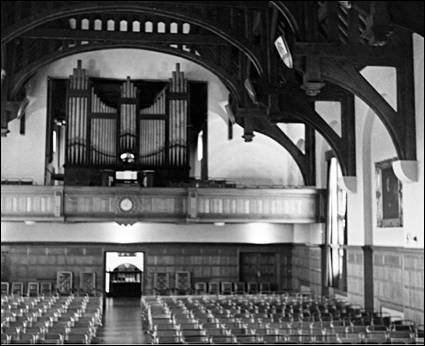
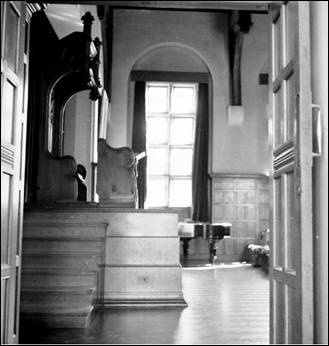
Big
School from the stage showing the organ Sapientia from the side entrance to Big School
A fine example of the
Lunt approach to school life was his ceremonial creation of prefects. After morning assembly, he would summon boys
so honoured up to his presence in Sapientia. He would take the appointee’s right hand in
his and then intone the prefect’s name in full:
“Gerald Aloysius Fothergill”, or suchlike, – and seventy impertinent
Upper Middles would think “Gosh! Who’d
have guessed Fothergill was called Gerald
Aloysius of all things” – while Lunt continued: “I, twenty-fifth Chief Master of King
Edward’s School, hereby give unto you the position and traditional
powers of a prefect, entrusting to you a share of the leadership and
governance of the boys brought up in this place: see that yer wield this power with justice, loyalty and discretion.” Those
three nouns resounded with truly frightening emphasis around
One of Lunt’s more endearing eccentricities was his attachment
to a Rolls Royce motor car, dating from the 1920s. He doubtless felt that it was the only make
of car appropriate to one of his standing.
He always drove it to school, perhaps a half mile by road, despite
having a private path about 200 yards long from his house to the school. Vintage cars are not always reliable. On one occasion the Rolls broke down while
delivering a guest speaker from the station to the school, no doubt a cause of
considerable embarrassment. Sadly, the
Rolls was soon to reach the end of its career, as during a severe frost its
cylinder block fractured and it had to be ‘put down’. Thereafter, Lunt was reduced to motoring in
more proletarian vehicles. [See note below the next photograph for
further information about Canon Lunt]
His unashamedly elitist attitude
enriched the school in a variety of minor ways, as “old traditions” were
re-discovered – or invented, as some cynics would have it. He invoked a little known reference from
past years to insist that instead of being called Headmaster, he should be
known as “Chief Master” – after all, St Pauls had a High Master. Various areas of the school were given
names: the courtyard where the naval
cadets practised became Admiralty Yard, that adjacent to the Music Room became
Chantry Court. A small group of
conifers was named Prefects’ Grove, although I doubt if that indicated any
requirement for gardening activity by the eponymous gentlemen. In summer boys were encouraged, but not
compelled, to wear boaters. I duly
complied and found it fun overhearing the comments – not always entirely
complimentary – passed by other passengers on the ‘bus as it made its way
through the less well-heeled districts of Birmingham. One elderly gentleman came up to me in
Corporation Street to congratulate me on my turn out and insisted on shaking my
hand. That was an occasion when I was
also wearing a rose in my button-hole:
by no means an unknown practice in the 1950s amongst professional men
and, curiously, railway guards in rural areas.
My second year was spent in Remove C
where the Form Master was Mr J.D. Copland. He cultivated an eccentricity of behaviour
which was often quite extreme and resulted in him earning the nickname “Coco”,
after the popular clown of the day. He
muttered to himself as he walked down the corridor, and was quite liable to
stop abruptly, cry out loud: “Ha!”, wrap
his gown tightly round himself like an Egyptian mummy, turn round and walk back
whence he came. A deaf aid added to the
impression of eccentricity, as, when bored by a boy’s long-drawn out and
inaccurate explanation of a point, he would fiddle with the volume control,
causing high pitched screeching sounds.
On snowy winter days he would wear Wellington Boots in which he would
squelch audibly and happily along the corridors. The unconventional behaviour masked a sharp
mind and a sympathetic interest in the boys in his form which only became
apparent after the passage of time. His
main punishment weapon was gentle humiliation.
If one dared to talk to a neighbour in a lesson, Copland would interrupt
his own sentence: “Darlaston; how dare you talk while I am speaking? Stand on the desk, boy.” As one self-consciously climbed up on the
desk, watched by all the form, he would wait until one was almost in position
and then say: “What are you doing up there boy? You look stupid – get down at once.” This always provoked laughter amongst the
rest of the class. An alternative
punishment sometimes hurled at one was “Write out the first 500 lines of The Revenge.” Later, he would suddenly turn to the
offender and say: “Make it the first 200 lines”, and later still “make it the
first 50 lines.” One might end up only
doing the first ten lines. If he
thought one was getting too familiar with The
Revenge, Coleridge’s Ancient Mariner
might be substituted.
When marking essays from junior boys
Copland was quite kind, and I usually scored 15 to 18 out of 20. But he also taught ‘A’ level History, where
the demands were far more rigorous, with a requirement to discuss and analyse a
topic, rather than to give mere description.
My first such attempt was not up to scratch. As he handed out each boy’s essay, he would
comment briefly. When he reached me he
lingered on the mark as if to emphasise the enormity of my failure, before
adding some very back-handed encouragement:
“Darlaston – two-o-o-o, out of twenty:
but don’t despair, boy, you will find it easy to improve. A fifty per cent improvement will take you
to three out of twenty, and a one hundred percent improvement will take you to
four." This was something of a blow
to my limited self-confidence, but I struggled up to eight or nine with
subsequent essays which was, from him, quite a healthy mark! [See
note below the photograph for further information about Mr J.D. Copland]
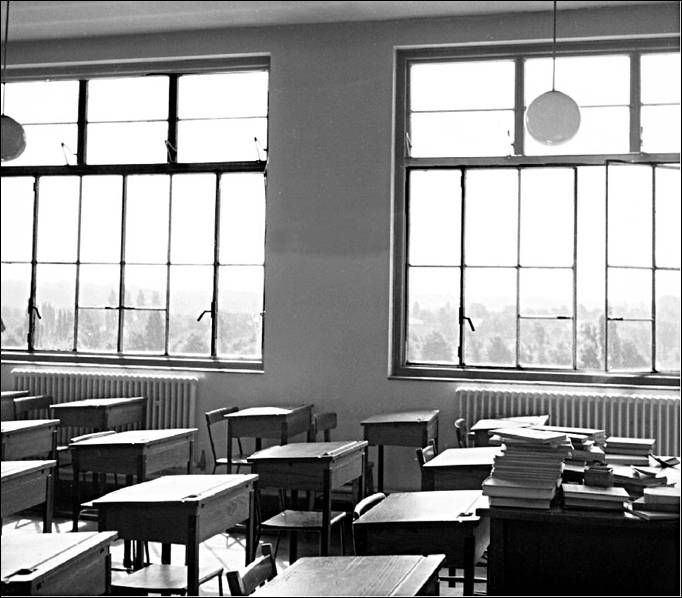
Room 149: Mr J.D.
Copland’s room and my form room in Remove C and History Division.
In both years I sat by the radiator at the left: very comforting in winter. Beyond lies sylvan Edgbaston!
Note:
I was most interested to
receive an e-mail from Mr D.D. Griffiths who is a nephew of Mr J.D. Copland. He writes:
“James Denison Copland was my Uncle, my
Mother's youngest brother, and I find your description of his behaviour most
accurate. He did not marry until late
in life and used to stay with my Grandmother in
He also liked to get my sister
and me to run round the block with him timing us with a stop watch.
He would sometimes ask my Mother
to carry out running repairs on his gown, which was so old that it had an
almost green tinge to it. The sleeves would be torn and much shortened by
catching on desks.
After my Grandmother had died
Uncle Denny (as he was known) used to stay with us. He was a very early riser and it was not
unusual for him to shout upstairs at 6 am, "I'm off, see you next
Wednesday". This was followed by
an earth shattering slamming of the front door. On his return we would get a loud
explanation as to where he had been, such as, "Went to
I could go on at length, however,
when I was older I found him very good company, especially in the pub!
“I was at
The "new traditions"
which you mention are almost exact replicas of ones which he instigated at the
College. The words for the initiation
of prefects only varied in that it began, "I, tenth Principal of this
College......"
One of his favourite forms of
address to a boy was, "You loathsome creature, what would yer father
say?"
I remember him getting the Rolls
Royce; it was left to him by his father
who had been the Bishop of Salisbury. I
particularly remember him coming to the school Scout camp in
“After Ronnie had gone to
It is fascinating to have the veil briefly lifted on the private life of
a master who was then so difficult for us to fathom!
= = ii =
=
1952 was the year of the school’s 400th
anniversary. It was commemorated by the
opening of the chapel, with adjacent outdoor swimming pool, as a memorial to
boys who had been killed in the two world wars. The chapel was a fine reconstruction, using
the original stone, of the splendid gothic upper corridor from the former
school building in New Street. It had
been designed by Charles Barry (architect of the Houses of Parliament) but had
been demolished in 1936, making way for shops, offices and the cultural
delights of the Odeon cinema. The
memorial Chapel was to be used for early morning Holy Communion and for
Evensong after school on Fridays.
Services were normally conducted by the Chaplain, the Rev. F.J.
Williams, who taught Classics and was generally known to his pupils as
“Stuffer”. There was something
especially atmospheric about attending Evensong at dusk in the late autumn
months, as mist gathered over the nearby playing fields. The voluntary early Communion service was
followed by a splendid cooked breakfast in the Dining Hall. Often there was a guest celebrant, which is
how I once came to spend breakfast chatting with the Bishop of Birmingham!
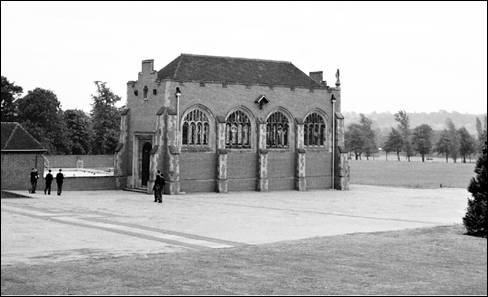
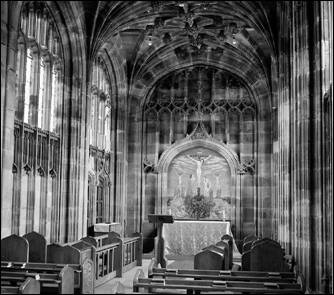
The Chapel, seen across the Parade
Ground, with the pool beyond Chapel
Interior
The swimming pool, which was adjacent to the Chapel, had attractive
sandstone cloisters for changing, but was unheated in its early years and thus
had relatively little use. I wanted to
learn to swim, but, because of my general lack of self-confidence and the short
time available each year for lessons, even when I reached the Sixth Form I had
still not succeeded. We were only
allowed in if the water temperature reached 63°F, when swimming would
take the place of gym periods. Even in
June, a cold night might knock the temperature down below 63°. Conversely, one sometimes found that
swimming had unexpectedly replaced a gym lesson after a couple of mild days in
May. Lack of swimming trunks was no bar
to participation on such occasions, or, indeed, at other times such as a sunny
lunch-hour when an impromptu dip could be rather pleasant. Many boys equate excessive modesty with
vanity and so one participated happily on those occasions, unconcerned whether
outsiders might be looking over the wall.
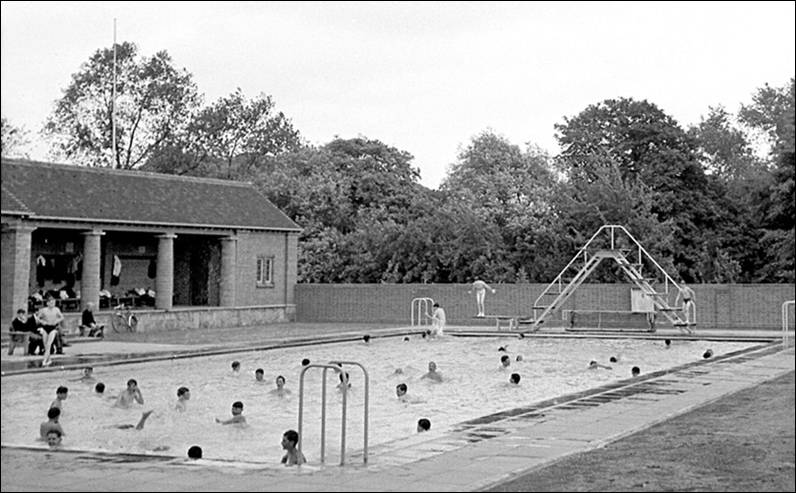
A Summer’s lunch hour at the Swimming Pool.
The boy on the spring board is one of
several present who did not let lack of suitable attire prevent him from
enjoying a cooling dip.
The next year took me to the Upper Middle
with F.L. “Freddie” Kay as form-master, followed by a year in the Fifth form
with A.J. “Gozzo” Gosling. “Freddie”,
who taught English and History, was unlike the general run of schoolmasters at
K.E.S. He was short and ebullient to
the point of chirpiness. He was also a
keen motor-cyclist and would arrive at school heavily disguised in black
leathers with goggles, looking more like a despatch rider from El Alamein. “Gozzo” was, by contrast elegant and laconic
with a neat but sarcastic turn of phrase.
One of his lessons was interrupted by a practical joke which
misfired. Two boys, Payne and Rogers,
had rigged up a device with a ruler, elastic and string, which they meant to go
off, making a rat-tat-tat noise inside a desk, after the lesson had finished. Unfortunately it went off unaided while
“Gozzo” was in full flow. He stopped, tapping his fingers while the noise
continued, his face growing steadily more flushed. When the noise eventually ceased he barked
that the whole form would be in detention the following Saturday, but the perpetrators
owned up and the rest of us escaped. [Addendum: since writing
the above, S.P. Tyrer, one of twins in our year, has claimed responsibility for
this modest outrage. I trust it is not
libellous to say that it would not have been entirely out of character for
Payne and Rogers!]
There were other masters encountered
through these first four or five years, many of whom are easily remembered for
individual characteristics. G.C. Sacret
(“Sacco”) taught Latin to younger boys.
A big man, he had easily the loudest voice in the school, heard to best
effect across the South Field on a summer’s afternoon when the windows were
open. He had memorable ways of
emphasising points of Latin grammar. “A
gerun-dive is an adjec-tive which takes the subjunc-tive”; “didicissem? – iubet” (“did ‘e kiss ‘em? –
you bet” - though what that was supposed to illustrate I cannot remember). “Sacco” was generally of a cheerful and
sunny disposition and a splendid teacher for small boys, but if he were in a
bad mood he would draw a flagpole up the side of his blackboard with a red flag
at the top. This warned that anyone
who larked about did so at his peril.
As a housemaster, his stentorian voice was used to good effect on the
touchline to support the house team. An
early initiative by “Sacco” to encourage new boys to take an interest in their
surroundings was “hunt the motto”. Some
areas of the school had large skylights, incorporating latin mottoes in a
pattern around the border. Sixpence
(2½p) was offered to the boy who could find Mens
sano in corpore sano (a healthy mind in a healthy body). No one could, for that motto was very high
up in the skylight over the steps down to, appropriately, the Gym.
Latin was also taught by Tom
Freeman, known, presumably for alliterative reasons, as “Ferdy”. My encounter with him was during the time
when the Cartland Room was being built above the Classical corridor. The construction work involved a rope and
pulley system outside his window for hauling up building materials. To a bunch of fourteen-year-olds this was
inevitably of more interest than Caesar’s exploits in Gaul. “Ferdy” stopped the lesson and made us all
face left and solemnly watch the bucket going up and down for five minutes
until we were so bored with it we were glad to return to our copies of Latin for Today, the covers of which
were often so cleverly amended to Eatin’
Pork Today.
“Spike” Jackson was a charming and
kindly man, who took Holy Orders on retirement.
He was, however, sadly incapable of maintaining discipline in class and
his maths lessons could be turned into a shambles by a determined form of
troublemakers. On one occasion he
arrived to take a lesson to find that all the desks had been turned to face the
wrong way. By contrast, Mr W. Traynor
(Physics) tolerated no trouble. A small
man with gingerish hair, he gained the nickname “Cocky”. As Flight Lieutenant he led the R.A.F.
section of the cadet force. They
possessed a curious manned glider kit which could be assembled and, in theory,
launched for a few yards of flight from a kind of catapult which seemed to rely
mainly on elastic and brute force. In
practice it seldom left the ground, but on one occasion the school magazine
reported that the Officer Commanding had succeeded in getting a few feet off
the ground. The report added “He should
not get too cocky over this flight in
the trainer.” This was then thought to be quite daring.
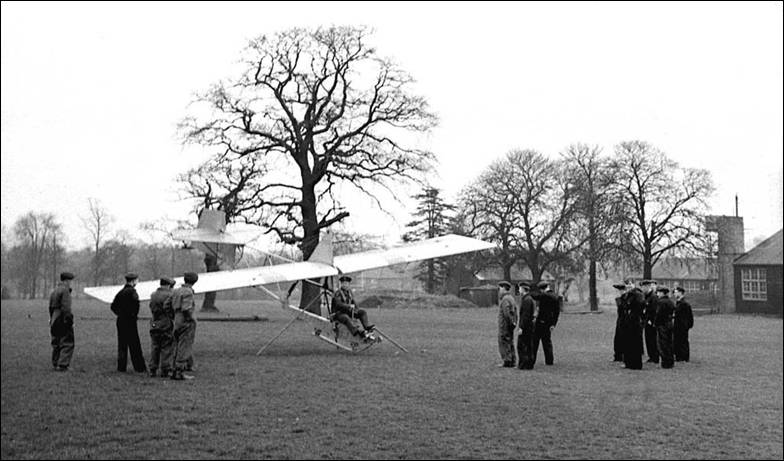
The CCF Glider on the South Field in
March 1957
The Temporary Buildings, used while
the new school was under construction, are at the right
Other members of the Science Department
whom I encountered were Mr S.D. “Slasher” Woods and Dr R.S. Allison. “Doc” Allison was a forthright Lancastrian
who once caught me pouring a small quantity of acid into a test tube without
having first measured it. “Dorn’t joost
lob it in laddie” he shouted at me. The
chemistry laboratory was the scene of my greatest inadvertent attempt at
mayhem. I lit a Bunsen burner with a
spill of paper, threw the paper away and walked to the balance room down the
corridor to weigh some chemicals. When
I returned three minutes later everyone was running round in chaos, the air was
thick with smoke and all the windows were all open. My spill of paper had not been completely
extinguished and had set fire to the contents of the waste bin to quite
spectacular effect! I succeeded in
having accepted my plea of not guilty to attempted arson.
In the Upper Fifth, my year for
taking ‘O’ levels, my form master was T.R. Parry, a rugby playing Welshman who
taught English. He had a strong
personality and knew how to handle rebellious boys in their mid-teens. There was a fine team of masters teaching
Modern Languages, but this was a department of the school I did not experience
in depth. “Jack” Hodges was the patient
and helpful master who ensured that I developed a basic understanding of
French.
The teaching staff was all male, but
there were three females on the premises.
Miss Chaffer was the long-serving chatelaine of the kitchens, and there
were two secretaries, of whom Miss Minshull was the senior. For a short time there was an extremely
attractive assistant secretary called Wendy.
She was about nineteen and was immediately appropriated by Wilkins, the
deputy School Captain, who thus became an object of great envy by the rest of
the older boys. It was hardly
surprising that Wendy did not remain long at K.E.S.: the pressures on her from Wilkins and his
rivals must have been enormous! It
would have been about the same time that I was sweet on a rather pretty girl
from the adjacent school. Even though I
occasionally sat next to her on the ‘bus and spoke to her from time to time, I
was far too shy to mention such matters and she presumably remained forever
ignorant of my brief infatuation. It
was often said by opponents of single-sex schools that they encouraged
unnatural relationships between boys. I
recall no evidence in my day of any serious examples of such activity, although
there were occasional superficial and unsophisticated associations between
individual boys, discovering new delights as they grew to maturity! There was, of course, no formal sex
education in those innocent days and boys acquired an often garbled knowledge
of the subject from their contemporaries.
I initially held out against believing the information I gained in this
way as the procedures in question then seemed utterly bizarre and quite
absurd. One of my classmates who
clearly had a bright future in business acquired a pin-up magazine with some
discreetly posed black and white photographs of unclothed females, which he
hired to his fellows at two pence a go.
He did a brisk trade but I failed to take up the offer, whether through
prudery or because I feared a maternal audit of my pocket money expenditure I
cannot now recall. But in the chaste
atmosphere of the 1950s such distractions were little more than a passing fad
to naïve fourteen-year-old boys who found sport or such popular hobbies as philately,
train-spotting or ornithology offered greater fulfilment in their everyday
lives.
Music was a feature of importance at the
school, but with what would now be regarded as an elitist approach. The Director of Music was Dr Willis Grant
who later left to become Professor of Music at Bristol University. He was principally interested in Church
Music and extracted phenomenally high standards from the Choir. He was supported in my time by one of my
Sixth Form contemporaries, J.W. Jordan, who became an Organ Scholar at
Cambridge and was to be Director of Music at Chelmsford Cathedral while still
in his twenties. Jordan was a truly
remarkable organist, accompanying morning prayers on most days. He could extemporise freely and on the
morning in 1957 that Sibelius’s death was announced his voluntary was a set of
improvisations on Finlandia. Another musical contemporary was David
Munrow who became a performer and broadcaster of considerable note before his
tragic early suicide.
My own contact with Willis Grant and his
Music Department was negligible apart from the weekly school hymn practice
sessions, although he did once tell me to stop whistling in the corridor: it was, he quite correctly remarked,
“antisocial”. He showed relatively
little obvious enthusiasm for music beyond his specialist field, and displayed
a strong disapproval of any form of popular music. There were, however, occasional concerts
named after Julian Horner who had evidently bequeathed money to promote music
at the school. From time to time
afternoon school would be suspended and everyone directed to Big School for a
concert provided by an ensemble of “semi-professionals”. I enjoyed music but have to admit that the
baroque ensembles which seemed to provide the usual fare at Julian Horner
concerts did little to encourage my interest.
There was, however, one occasion when a group of singers, with piano
accompaniment, came to give a “potted” version of a Mozart opera. Excerpts would be sung and then one of the
characters, in costume, would come in front of the curtain to set the scene for
the next excerpt. But on one occasion,
after explaining what was to come, he could not find the gap in the curtain to
return to the stage. He chased
backwards and forwards in mounting panic, tugging vainly at the curtain to find
the gap. Clad in 18th
century wig, jacket and breeches, the poor man looked increasingly absurd as he
darted to and fro while his neck became redder and redder. Titters began in the audience and before many
seconds had passed the entire school was paralysed with laughter. Even the masters joined in. Eventually, he found the gap and retreated
to loud cheers. At the next break he
prudently held the edge of the curtain to ensure safe passage after his speech,
and he departed to great applause.
Until I was about fourteen my
knowledge of classical music was negligible and confined mainly to a handful of
pieces used as incidental music on wireless or television. The impetus to broaden my knowledge came one
sunny Friday afternoon in May 1954, a few weeks before my 14th
birthday. It was half term weekend and
school had finished at lunchtime. Most
boys had gone home but I had arranged to meet my parents in the centre of
Birmingham late in the afternoon before driving to South Wales for the
weekend. To while away the time, I sat
reading in the sunshine on the South Field.
In school, another boy who had remained behind was practising the piano
and the sound was drifting through the open windows into the warm spring
air. He was a competent player, but
repeated the same magical theme several times.
I had no idea what it was but soon learned that it was the piano part of
the first movement of Grieg’s Piano Concerto.
I could understand why it was one of the most popular works in the
repertoire. This encouraged me to
listen to broadcast concerts where I was to discover a world of endless delight
and fascination. I also found that
several of my friends had a similar embryonic interest in music and this led to
interesting discussions during our leisure time which, in turn, developed one’s
interest still further.
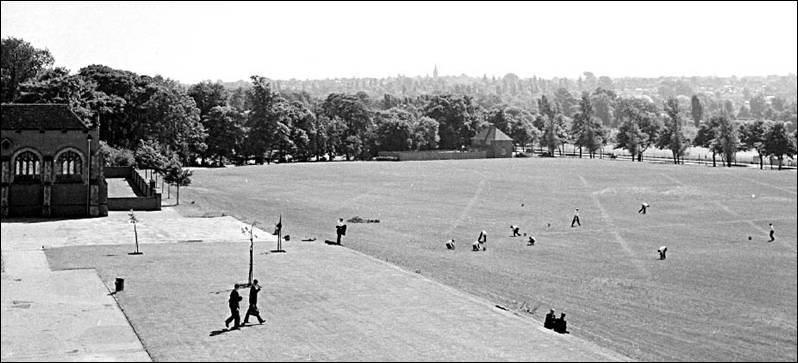
South Field from the Library 1959:
stone-picking in progress on new rugby pitches.
Chapel at left
Pop music, as known today, did not exist in
the early 1950s and so it was not difficult for Willis Grant to maintain the
purity of classical music in the school.
In pop terms, neither the market nor the product existed. Things began to change later in the decade,
especially under the influence of Bill Haley’s “Rock around the Clock”. Cliff Richard arrived on the scene and a
phenomenon called ‘skiffle’ was introduced.
By now Willis Grant had moved on and his successor, Thomas Tunnard,
recognised that a more flexible attitude was appropriate. For a while a ‘skiffle group’ was
established in break, performing in the tuck shop. It was all very low-key by the standards of
later decades, but made a musical change from the break-time practice of the
cadet force band who only knew one tune, endlessly repeated over the
years. The skiffle era coincided with
the rising popularity of the Espresso Bar.
One such establishment was El
Sombrero in Bristol Street. It was
popular with a group of rather maverick boys who could be found there on
half-days, capless and smoking cigarettes.
Eventually, the Bar was placed out of bounds by Lunt. Another place which neither boys nor staff
were expected to patronise was the Gun Barrels public house on Bristol
Road. There is an apocryphal story that
a boy and a master met in the Gun Barrels on one occasion. Each is reputed to have said to the
other: “If you don’t split on me, I
won’t split on you.” Further up Bristol
Street from El Sombrero, on the
opposite side of the Horse Fair, was another
The school tuck shop was run by
Allard, the Head Porter. His
predecessor, Kelly, had ruled the shop in the days of sweet rationing. The only ‘sweets’ not on the ration when I
started at K.E.S. were very strong ‘Troach’ cough sweets to which I became
slightly addicted until rationing of other delights was ended. Sweets were loose in those days and paper
bags very insubstantial. Thus my mother
regularly found in my blazer pockets a solid wedge of sticky sweets, all
covered in navy blue fluff, the paper bag having disintegrated long ago. Allard was a former policeman of substantial
build and conducted himself accordingly.
His chief assistant was Cradock, a bluff individual with a sharp sense
of humour, essential in his job. He had
an artificial leg, which gave him a characteristic gait, as he hurried on his
business about the premises. When a new
porter, Hewlett, started who, like Allard, was a retired policeman, Cradock was
heard to mutter “place gets more like a
bloody police station every day.”
In an era of military conscription
it was customary for most boys to join the cadet force in their third year, as
it would advance their chance of officer status in the forces. I was not keen (albeit for probably all the
wrong reasons) on the idea of “playing soldiers” and rather taken aback when my
parents supported me. They felt that
there were already too many other activities which tempted me away from those
studies with which I was experiencing difficulty. I thus joined a few dozen other boys as
“Remnants”, usually spending the afternoon doing Art, or, in later years,
revising. I was regarded as a passable
artist, although at ‘O’ level Art was to be the only subject I failed. There were also craft sessions, involving
either woodwork or pottery. I never
succeeded in making any pottery ware, and at woodwork the nearest I came to
success was a shoddy plywood tray with beading round the edge which amazingly
survives as a firm base (happily hidden from view) for a standard lamp!
When I started at K.E.S. I travelled
by tram, a means of transport to which I was then devoted. But after a year the trams with their oak
and mahogany bodywork and brass fittings were replaced by ‘buses which I found
bland and lacking in character. I soon
transferred my interests to trains. On
half-days when there were no games a form-mate and I, clad in school caps and
full length navy blue belted raincoats, would drop in at Snow Hill station for
an hour or two on the way home to collect steam engine numbers. We usually waited until 4 o’clock when the Cambrian Coast Express came through on
its way from Aberystwyth to
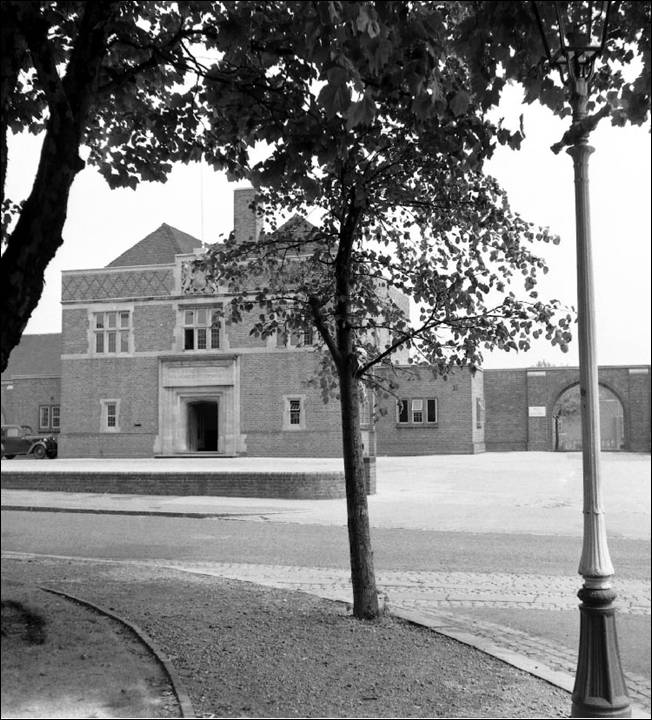
The entrance from
gas-lit Edgbaston Park Road, showing the Governors’ Offices.
= = iii =
=
The outside world impinged on our lives at
school to only a modest extent. Perhaps
the greatest impact was that of the Hungarian Revolution in 1956 when boys were
encouraged to devise fund raising ideas to support refugees. General elections, won in 1951 by Winston
Churchill and in 1955 by Anthony Eden, provided brief excitement and boys with
access to the not-very-portable radios of the day found themselves in great
demand. The 1955 election coincided
with subsidence by the left-hand gate as one left school by the Main
Drive. This necessitated the temporary
closure of the gate and replacement of the sign urging one to keep left by one
requiring motorists to “Keep Right”: a
demand which seemed to coincide with the political allegiance of most
boys. The Suez crisis of 1956, however,
brought about more sophisticated political argument as heated exchanges raged
over the government’s intervention in Egypt.
As boys progressed up the school, so
they encountered different masters.
Older boys were taught Geography for ‘O’ and ‘A’ level by J.F. (“Uncle
Ben”) Benett, and by W.L. Whalley. The
former was fairly volatile, striding to and fro as he spoke. In the process, he often caught his gown on
his chair, with the result that the gown was slowly but surely being torn to
ribbons. Whalley appeared the gentler
character but was no soft touch. On one
occasion in my ‘O’ level course he was talking about grain production on the
Canadian prairies, supported by illustrations from a projector. He showed a picture of a tall grain elevator
alongside a river and asked the form what we could see across the river. Convinced of the genius of my wit, I shouted
out, accurately but unhelpfully, “A bridge”.
The rest of the form were kind enough to laugh moderately at my
contribution but Whalley was less impressed:
“Darlaston - out” was his terse response, and so I spent the rest of the
period contemplating the architecture of the corridor. Echoing the words of Sir Isaiah Berlin,
“Wal” would on such occasions describe teaching as “casting sham pearls before
real swine”.
My facetious answer was somewhat out
of character, as Geography was my best subject and so I was generally held in
reasonable favour by the masters. I
was, moreover, one of the team of weather observers who ran the school
meteorological station, supplying readings to the Meteorological Office, then
part of the Air Ministry. This entailed
someone attending the school every day, including Christmas Day. Entries had to be made in monthly returns
which stretched my modest mathematical abilities when it came to producing
figures for total rainfall and average maximum and minimum temperatures. I rose to the position of School
Meteorologist for my last two years, having the privilege of keeping the school
barograph during the holidays. This
gave me a fascination with these beautiful brass instruments which culminated
in the purchase of a barograph some forty years later, after my retirement.
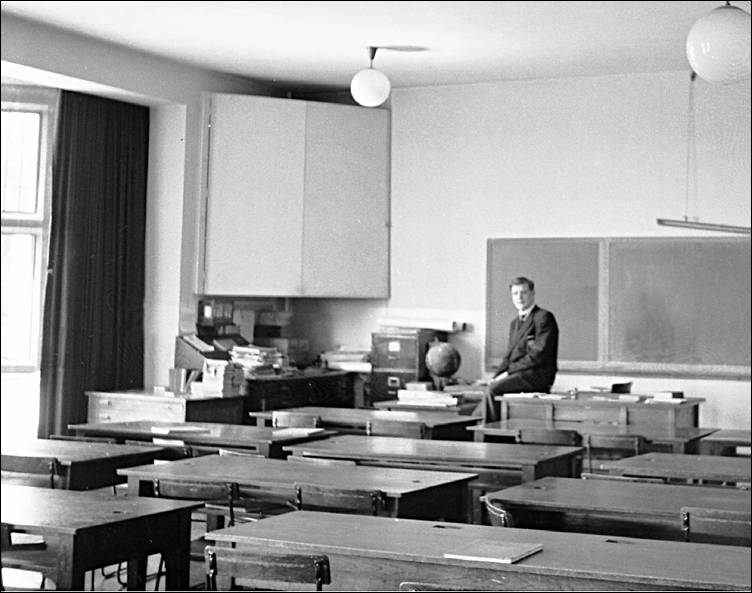
Geography Room ’A’: This was the empire of Mr W.L.Whalley, but.
Parke seems to have taken over for the moment!
The barograph can be
discerned just below the folding projection screen.
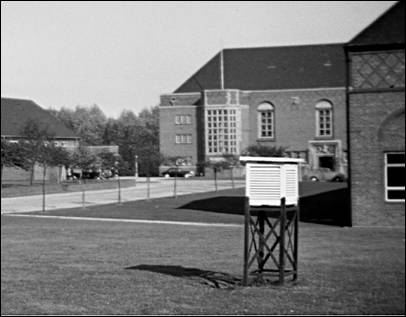
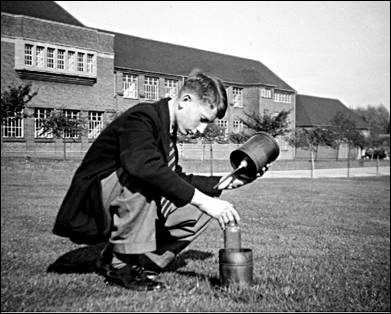
The School Weather
Station: the thermometer screen (left)
and Cartwright demonstrates the rain gauge!
(These photographs were taken for the
display mounted on the occasion of the visit by H.M. The Queen in 1955)
Mathematics was proving the weakest
of my subjects and it was becoming evident that unless something dramatic was
done I would fail my ‘O’ level. Credit
for remedying this position must be given to Mr G. Cooper. A quiet man of infinite patience, he regularly
sat down at an empty desk by me and explained things repeatedly until I had
understood them. I was always to be
grateful for his work in getting me through ‘O’ level, although some boys had
their suspicions about him as he used hand-cream after handling chalk!
After my third year games ceased to
be compulsory. This was, to me, a
welcome change after the years of plodding round a Rugby field.
Cricket enjoyed a glorious reign in
my time at school – although, sadly, I made no contribution to that success. Contemporaries at school included O.S.
Wheatley, who was to become captain of Glamorganshire Cricket Club, and A.C.
Smith who became captain of Warwickshire and an England Test Match player. I liked cricket and, for once, understood
the rules of the game. My enthusiasm
was probably based largely on an aesthetic approach to the game, which
presumably accounts for my rapid loss of interest in professional cricket in
more recent times! With friends, I made
several visits to the County Ground at Edgbaston on school half days. One match to remember was the First Test
against the West Indies in 1957, where I witnessed the record partnership of
411 by May and Cowdrey. This was
followed by the spectacular collapse of the visitors (including Sobers) to 72
for 7 at the hands of Lock and Laker, before the match ended in a draw. But the simple fact is that I was no good at
cricket. I could neither catch the
ball, nor could I synchronise the bat in such a way as to hit the thing. My recollections now of school cricket are
of long spells fielding in the hot sunshine while sucking Spangles or Refreshers. On one occasion, by pure chance, I made
a catch to dismiss the opposing team’s last batsman, thus securing my house’s
victory. I was chaired off the pitch by
the rest of the team in traditional style, but the action was somewhat
ironical.
In some schools there is no doubt
that my general lack of interest in sport would have made me a marked man. But at K.E.S. there was a broad church of
pupils so that different attitudes and enthusiasms were happily accepted. The football cult that rules in other
quarters today was quite unknown.
Moreover, bullying, the bane of pupils at so many schools, was almost
totally non-existent and quieter boys or those with unusual interests were
happily accepted. Boys’ diverse
interests were well served by the wide range of societies which met after
school, often with interesting guest speakers.
Such societies included, inter
alia, Debating, Photography, Music, Railways, Drama and Archaeology,
although I did not participate in the activities of the last two and my
contribution to debates was minimal to say the least. In my last year I also joined the
Shakespeare Society which met to read plays on Saturday evenings in the relaxed
red leather comfort of the Cartland Room, where I like to think I contributed
near Gielgud qualities to such distinguished roles as Third Messenger and
Second Page.
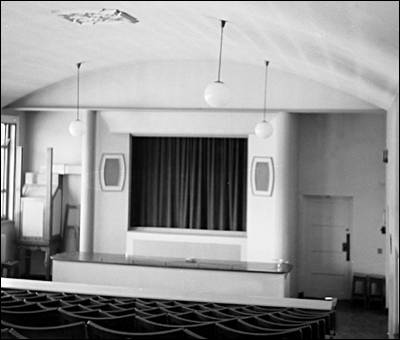
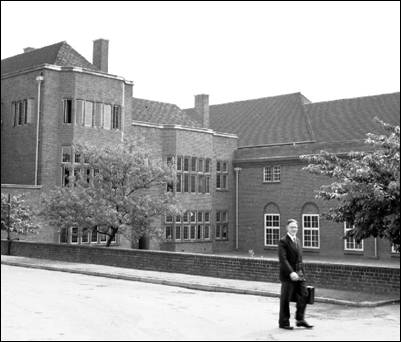
Left: The Ratcliff Theatre, complete with blue
plush tip-up seats – and a fume cupboard at the left!
Right: The
In 1956 I took my ‘O’ levels, gaining
reasonable passes in Geography, Maths, Chemistry and Physics, and just scraping
through the rest of the subjects apart from Art. It was assumed that I would choose to do
Physics, Maths and Geography, a popular combination at ‘A’ level. But, I found Physics and Maths unrewarding. Literature and History seemed more
worthwhile and so I went into History Division to study History and English
along with Geography. Only one other
boy, Brown – known as D.G. to distinguish him from I.W. of that ilk-, had
chosen the same combination and the rest of the form did French instead of
Geography. This resulted in the two of
us having to do certain subjects in different groups from the main body of the
form. I was thus able unofficially to
drop the hated Gym altogether on the basis that one P.E. master thought I was
in the History and French set and the other thought I was in the Physics and
Maths set. At last I had escaped from
the torture of hanging like a trussed turkey from the wallbars, or, worse,
vainly trying to leap the vaulting horse.
The latter activity never seemed possible without a pain-inducing
collision, the suffering varying in intensity according to the portion of my
anatomy involved. To be fair, the usual
Gym instructor, “Sam” Cotter, was a genial man. More agile than his short, barrel-like
figure suggested, he usually stood still while issuing orders, military-style,
but occasionally surprised us by leaping into action. He reluctantly accepted the ineptitude of
the unathletic with a resigned tolerance.
I was taught English Literature for
‘A’ level by Mr A.J. “Tony” Trott and by K.G. Hall, a young master, christened
with the infinite wit of schoolboys as “Albert”. Tony Trott, who was Head of the English
Department, showed no false modesty and had an encyclopaedic knowledge of
literature. He responded to a challenge
by the form and identified correctly an obscure couplet from Henry VI Part
3. A natty dresser, with a taste for
exotic shirts and ties, he was very much the aesthete. His moment of glory in the 1950s was
undoubtedly his starring role in the Common Room performance of Peter Ustinov’s
Romanoff and Juliet. Trott played the indecisive president of an
impoverished central European state being wooed by Russia and the United States
whose scheming ambassadors were played respectively by Messrs Leeds and Hodges. Some years later Trott achieved more
permanent fame by writing an excellent and entertaining history of the
school. Nothing would stop Keith Hall
talking. He seemed to know everyone of
note in the world of literature (“As Lord David Cecil told me over
sherry…”). He would quote the opinions
of unknown American Professors of Anglo-Saxon literature, and never ceased to
remind us that he had studied Beowulf
in the original. (Didn’t all English
undergraduates at Oxford do so?) The
main problem was that he never seemed to mark or return essays we had handed
in. Although Hall was clearly highly
gifted, he was later to leave K.E.S. rather abruptly amidst a spate of
rumour. Another English master was
Peter Robbins, the England Rugby Football player. He had a disconcerting habit of doing his
exercises while lecturing, so that he would sit talking while raising and
lowering his legs, a heavy brief case being balanced on his feet.
I was now studying European History
with Charles Blount (who was to be my form master in History VI the following
year). Charles became a good friend in
later years. Studying with him gave a
real insight into the subject, with fascinating diversions into side issues. It was only appropriate that part of the
syllabus he covered included the Renaissance, for he was surely Renaissance
Man, knowledgeable on a host of topics both in the arts and science. Unlike many other masters, he was able
succinctly to explain a topic in a perfectly formed grammatical sentence, comprising
subject, verb and object, and without hesitation, repetition or deviation. This skill may have been aided by his
successful career as an author of history textbooks. With complex aspects of the subject he would
not trust our note-taking abilities but would dictate a prepared note. This would be divided up meticulously under
various levels of heading and sub-heading, starting with “Big Roman one”, and
working down through large and small letters to arabic numbers.
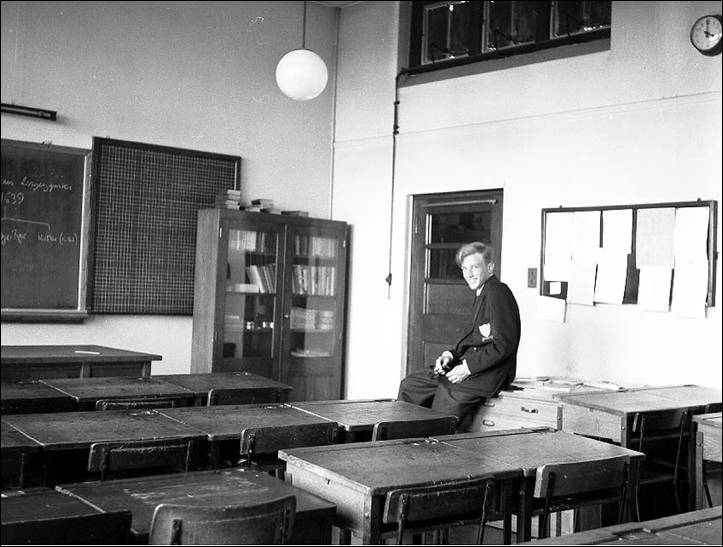
Room 174: Charles Blount’s History VI form room: Molyneux relaxes at 4 pm!
The
blackboard displays in Charles’s
handwriting the family tree of the Leszczynskis, a noble Polish family who
occupied a variety of government posts in the 17th century and
ultimately provided a king (Stanislaus)
and also a wife for Louis XV of
In most forms throughout the school it was necessary for boys to
“give a talk” on a chosen subject once in the year. In my year in Charles’s form I chose to talk
on the music of Elgar. When he knew of
my topic, Charles expressed great interest and provided invaluable technical
help in preparing musical examples.
Thus, I made the first of many enjoyable visits to his home, on that
occasion to copy old 78 r.p.m. records onto tape to provide illustrations for
the talk.
Several good friends were made in
the Sixth form, and the use of surnames in addressing them gave way out of
school to a more informal approach.
Such colleagues included Roger Guy (a geographer), and Jim Parke and Anthony
Mills amongst the historians. Bill
Oddie and David Munrow were also contemporaries, but I did not keep up the
friendship with them after school days.
Oddie was a prefect and always immaculately turned out – quite unlike
the image he was later to adopt on television.
In addition to his interest in natural history, he was a competent
artist, specializing in cartoon posters for school events, and he had an
enthusiastic interest in jazz. Although
Munrow was a keen and successful practitioner of music, he showed few
indications then of the tremendous success he would achieve in his tragically
short career as performer, composer and B.B.C. ‘personality’.
In my last two years at the school I
was School Librarian, which also involved working closely with Charles Blount. He had overall responsibility for the
library and my duties were to organise rotas of junior librarians and ensure
that the shelves and indices were kept in order and records of books lent and
returned were maintained. The routine
work thus involved was good experience for later years working in banking. Acting as School Librarian gave me very
valuable privileges. I had immediate
access to all new books, but, best of all, I shared a small but elegant office
with Charles Blount which became my ‘study’.
With carpet, damask curtains, desks and green leather armchairs, and
access to a vintage typewriter I had excellent facilities for personal study in
free periods. During my two years in
office there were a few other boys entitled to share access to the Librarian’s
Room, including Roberts, Dodwell, Walker and Coombes who later became Vicar of
Edgbaston. We turned the room into a
very homely base, even succeeding in making toast on the electric fire, although
on one bitter winter’s day it was necessary to open the windows to let out the
smoke from burnt toast before Charles came back!
The
Library:
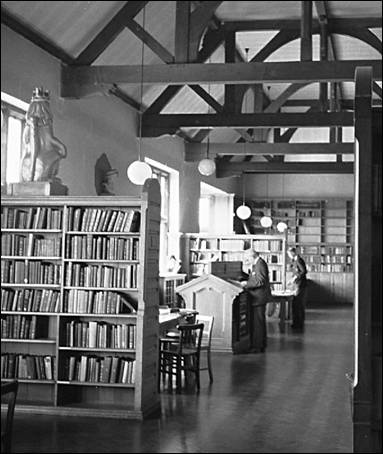
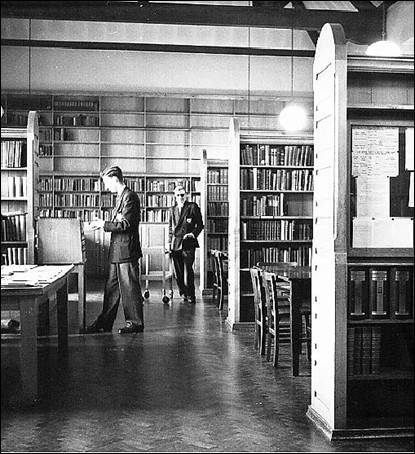
The Library: left: Mr J.D.
Copland stands at the Heath Memorial Library desk. Note also the ‘Queen’s Beast’, carved for the
1955 Royal Visit, and the bust of Edward VI.
right: Darlaston
at the card index while Molyneux, apparently in mafia guise, has him covered
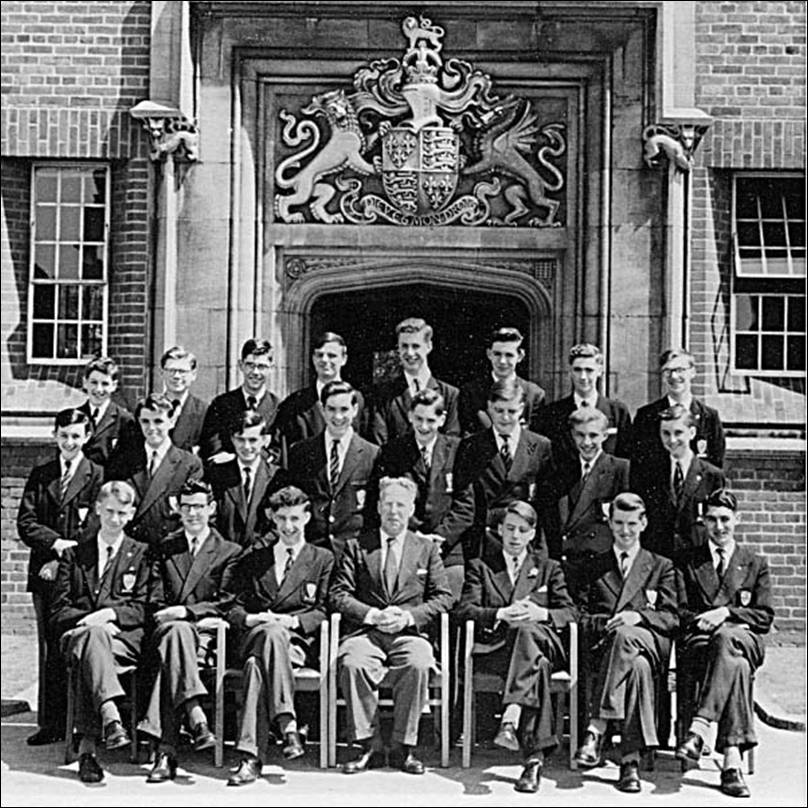
Librarians Line-up, 1958
(front row) Cartwright, Birch, Darlaston, Mr C.H.C. Blount,
Coombes, Walker, Bryant
(Photo by R.F.L.
Wilkins)
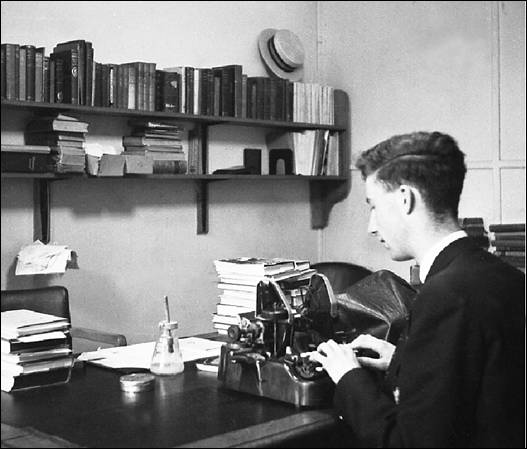
Darlaston in the Librarian’s Room,
attempting to tame the vintage typewriter
Note book suppliers’ bills on the
spike, Gloy for attaching book labels, and the inevitable boater
Saturday mornings in the Sixth Form
concluded with a lecture given by an outside speaker. Many well-known and entertaining people came
– and some who were, to me, neither well known nor the least bit
entertaining. The most enjoyable by far
was the percussionist James Blades who assured us that although he had provided
the sound effect for the gong which opened J. Arthur Rank films, the torso in
the film sequence belonged to a mere actor.
Less enjoyable was the gentleman from the Amateur Athletics Association whose
speech was like a Rolls Royce (almost inaudible and seemingly capable of
continuing for ever). He appeared set
to keep going for the afternoon, but was interrupted by Lunt in characteristic
manner: “I’m afraid I shall have ter
stop yer there, as parents will have soufflés waiting on the luncheon
table.”
Speakers on Sixth Form Speech Day at
the end of the summer term were more illustrious. Memorable visitors in the late 1950s
included Roy Jenkins, and Lord Denning who opened his speech by telling the
gathering that while he did not mind the audience looking at their watches when
he spoke, he would be hurt if they held them to their ears and shook them. After the formalities of Speech Day,
everyone adjourned to the playing fields for the annual cricket match between
the school and the old boys, with accompanying strawberry tea. This was essentially a social event where
mothers showed off their hats, fathers watched the cricket and boys tried not
to look too embarrassed by their parents.
The last day of the summer term
provided leavers with an opportunity for high spirits with no fear of reprisal
by authority. Most of the activities
were harmless fun, but a few involved minor vandalism or graffiti and thus
provoked official displeasure. Even
worse, it was not entirely unknown for young ladies from the girls’ school to
insinuate their way into proceedings.
The most entertaining episodes involved senior boys arriving in a
variety of eccentric means of transport.
In 1957 these included a ‘tandem’ for three, a pony and trap, and a
short convoy of disreputable cars with an escort provided by the U.S.
Army. This episode offended Canon
Lunt’s sense of dignity as he was at pains to ensure that nothing disrupted the
sacred end of term routine. This
culminated in the singing of “God be with you till we meet again” and the
rousing School Song, beginning “Where the iron heart of England throbs beneath
its sombre robe/Stands a school whose sons have made her great and famous round
the globe/Great and famous round the globe…”
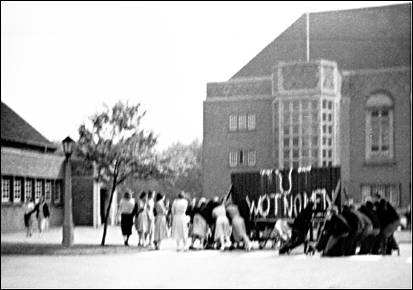
End of Term, Summer 1955: the girls of KEHS invade.
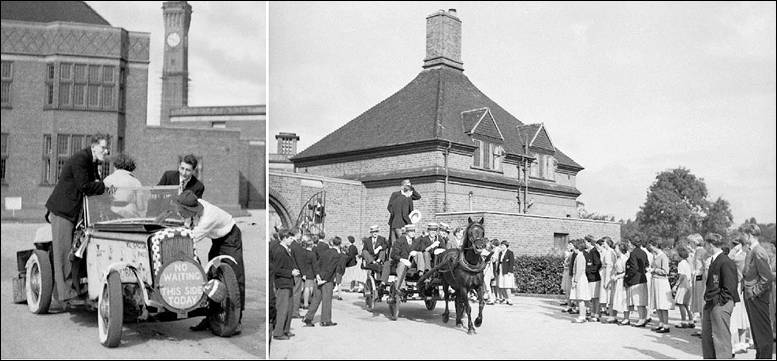
End of Term, Summer 1957
My ‘A’ level results in 1958 were, alas,
disappointing and inadequate for university entrance. I therefore stayed for an extra year for
another attempt, but it soon became clear that there would not be a place for
me at university. I stayed to complete
the year, retaking my ‘A’ levels, as by now a career in banking was looming and
better examination results would ensure a higher starting salary. But to a large extent the pressure on me
during my last year at school was lifted.
I had been at K.E.S. for almost eight years and the experience had changed
me from a child to someone equipped both to make a contribution to life in the
outside world, and to appreciate what the world had to offer. Moreover, associating with boys and masters
of outstanding ability had taught me a great deal about self-assurance. But above all, I had been privileged to
receive (in those days at no cost to the family) a first rate education in a
delightful environment with facilities and amenities of the highest standard.
With examination pressures largely
removed, my last term at school remains in memory as one of elegant ease,
enhanced by one of the finest summers of the century. I sauntered to school wearing a boater and
occasionally with a rose in the buttonhole of my double-breasted blazer. I was lord of the library and enjoyed my
privileged use of the Librarian’s Room.
If not unwinding in the comfort of its armchairs, I could relax in the
sunshine on the South Field or overlooking the swimming pool in the shade of
the Chapel. Occasionally, with friends,
one would take a relaxed afternoon stroll through the sunlit horse-chestnuts and
copper-beeches of Edgbaston, animatedly discussing music, or literature, or the
best trains to Much Wenlock. There were
still, of course, some lessons to attend.
One might have to dash off an essay on the domestic policy of Louis XIV
or the nobility of human nature evident in “King Lear”, but on the whole life
seemed to be a sweet succession of free periods and sunshine. Cold reality would catch up with me before
long, but that enchanted summer of 1959 remains a grateful memory of another
world.
=========================================================================================
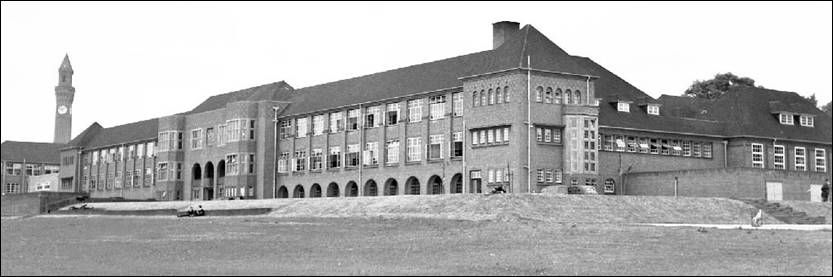
The South Front with
‘Old Joe’, the University Clock Tower modelled on the Torre di Mangia at Sienna
prominent at the left.
The Gyms are to the
extreme right
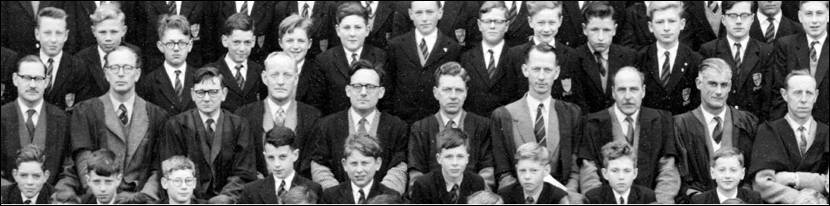
A detail from the
official 1959 School photograph with a selection of masters:
Messrs: J. Hodges,
T.G. Freeman, A.J. Trott, W.L. Whalley, J.B. Hurn, W. Traynor, W. Buttle,
L.K.J. Cooke, J.B. Guy, F.L. Kay.
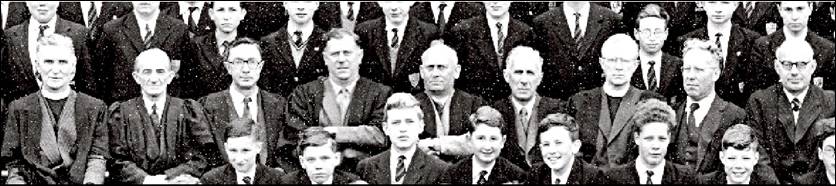
Another detail from
the 1959 School photograph with a further selection of masters:
Canon R.G. Lunt,
Messrs: H.W. Ballance, J.C. Roberts, A.E. Leeds, W. Barlow, N.J.F. Craig,
the Rev F.J.
Williams, C.H.C. Blount, G.C. Sacret.
==========================================================================================================
A reminder of the
glorious summer of 1959:
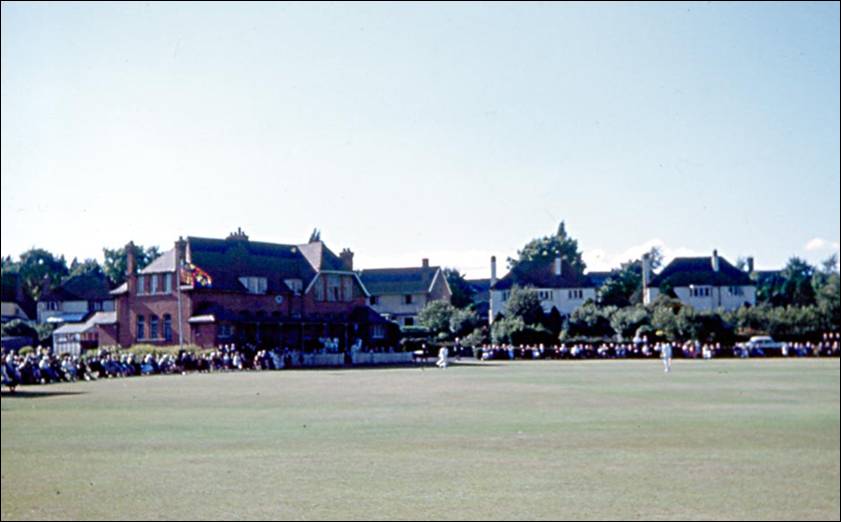
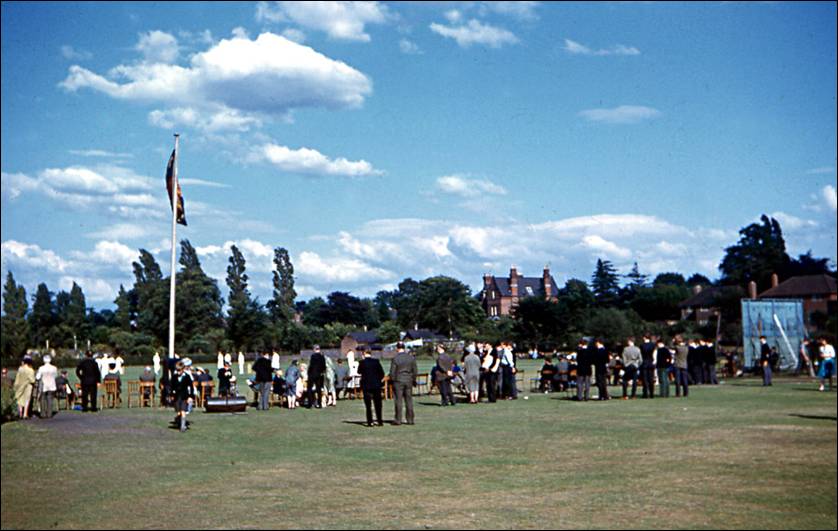
School v Old Edwardians, Eastern
Road, Speech Day July 1959
==========================================================================================
and, finally, a few holy
relics which have survived the passage of the last forty-fifty years:
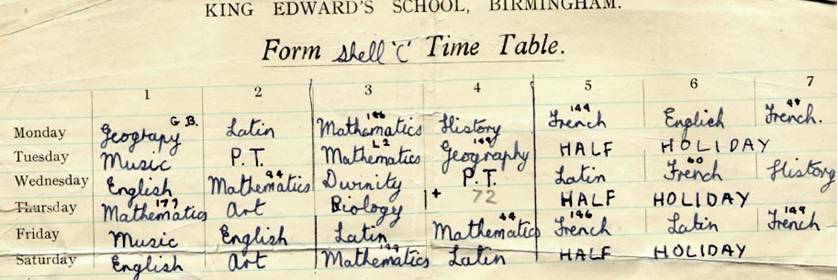
Shell ‘C’ timetable: September 1951
(The small figures indicate
room numbers!)
At that time C.C.F. activities
were held on Thursdays, commencing after break.
Friday was a normal full day.
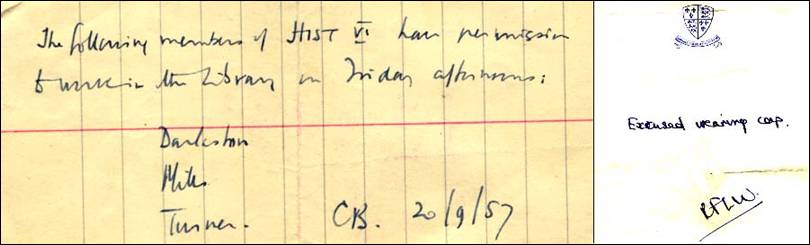
A ‘chit’ from Mr C.H.C. Blount
and a “cap pass” issued by R.F.L. Wilkins, a prefect.
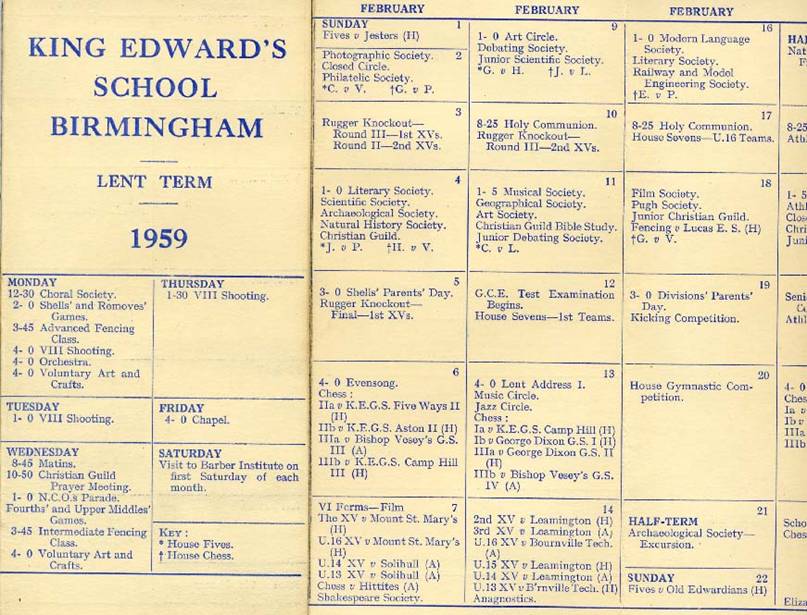
School Calendar
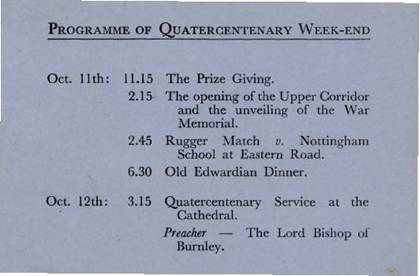
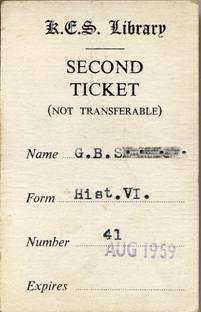
Quatercentenary programme
(1952) and a Library Ticket
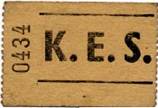
A “Dinner Ticket”
A 10d (=4p) passport to
Miss Chaffer’s culinary
glories.
You
might also be interested in the following further pages, both with many
photographs:
MemoryLane2.htm
(Robert’s childhood memories of the war, early days at school, food
rationing, a spell in hospital, and other boyish memories!)
FamilyTrees.htm (Family history, including tentative links back to 1373, in
the reign of King Edward III !)
A
few contemporaries revisited the school in 2006: here are our impressions on returning to the
scene of our past endeavours:
HALF A
CENTURY ON
A grey
winter’s day saw three contemporaries from the intake of 1951, Roger Bickerton,
Patrick Walker and the writer, together with wives, take up Derek Benson’s
offer in the Gazette of a conducted
tour of the school. It proved a
fascinating day which we recommend to any other Old Edwardians who have not had
a chance to revisit the scenes of their youth.
In the 45
years since we last trod those corridors there have been some remarkable
changes! Passing through the Main Door,
we found the dreary cloakrooms and locker rooms have long gone. Instead of the Porters’ Lodge, forbiddingly
occupied by Allard or Cradock, we were welcomed by a lady receptionist
presiding over an area with comfortable chairs, magazines and attractive
engraved glass screens. We were quickly
taken for coffee, served in a Common Room which bears no resemblance to the
crowded smoke-filled room briefly glimpsed in the 1950s. It has grown to absorb much of the
Moving to the
South Front, we found the cloisters with the Tuck Shop and Changing Rooms had
given way to a splendid array of new form rooms for the Classics Department
which we would shortly inspect. There
was also a small anonymous looking door, which Derek said led to the Tuck Shop,
but whose appearance seemed to owe more to a
On returning to the School, we entered territory new to us all: the new Classical Corridor. Despite its relatively recent construction, we agreed that it had the authentic ambience we recalled from our schooldays. It was particularly good to discover that the Classics Department apparently thrives in an era when Latin and Greek have vanished from so many schools’ curricula. Next, we dropped in on Room 48 which was obligingly empty. Here, despite changes, was the true form room atmosphere we remembered so well! The passing years have seen the advent of the computer, the covering of polished floor blocks by carpet, replacement of black and yellow chalk boards by white boards and marker pens, and removal of the masters’ dais so that staff are brought down to the same democratic level as their pupils. But this was still recognisable as holy ground where in the 1950s “Sacco” had attempted to give us an understanding of subjunctives and pluperfects. If anyone thought I displayed a nervous twitch, it was because I was half expecting that once familiar voice to call out “Darlaston, I am still waiting for you to hand in your prep. Fifty years should be long enough even for your modest abilities.”
Next door, the Geography Department was much changed from the days of “Wal” and “Ben”. The balconies, almost never used in the 1950s, have been enclosed and doors realigned to provide useful additional administrative space. Here I noticed an old friend, the barograph, which in the Sixth Form accompanied me home in the holidays so that full records were maintained. But it had stopped, and of the old weather station which provided statistics to the Meteorological Office in the 1940s and 1950s, nothing was to be seen: a sad loss of an interesting and rewarding topic.
It was time for lunch in the Dining Hall, a building which seemed little altered from the past, although the squeaky trolleys with stacked meals distributed by boys have given way to the inevitable self-service system. The quality of the food has, however, changed beyond belief and we all enjoyed an excellent meal.
Big School,
still dominated by Sapientia,
remained as impressive as we all remembered it;
although because of fire safety regulations there is now an additional
access to the Organ loft. Such
requirements also restrict the numbers permitted in
We next had an appointment with the Chief Master, Roger Dancy, and we were especially grateful to him for giving us his time on a busy day. Our discussion with him was more genial and relaxed than those on some earlier visits to the Chief Master’s study!
The Cartland
Club no longer exists and its room is now used for English: possibly, as Derek said, the smartest form
room north of
The Language Department had changed beyond recognition in this age of computers. We were shown the latest in touch-screen technology, but sadly it was not working because, we were told, a squirrel had gnawed through the cable: the KES equivalent of leaves on the line, I suppose. Progressing along the upper corridor, we were alarmed to see that the entrance to Charles Blount’s old room (Room 174) had been bricked up and plastered over. Momentary fears that Charles and History VI had been immured, frozen in time at Big Roman One, were allayed on discovering a new entrance direct from the Library which has appropriated Room 174 for its own use. The Library itself remains a most impressive feature of the school; although here too the polished blocks had been covered by carpet. The elegant Heath Memorial reference desk has sadly been removed, but replaced by a well-equipped information centre. We enjoyed a pleasant discussion with the lady Librarian: a full time post which has given the Library a more active role in assisting boys’ studies than in the past.
Inevitably, since the 1950s there have been far-reaching changes in the Science Department. New rooms and laboratories seem to fill every space and this is clearly a thriving and well-equipped part of the school. The casual demeanour of former years – boys conducting experiments in shirt-sleeves – has given way to an era of protective clothing, including goggles. In our day, the science block ended at Lecture Room 3, later the Ratcliff Theatre, equipped with tiered plush seating and a curtained cinema screen with a projection room at the rear, where cinema films were once shown in fine style. This has been swept away, making more room for laboratory space, but it does seem a regrettable loss.
The modern Design Centre is equipped with an amazing array of equipment for art and for work with wood, metal and plastics. The exterior of the block is quite attractive, if not wholly in keeping with Hobbis’s design, but the interior is most unusual, giving the appearance of having been designed so that every journey, no matter how short, involves a few steps up, a short metal landing, and more steps down again! But there is no doubt that the boys here learn useful skills not available to their predecessors.
Time was running out, even though there were parts of the school, including the Music Department and Eastern Road, not visited; and so, not for the first time, we found ourselves heading up the Main Drive at 3.45 in the afternoon. But even here there was a variation from old practice: girls, leaving KEHS, now take a short cut from their building so as to join the boys’ drive, making their exit past the Foundation Office. That was not something to have been tolerated by Canon Lunt who famously telephoned the girls’ school Head Mistress to complain that one of her ‘gels’ was in his drive and would she kindly have the trespasser removed!
We had been treated like royalty (indeed, we had seen a great deal more than was vouchsafed to Her Majesty on that wet day in November 1955) and had witnessed a great school hard at work. Despite the occasional flamboyant young gentleman with shirt worn outside the trousers and some pretty sloppy ties, the boys are an impressive bunch who looked keen to go about their studies. We spoke to several members of staff who were clearly committed to their work and who were excellent communicators.
Numbers at the school have grown since the 1950s, so that the buildings seem rather more crowded and frenetic. Then the school was almost entirely populated by middle class, white males. Today such distinctions no longer obtain. The number of boys of Asian origin is testimony to the fact that their parents show greater enthusiasm for paying fees for education than do those of the indigenous population. The male domination of the staff is still maintained – but eroded by the steady growth in the number of female teachers (dare one refer to them as Mistresses?) This, coupled with the need of a fee-paying school to appeal to parents “of taste and discernment” has led to a gentle feminisation of the school. The good old boys’ school tradition of calling people by surnames has yielded to the general use of Christian names. Roses bloom by the Main Door and potted palms adorn the South Door. Attractive décor is essential.
Yes, we were all impressed. For the males in our group there had been the opportunity to indulge in unalloyed nostalgia while enjoying a glimpse of the wonderful opportunities available to the rising generation. For our wives, there was the chance to discover something about the place which made their husbands what they are, and which still comes into conversation on so many occasions. We all left hoping that the School continues to go from strength to strength and resolved to do our bit to help that cause by making our own contributions to the Bursary Appeal.
Robert Darlaston
If other
pages are not listed to the left, the Home Page can be accessed here: www.robertdarlaston.co.uk